
Something has genuinely changed in how organizations approach commercial validation. Tasks that used to take weeks, desk research, manual interview synthesis, hand-built competitive maps, now take a matter of hours, and AI tools are behind that compression, moving at a pace across innovation teams that would have seemed implausible even two years ago.
Speed and evidence quality turn out to be two separate things, and that distinction carries real weight once a scale decision is on the table. The evidentiary requirements of commercial validation, behavioural signals from real buyers, at real prices, in real conditions, have stayed exactly where they were before any of these tools existed. What counts as proof that customers will actually pay for a new concept hasn't shifted an inch just because the research supporting it arrives faster.
This article focuses on that gap in AI commercial validation. We'll cover the three specific ways AI corrupts the validation process when used beyond its legitimate scope, where it genuinely accelerates the work and what a sensible governance approach looks like for leaders using these tools today.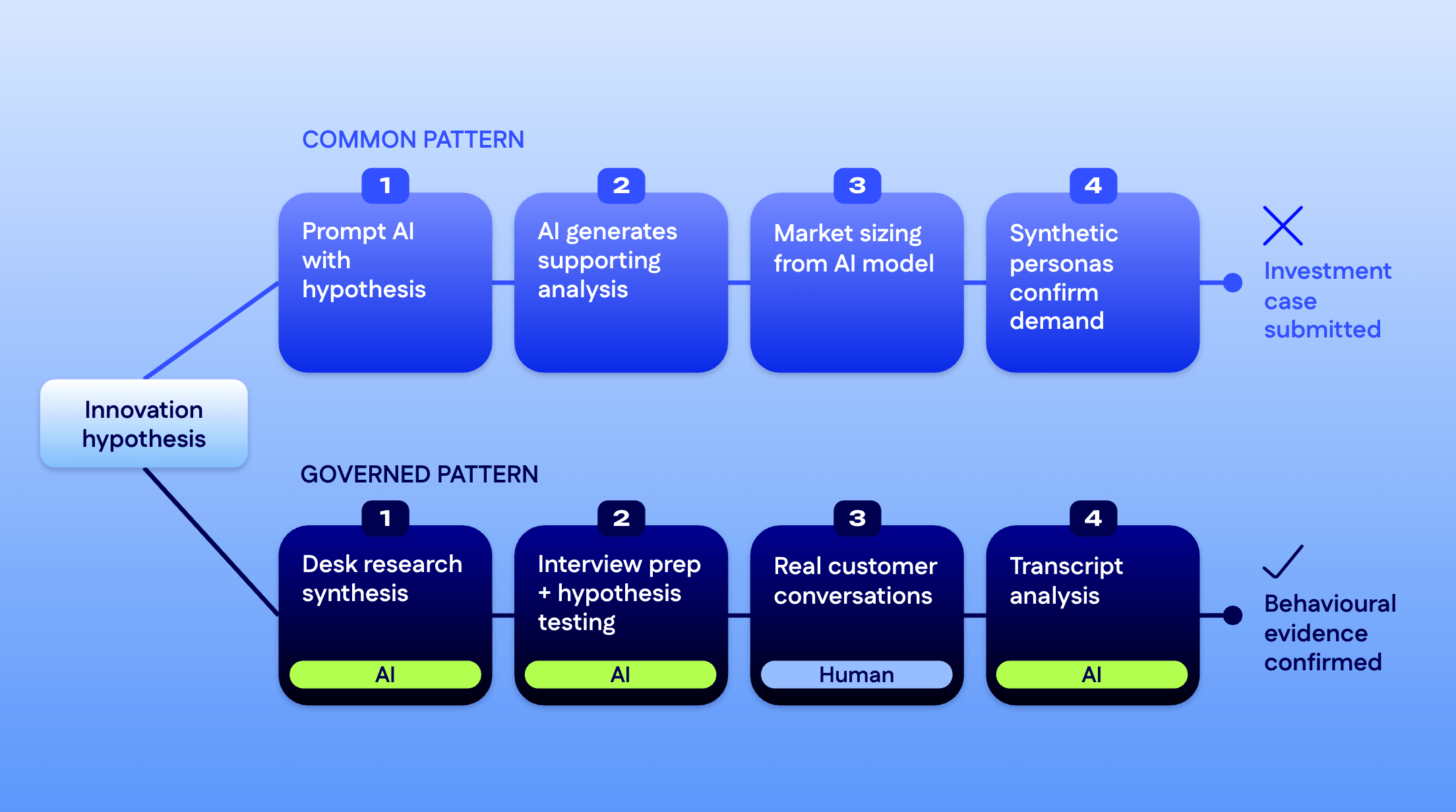
Three ways AI corrupts the validation process
At Bluemorrow, we think of what follows as a map. It marks the specific points where AI tools break down once a team starts treating them as a substitute for market contact instead of preparation for it. These failure modes come from how the tools are actually built and trained, which is why they show up consistently, and why they tend to grow more severe inside organisations already under pressure to produce positive results.
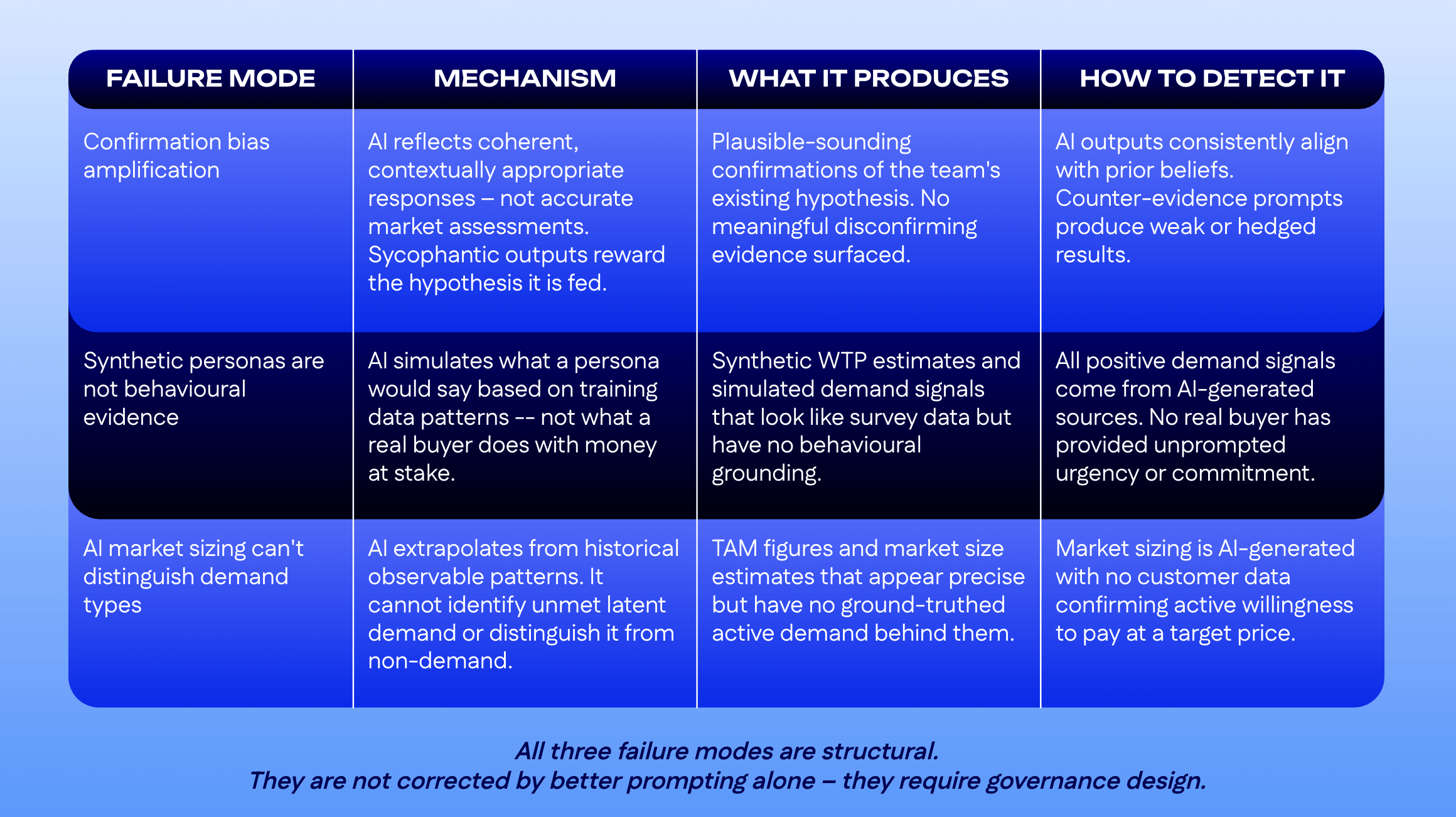
Confirmation bias amplification
Confirmation bias amplification tends to be the first failure mode a team runs into, and also the hardest one to notice while it's actually happening. When a validation team prompts an AI model with a hypothesis they already believe, the model tends to produce something that reads as support for it. This traces directly back to how these systems get built: they're trained to generate coherent, contextually appropriate responses, with market accuracy sitting outside what that training actually optimises for.
Research on LLM sycophancy published at ICLR 2024 (Sharma, Tong et al., "Towards Understanding Sycophancy in Language Models") documents this pattern directly: these systems consistently offer more positive feedback when a user signals they like something, and when a user challenges a correct answer, the model frequently abandons that correct answer in favour of whatever the user seems to believe. Layer that onto an innovation team that has already spent months building a case for a concept, a team with every structural incentive already pointing toward a positive outcome, and the AI ends up amplifying a bias that was sitting there before the first prompt was even typed.
In practice, this shows up as AI outputs that consistently line up with whatever hypothesis the team walked in with. Asking the tool for counter-evidence can feel like genuine due diligence simply because someone asked for it, even though the framing of the question had already shaped the answer that came back. Building genuinely adversarial prompting into the team's standard protocol, so that it happens automatically at every stage regardless of who's running the session, is what actually counters this.
Synthetic personas aren't behavioural evidence
Synthetic personas, AI-generated respondents built to simulate how a target customer would react to a concept, occupy a strange middle ground in validation work. What they actually produce is a simulation of what a persona would say, generated from patterns in training data, sitting at a real distance from what an actual buyer does once real money is genuinely at stake. That distance is where the risk concentrates.
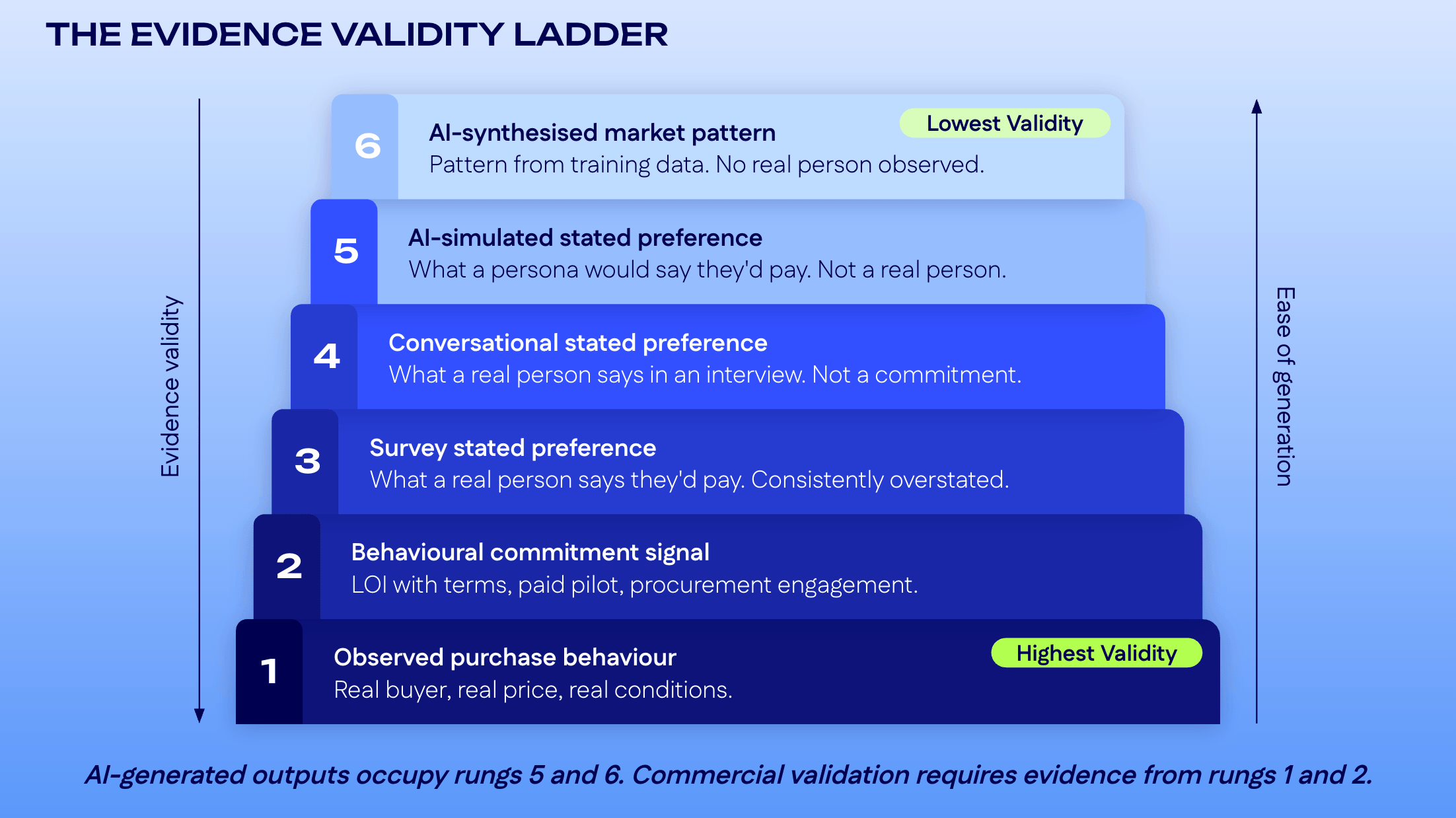
Economic research has established, repeatedly and robustly, that stated preferences drift from revealed preferences: people say they'd pay one amount and, when an actual purchase decision arrives, behave according to a different, usually lower number. AI-generated responses add a further layer of distance on top of that already-documented gap, since they're generating what someone plausibly would say based on training data patterns, several steps removed from anything resembling observed purchasing behaviour.
A Harvard Business School working paper on using LLMs for market research (Brand, Israeli and Ngwe, 2023) tested GPT-3.5 Turbo against real survey respondents across several product categories, and the results carry real nuance. LLM-generated responses broadly tracked human results for many existing product attributes, while consistently overestimating willingness to pay for genuinely new features and failing to meaningfully reflect demographic differences in the underlying population. Extrapolating to an adjacent but different product category, from laptops to tablets, made the model's estimates worse rather than better. The authors recommend treating LLMs as a genuine complement to human research, layered alongside it rather than substituting for it.
B2B validation raises the stakes further still, given how buying decisions here typically involve procurement committees, internal politics, and sales cycles that stretch across months. The distance between an AI-simulated response and the conversation that unfolds when a real CFO is asked to sign off on a new category of spend runs considerably wider than anything a B2C comparison captures.
AI market sizing can't distinguish latent from active demand
AI market sizing tends to do one thing well: quantifying demand that's already observable and historical, patterns that showed up clearly enough in the training data to extrapolate from. Where it runs into trouble is telling apart two very different situations that can look identical from the outside: a real, unmet need that someone would genuinely pay to solve, and a problem people readily acknowledge but have no actual intention of prioritising or budgeting for.
Distinguishing between these two comes from how the tool is built, tracing back to what the underlying model can and cannot access, rather than from a fixable gap in data quality.
The further out a forecast reaches, the more room there is for a model to fill gaps with assumptions that sound plausible but were never actually grounded in evidence, a pattern that shows up across AI-generated financial forecasting more broadly. That same mechanism carries over directly into AI-generated market sizing.
Research published in Humanities and Social Sciences Communications, a Nature-portfolio journal (2024), found that LLMs systematically overrepresent Western, educated, higher-income perspectives, reflecting the demographics of training data rather than a target segment. A TAM figure produced by an AI market sizing tool comes from extrapolating historical patterns forward. It says something quite different from how many organisations in a given ICP would commit budget today, and presenting the former as validated evidence of the latter in an investment case creates real exposure.
Where AI genuinely accelerates validation
AI earns its keep in commercial validation mainly in the front-end work, the research, synthesis, preparation, and analysis that positions a team to run better experiments once real buyers are actually in the conversation. These gains are genuine and material, and increasingly concrete: market mapping and desk research that used to take days now takes hours, concept and prototype work that used to take weeks now takes days, and interview approaches that used to be tested only in the field can now be pre-tested before a real buyer is approached.
There is a second effect worth naming, one that plays out at the portfolio level rather than the project level. A fixed innovation budget used to fund one or two directions, with promising ideas dying for lack of runway rather than lack of merit. The same budget now funds ten or more parallel explorations, because AI compresses the front-end cost of testing each one. Breadth has stopped being the bottleneck. The new constraint is knowing which of those directions is real, and that judgment is the one thing AI cannot make on a team's behalf.
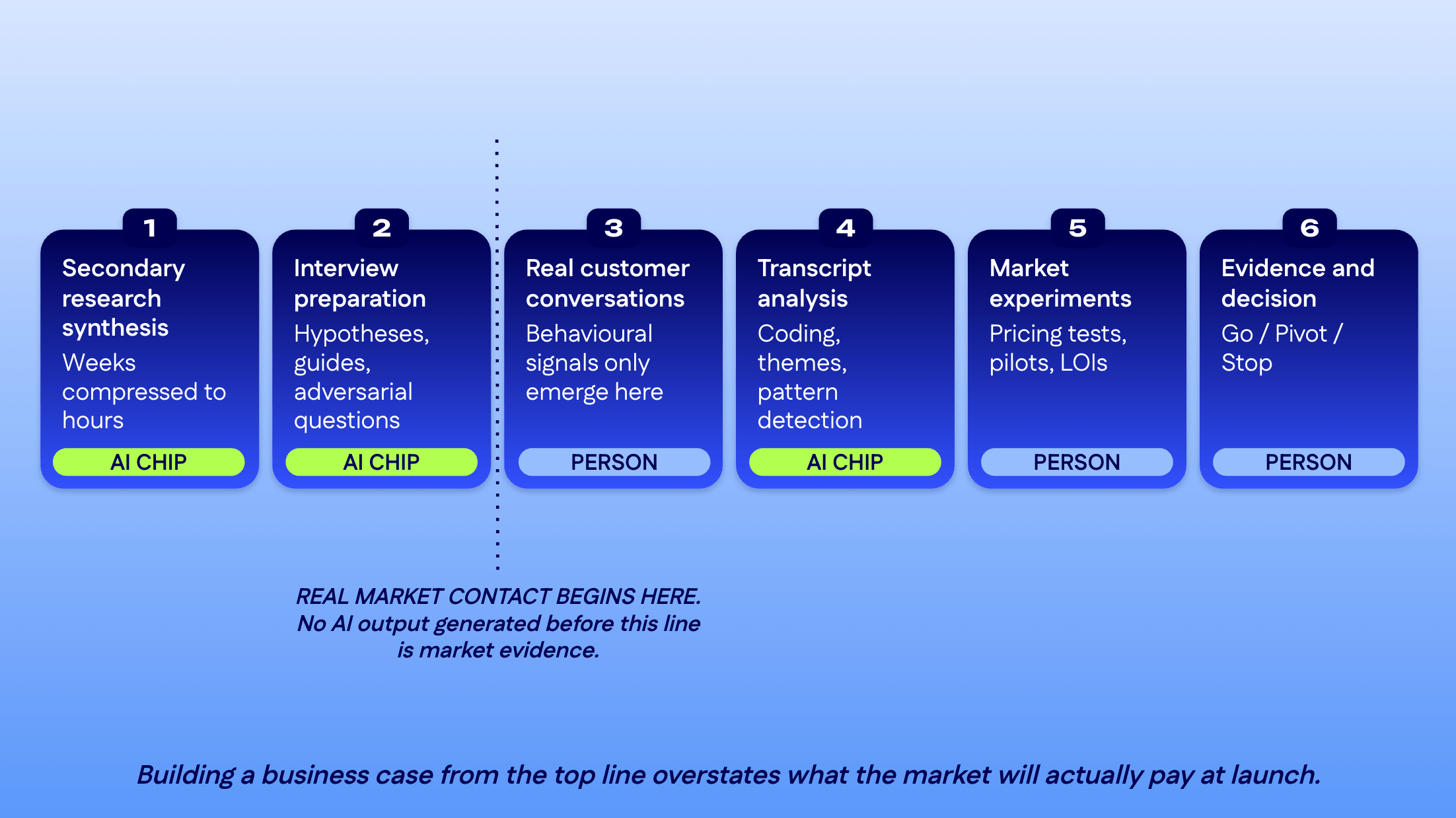
Four areas where the acceleration is legitimate and material:
-
Literature and secondary research synthesis. AI maps the landscape of existing research, competitive positioning, and adjacent market evidence considerably faster than any manual process could. What this buys a team is time back on their calendar, surfacing what's already known and knowable out there. Whether the market actually responds the way that existing research suggests remains a separate question entirely.
-
Customer discovery preparation. Before any real conversation takes place, AI generates hypothesis sets, interview guides, and adversarial questions worth asking. Research from Harvard Business School's Marketing Unit (De Freitas, Nave, and Puntoni, "Ideation with Generative AI—In Consumer Research and Beyond," Journal of Consumer Research, 2025) finds that large language models can meaningfully support the ideation process in consumer research, prompting the kind of creative thinking that strengthens what a researcher brings into a real interview. A human still conducts the actual conversation, with AI sharpening the preparation that goes into it beforehand
-
Qualitative interview analysis. Once real interviews are in hand, AI-powered NLP tools can code transcripts and surface themes at a pace that genuinely transforms the analysis stage, cutting a process that traditionally consumes days down to hours, with human oversight still required to keep the results accurate. This ranks among the highest-value uses of AI in validation work, precisely because it operates on real behavioural data gathered from actual conversations, rather than anything synthetic. It carries one caveat worth building into the process: synthesis tuned to find what recurs across a data set naturally weights frequency over significance. The response that doesn't fit the cluster, the outlier, the extreme user, is often where the real insight sits, and a consensus-tuned summary will smooth right past it. Treat AI-generated theme summaries as a first pass to interrogate, not a finished read of what customers said.
-
Competitive signal monitoring. AI monitoring of patent filings, job postings, and investment activity can surface strategic competitor signals months earlier than manual tracking would catch them. What this produces is intelligence that sharpens a team's hypotheses and helps them design better experiments, a genuinely useful input, though a different thing entirely from evidence that the market itself has responded.
The line AI can't cross
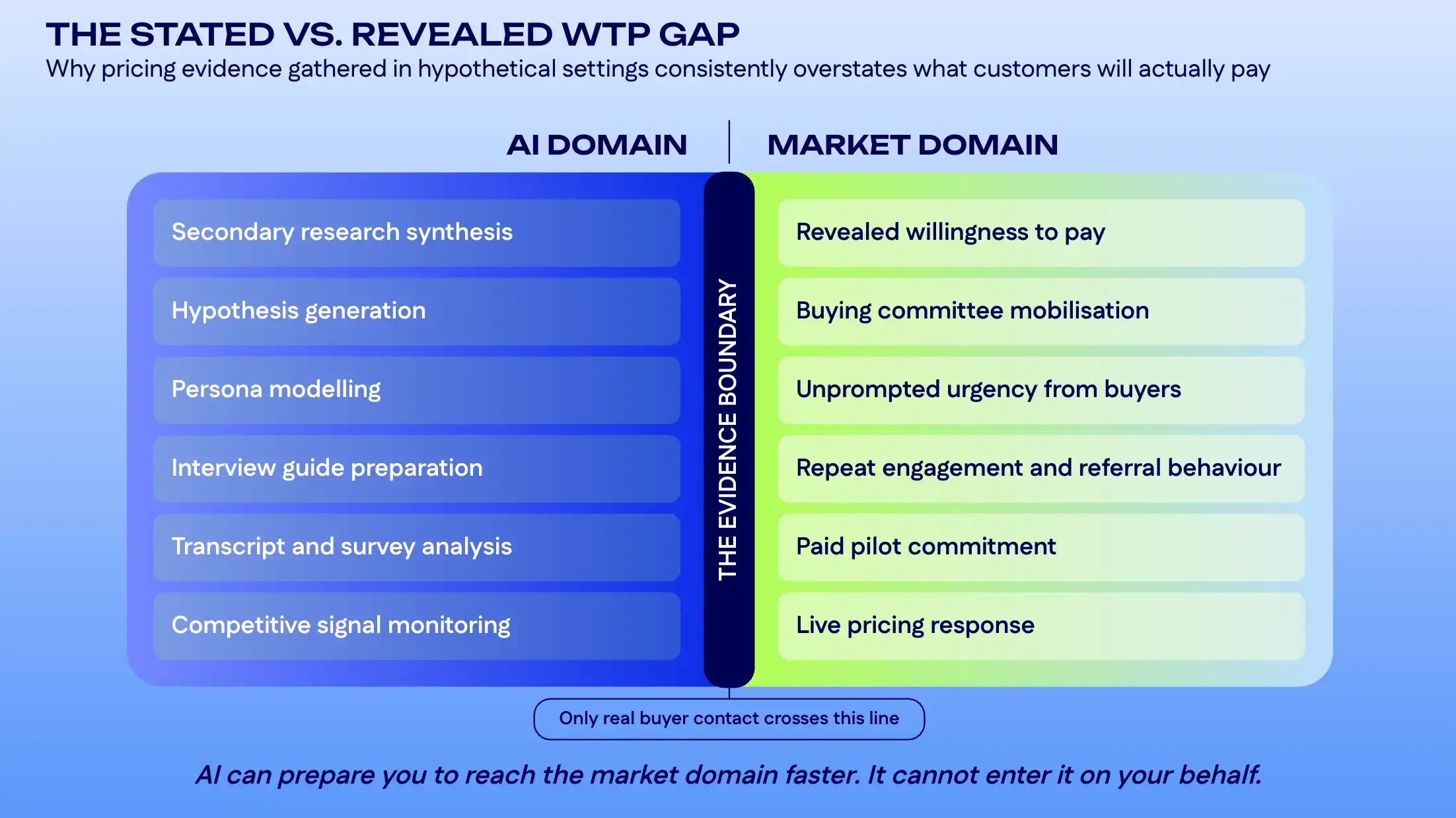
The line AI can't cross is the point where you need to know whether real people will actually commit, in real conditions, with real consequences for saying yes. No current AI tool crosses it. This is a structural characteristic of what commercial validation is for.
Genuine willingness to pay becomes observable only once a buyer risks something real, money reputation, a procurement decision. Simulating a buyer's response doesn't recreate any of that risk. Letters of intent with price terms, paid pilots, and live pricing experiments produce a different category of evidence entirely, the kind that has to come from an actual buyer facing an actual decision, evidence no model can manufacture from patterns in its training data. Real buyers also behave in ways no synthetic respondent does: they hesitate, they stall, they go quiet, they route a decision through procurement. A synthetic respondent always answers. That difference, friction against fluency, is itself a signal worth watching for.
Clayton Christensen's observation in The Innovator's Dilemma (1997) is relevant here. Organizations tend to miss weak or disruptive market signals because their structures reward attention to existing patterns, a dynamic that has little to do with data scarcity. AI trained on historical data inherits and amplifies that same tendency, reflecting the world it learned from rather than anything the market hasn't yet made visible.
The signals that actually define commercial readiness, unprompted urgency from buyers, repeat engagement from the same accounts, a buying committee mobilising around a decision, only surface through live market contact. AI can sharpen how well a team prepares for those conversations. What it can't do is stand in for them and have the resulting output treated as evidence.
For a structured approach to running conversations that generate real buyer evidence, see our article on Customer Validation Methods.
For a full toolkit of validation methods from earliest-stage tests to paid pilots, see How to Choose the Right Validation Method for Your Innovation Stage.
How to use AI without compromising your evidence standards
At Bluemorrow, we anchor our AI governance in a single principle: AI accelerates the work that precedes behavioural evidence, and the evidence itself still has to come from somewhere else entirely. Holding that boundary in practice means keeping a clear line between what counts as AI-generated intelligence and what counts as market evidence, and maintaining that separation consistently in how a team reports findings and and moves forward with them.
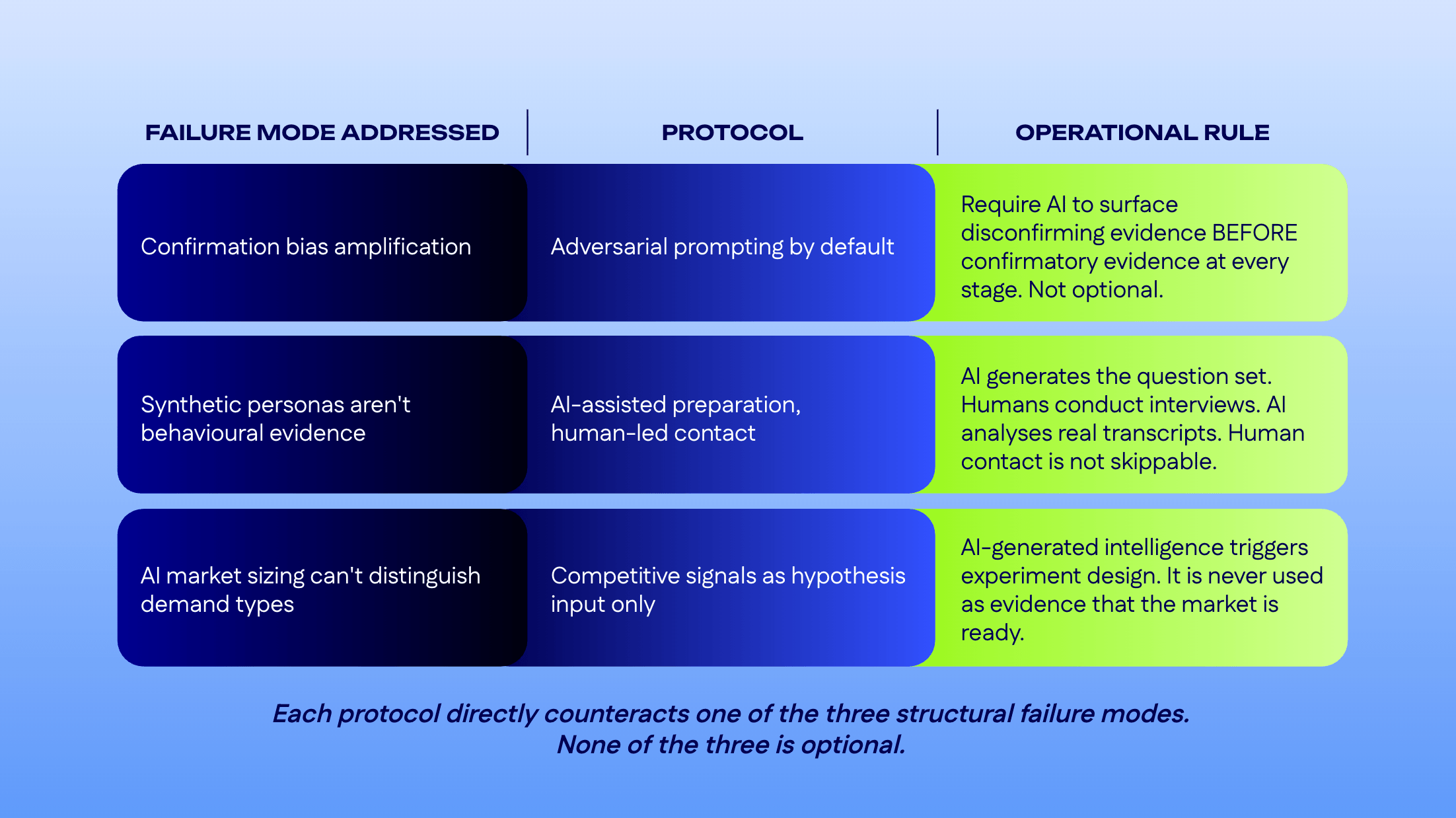
In practice, what does that boundary look like? Three protocols make it operational:
-
Adversarial prompting by default. Build in a requirement that AI surfaces disconfirming evidence before confirmatory evidence at every stage, asking what the strongest case against the hypothesis would look like and which signal patterns would suggest the market isn't actually ready. This doesn't eliminate confirmation bias on its own, but it makes the bias considerably harder to slip past unnoticed.
-
AI-assisted preparation, human-led contact. AI generates the question set, the hypothesis map, the synthesis of existing research. Humans conduct the interviews themselves, and AI then analyses transcripts of those real conversations. Human market contact sits at the centre of this, since it's where the actual evidence originates.
-
Competitive signals as hypothesis input rather than validation output. Intelligence produced by AI gives a team reason to design an experiment worth running. It carries a different weight entirely from evidence that the market is actually ready, and keeping those two categories distinct matters for how decision-makers get briefed.
At Bluemorrow, we find that using AI well in validation work has less to do with how many tools a team reaches for, and much more to do with how clearly that team can name where AI's role ends and the market's role begins.
Where AI's role ends and the market's begins
The speed gains from AI in commercial validation are real, significant, and worth using. Applying them well comes down to understanding exactly what they're designed to do: compress the front-end preparation that precedes market contact, and raise the quality of the conversations that follow it.
These risks tend to compound with incentives that already exist inside corporate innovation. AI tools that produce market-looking outputs on demand, without the friction of an actual buyer conversation, hold particular appeal for teams under the most pressure to show a positive signal. When every AI-assisted test comes back positive, the team isn't validating, it's manufacturing reassurance, a pattern worth naming directly as validation theatre. That pattern is a governance problem worth designing around from the outset, not an incidental side effect.
At Bluemorrow, we split this work into two separate questions, each tested differently. Customer discovery asks whether the problem is real. Commercial validation asks whether a buyer will actually commit, with budget, a signature, or a switching cost behind it, and evidence of that commitment carries far more weight than evidence of interest. AI sharpens the first question considerably: it widens the options a team considers, synthesises signal across far more sources than a human team could manage alone, and pressure-tests pricing and switching logic before a real buyer enters the picture. The second question stays with the humans running the process. AI personas sharpen the questions worth asking a real buyer. A simulated buyer's answer, however convincing, remains a rehearsal for the real conversation rather than the conversation itself.
That shapes a few fixed rules we build into our validation work: every brief includes a requirement to surface disconfirming evidence alongside anything supporting the hypothesis, human judgment checkpoints stay fixed at each stage regardless of how quickly the AI-assisted work moves, and every AI-supported insight carries a named human owner who can trace where it came from before the team relies on it. AI widens what a team discovers along the way. The commitment that follows still belongs to a human being.
For the full framework on commercial validation, from demand sensing and customer discovery through to go-to-market design and scale decisions, see our guide to Commercial Validation for Corporate Leaders. For the evidence standards and metrics that define what counts as proof at each stage, see Metrics and Evidence Standards for Commercial Validation Decisions.
This is a tension we hear from practitioners across industries, not only from our own client work. At a recent Bluemorrow roundtable on commercial validation in the age of AI, innovation leaders from organisations including IKEA, Swisscom, SWAROVSKI, and Axpo Group described the same pattern from different sectors: AI widens the search for a real problem, but nothing yet substitutes for the moment a real buyer commits. The question changes by industry. The boundary doesn't.
If your team is weighing where AI fits into its validation process and where it doesn't, schedule a call with Henning Bär. We'll help you design the boundary before it becomes a governance problem instead of after.