
Most innovation programs validate demand with real discipline. Customer interviews, hypothesis testing, conversion tracking – these are the standard moves, and teams get good at them. Then they arrive at a price, put a number in a planning spreadsheet, and treat it as though the market signed off on it.
It didn't.
Pricing validation is the step that separates a demand signal from a commercial signal. You can confirm that customers want your solution and still build something they won't pay for at a margin that makes the business viable. These are separate experiments, and skipping the second is one of the most expensive decisions an innovation team can make without realising it's a decision at all.
This article explains why the standard approach to pricing validation systematically overstates what customers will actually pay, how to build a reliable evidence hierarchy, and what pricing validation means specifically for corporate ventures.
It connects directly to the commercial validation foundation in our Market Validation Framework and the customer-level work covered in Customer Validation.
The reason most innovation programs never validate pricing
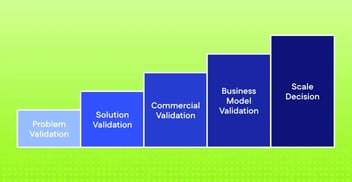
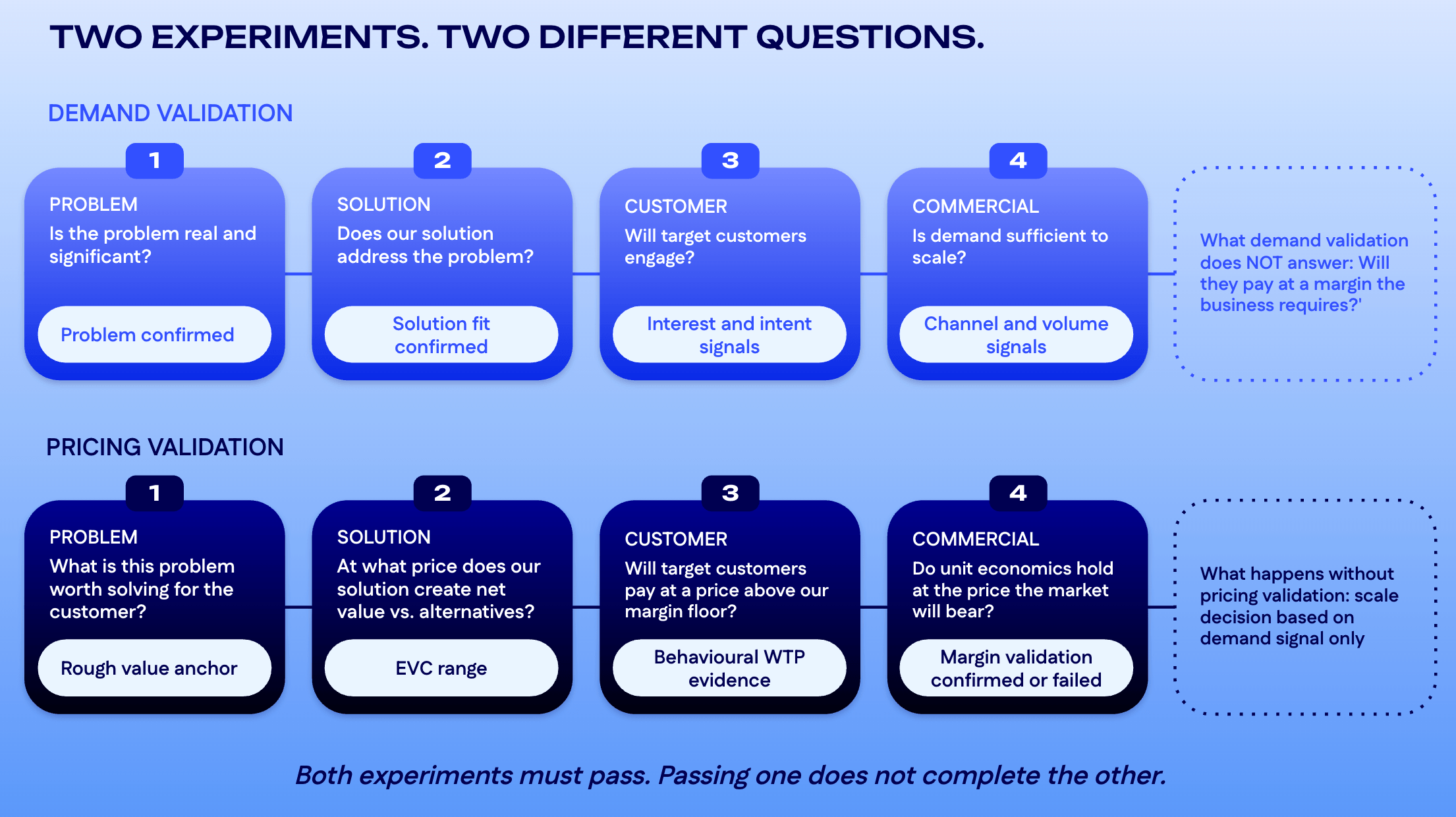
The reason most innovation programs never validate pricing is structural. Teams are trained to validate problem, solution, and customer – in that order. Price is assumed to follow naturally once the value case is established. But demand and pricing are separate hypotheses. They require separate experiments and produce different types of evidence.
Think about what demand validation actually proves. A customer confirms the problem is real, engages with your proposed solution, and agrees it would create value for them. None of that is evidence they'll pay your price. What you've validated is problem-solution fit. What you haven't validated is whether the business model works at the price point the market will actually bear.
The practical consequence isn't visible until after capital is committed. An idea can clear every validation gate – problem, customer, channel – and then fail commercially because the price the market will accept doesn't support the margin the business requires. By the time that becomes clear, you've already scaled.
So the question worth asking now, before the business case is written: at what point in your current validation process does pricing become a structured experiment rather than an assumption?
Why the standard ROI-based approach overstates willingness to pay
The standard ROI-based approach to pricing validation runs like this: quantify the economic value your solution creates for the customer, build a compelling value case, present it in a meeting, then ask whether they'd pay the number you have in mind. It feels rigorous. The problem is what it actually measures.
What it measures is whether the customer agrees with your argument. A well-constructed ROI model, presented by a credible team in a professional setting, produces social agreement. The customer nods. They say the numbers make sense. They might say “yes, at that price, we'd want to move forward”. And none of that tells you whether they'll pay when an invoice arrives and procurement is in the room.
This is the stated preference problem. When customers respond to a pricing question in a hypothetical context – no budget committed, no procurement involved, no real risk of being wrong – their answer reflects the quality of your pitch. They have every incentive to be agreeable and no consequence if they aren't.
The stated vs. revealed WTP gap
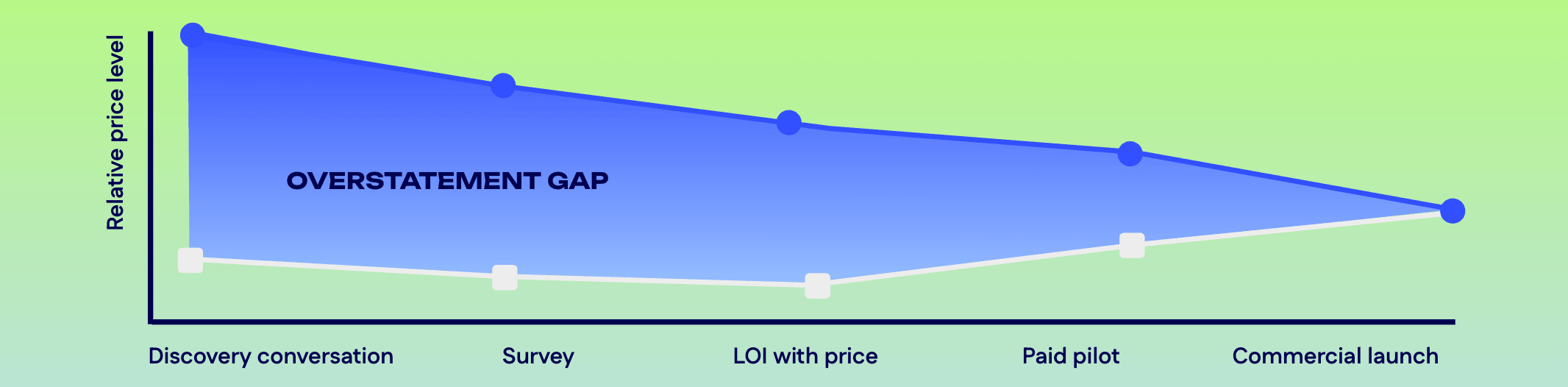
The stated vs. revealed WTP gap is well-documented in pricing research and consistently underestimated in practice. Studies measuring willingness to pay under hypothetical conditions find overstatement relative to actual purchase behaviour – in some cases by a factor of two or more (Breidert, Innovative Marketing, 2006; Columbia Business School, A Review Of Methods For Measuring Willingness-To-Pay). B2B isn't immune to this effect. The context may actually make it worse.
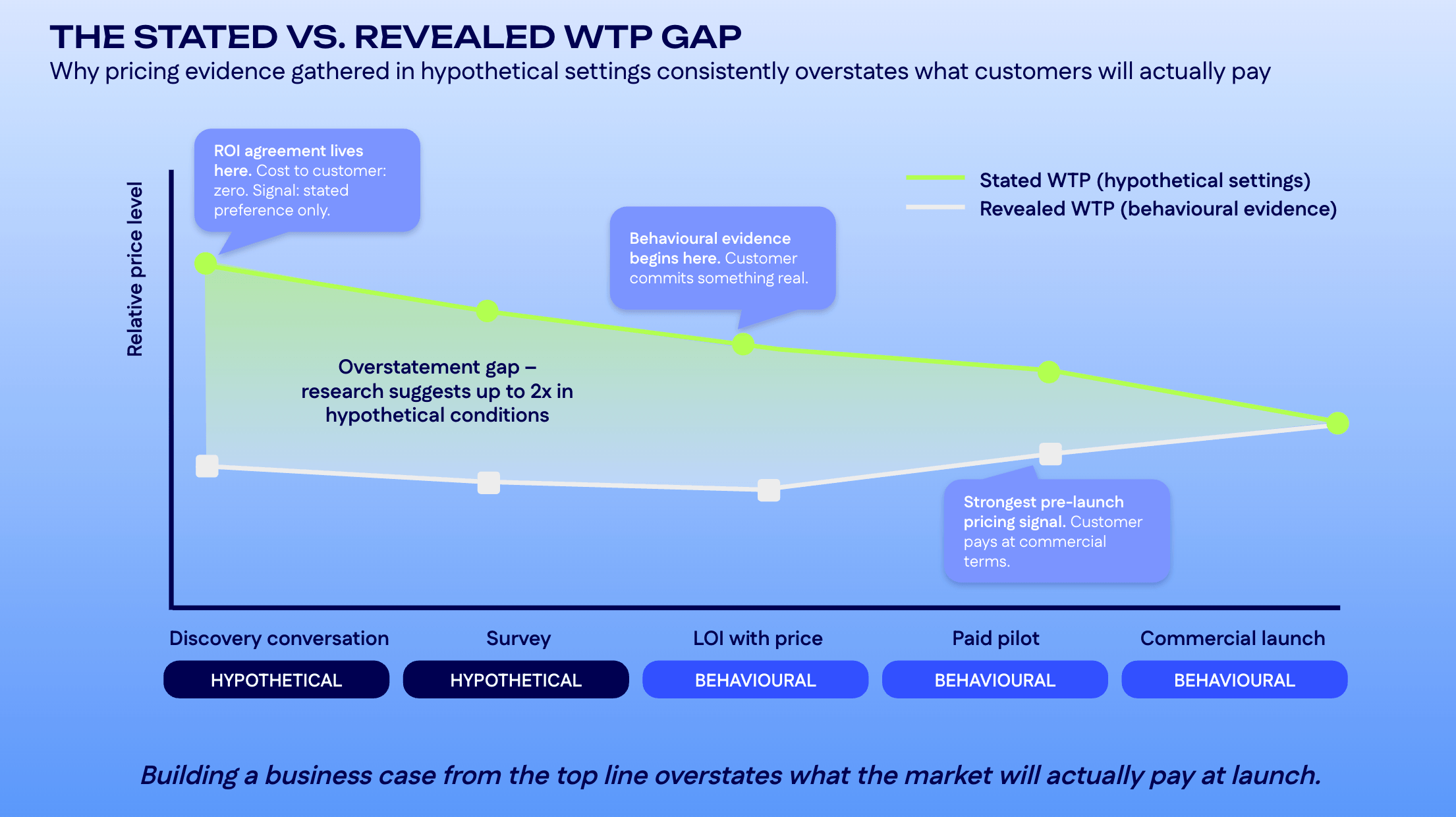
In a B2B discovery conversation, the decision-maker you're talking with typically hasn't engaged procurement, hasn't allocated budget, and doesn't personally bear the cost of overstating what their organisation would pay. The “yes” you receive is their genuine best estimate – made with no skin in the game.
That doesn't make qualitative pricing conversations useless. They produce hypotheses, and those hypotheses are worth forming. The problem is when they get reported as validated pricing in a business case that then drives a scale decision. That's the moment the overstatement becomes expensive.
A customer who agrees with your ROI model has confirmed the coherence of your logic, not their commitment to your price. Those are different things with very different evidential value.
A hierarchy of pricing evidence: from weakest to strongest
A hierarchy of pricing evidence gives you a framework for knowing how much weight to put on what you've gathered. Not all pricing signals carry the same meaning. The key variable is consistent: how much does it cost the customer to say yes? The higher that cost, the more the signal can be trusted.
Think of it as a commitment ladder. At the bottom, the customer agrees with your argument – cost to them is zero, and the signal tells you almost nothing about real WTP. At the top, the customer pays your price through a standard procurement process – cost to them is real money, and the signal is the most reliable evidence available before a full commercial launch.
The four levels of pricing evidence
Each level in the pricing evidence hierarchy represents a different quality of signal. The practical rule is to use lower levels to form hypotheses and narrow a range, and higher levels to validate before committing capital.
-
Level 1 – ROI agreement (stated): The customer confirms your value calculation makes sense. Cost to them: zero. Signal quality: low. Use it to test your narrative framing, not to anchor a business case.
-
Level 2 – Survey-based WTP (Van Westendorp, conjoint): Structured instruments that produce a quantified price range across a segment sample. More rigorous than a conversation, still hypothetical. Useful for narrowing the acceptable range and identifying price sensitivity thresholds. Not sufficient alone for a go/no-go decision.
-
Level 3 – Soft behavioural commitment (LOI with price terms, concept test with pricing tier selection): The customer signs a non-binding document that names a price, or chooses a pricing tier under conditions where that choice carries a real consequence, such as triggering a follow-up commercial conversation or a formal quote at the selected terms. A signed LOI carries weight because the customer's name and professional reputation are attached to a specific number. A pricing tier selection reaches the same level only when the customer knows their choice will shape what happens next, rather than being collected as an anonymous preference with no follow-through. Without that condition, tier selection sits closer to Level 2 survey evidence than to a genuine commitment.
-
Level 4 – Hard behavioural commitment (paid pilot at commercial pricing, pre-order with deposit): The customer pays. At commercial terms, without a discount, through standard procurement, with a vendor they weren't already obligated to close. This is the strongest pricing signal available before launch.
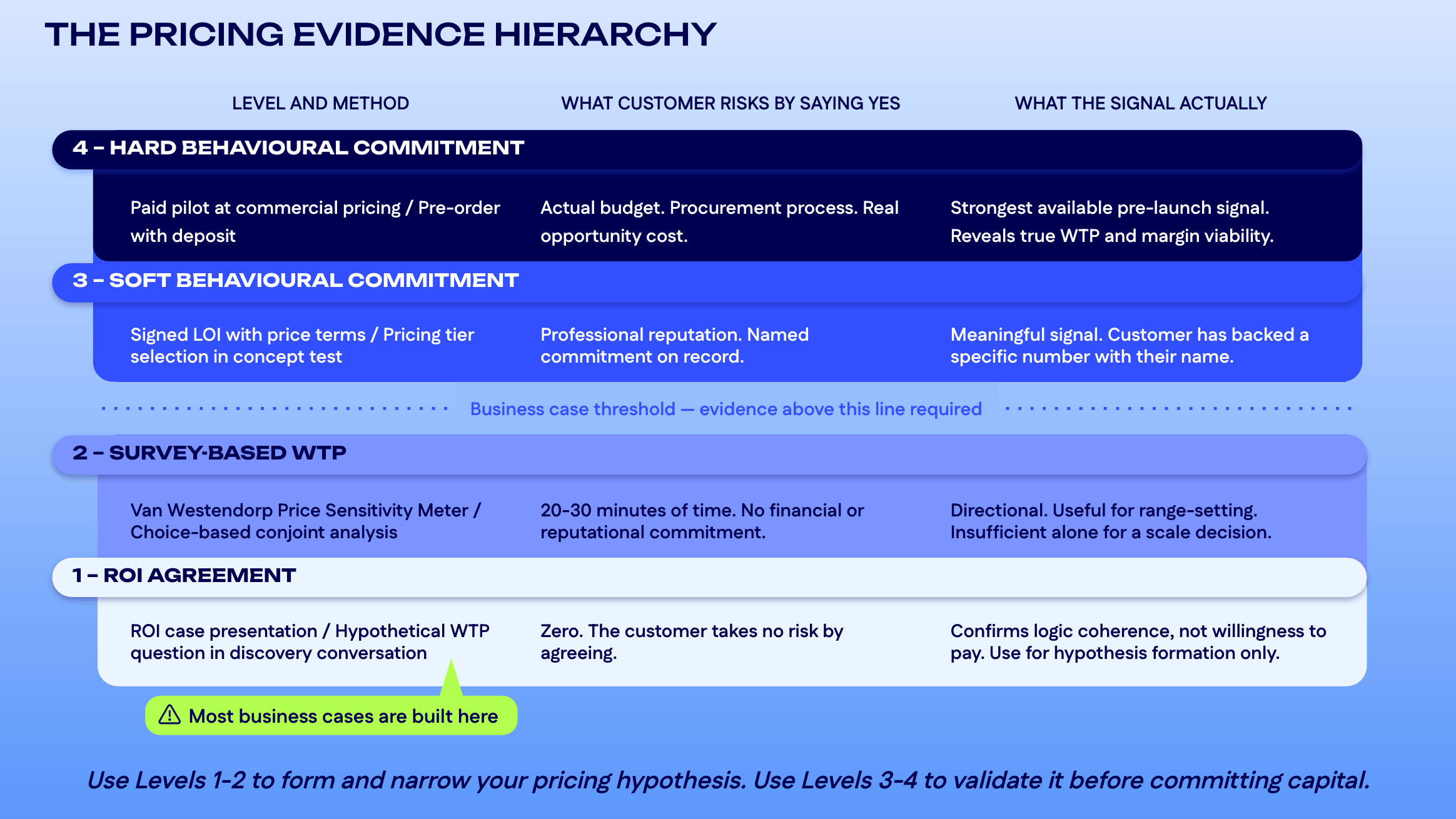
The practical sequencing: use Levels 1 and 2 to narrow the range and form your pricing hypothesis. Use Levels 3 and 4 to validate it. A business case built on Level 1 evidence alone – and most are – is built on a hypothetical.
When and how to introduce price in customer discovery
When and how to introduce price in customer discovery changes the quality of what you learn from the conversation. The standard approach – build trust, establish a full value case, then name a number – primes the customer to respond positively before they've had a chance to form an unanchored view. The fix isn't to ask about price at the very start of the conversation either. If you ask before the customer understands the problem you're solving and how your solution addresses it, they have nothing to measure the number against, and their reaction tells you more about how they respond to being caught off guard than about what they'd actually pay.
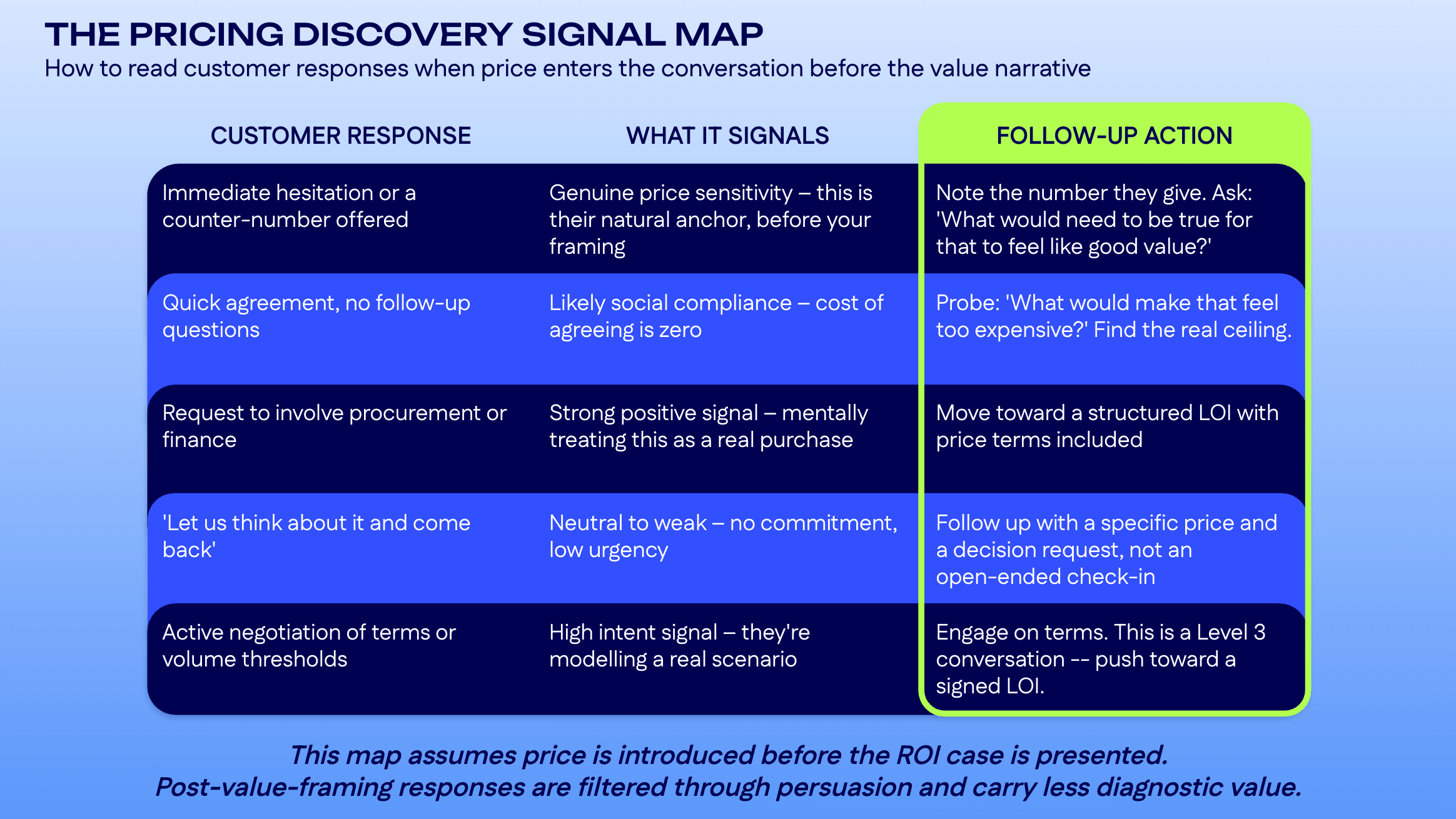
The useful sequence sits between these two extremes. Once the customer has enough context to understand the use case and the value at stake, but before you've built the full ROI case and made your argument for why the price is justified, ask for a reaction to price. At that point, the customer has what they need to form a genuine view, but your narrative hasn't yet done the persuasion work that shapes their answer. Follow that reaction with a behavioural test, such as a letter of intent or a paid pilot, to confirm what the reaction actually holds up to.
What to read when price enters the conversation early:
-
Immediate hesitation, or a counter-number offered: meaningful price sensitivity signal – note the anchor they give you, don't argue with it
-
Quick agreement without follow-up questions: likely social compliance – probe with “What would make that feel too expensive?” to find the real ceiling
-
A request to involve procurement or finance: a strong positive signal – they're mentally processing this as a real purchase decision
-
“Let us think about it”: neutral at best – follow up with a specific price and ask for a decision, not more reflection time
For B2B, a signed letter of intent with a price included is often the most direct bridge from a discovery conversation to meaningful pricing evidence, though it comes with its own risks. Not a general expression of interest, but an LOI that specifies what the customer will consider and at what commercial terms. Securing one can still take weeks of internal alignment on the customer's side, and a signature alone doesn't guarantee purchase intent: some customers will sign an LOI as a low-cost way of staying engaged, without any real commitment behind it. Treat the LOI as a stronger signal than a survey response, but confirm it with a paid pilot or actual procurement activity before relying on it as your primary evidence.
For corporate ventures, pricing validation is also margin validation
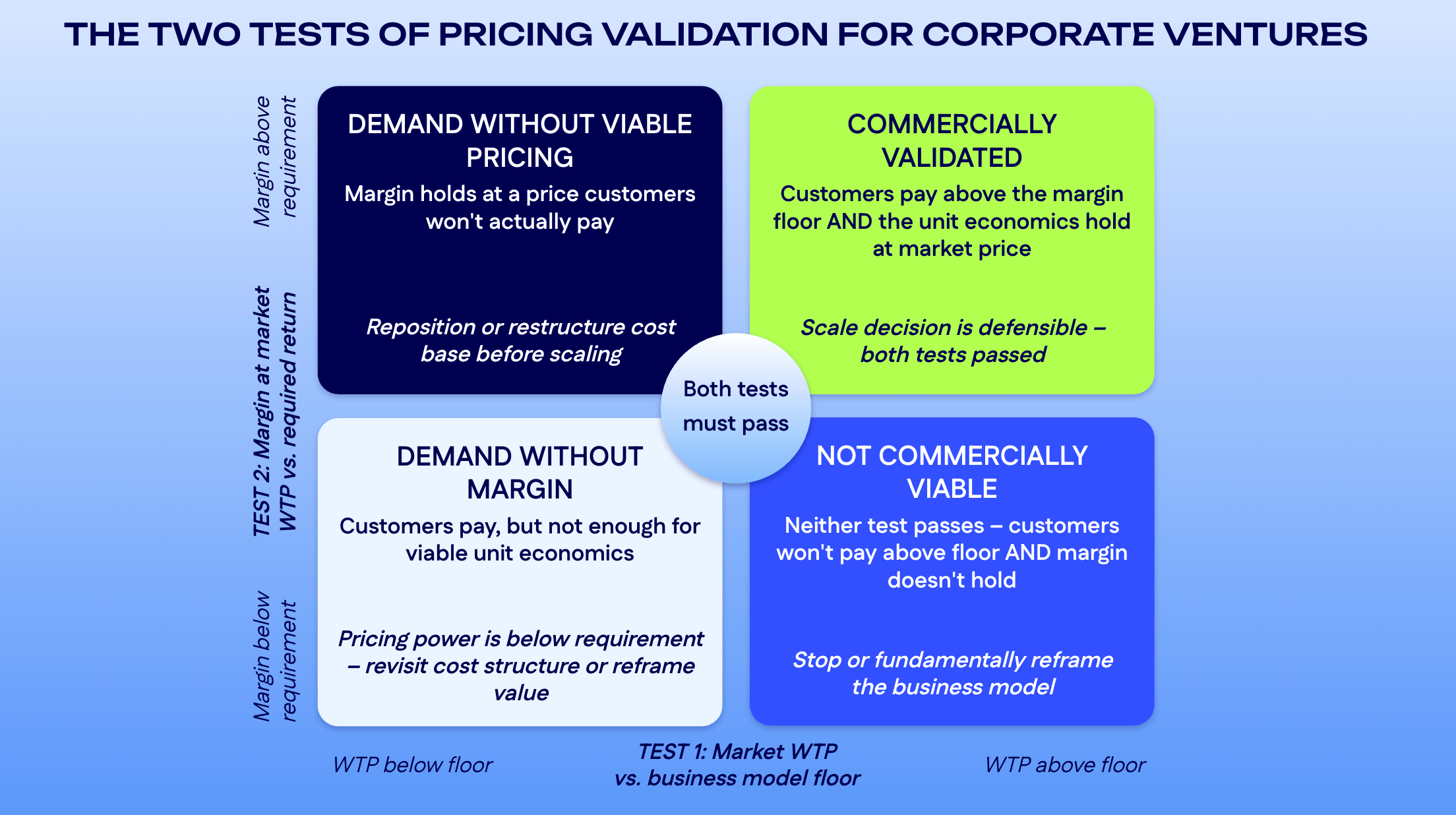
For corporate ventures, pricing validation is also margin validation – and the two tests are not the same question. Knowing that customers will pay is the starting point of the analysis. The question that determines commercial viability goes further: will they pay at a price that makes this a viable business line within your organisation's cost structure and return requirements?
A startup can iterate toward a price that works. It can renegotiate cost structure or reposition until the unit economics make sense. A corporate venture typically has to demonstrate from early validation that those unit economics are viable within a margin floor the parent organisation will accept. That floor isn't negotiable mid-pilot.
Which means there are two tests that must both pass.
-
First: will customers pay at a price above the floor the business model requires?
-
Second: at the price the market will actually bear, can we deliver at a margin that justifies the investment? You can pass the first test and fail the second entirely – and still report the pilot as a commercial success.
There's a second corporate-specific trap we see consistently. Customers in corporate innovation pilots may agree to a price that reflects the parent company's brand trust and relationship equity, not the new product's standalone value. When the venture eventually operates on its own terms – in new markets or with accounts that don't carry the relationship history – the WTP collapses. Pricing validation must be designed to isolate what customers will pay for the product, not for the context it was sold through.
The commercial signal that pricing validation is designed to produce – do customers pay at a price that makes this viable? – can usually be gathered well before the business case reaches its final draft, once the team has moved even one step past a purely qualitative conversation.
Building that experiment into the schedule early, rather than treating it as a step that happens once the business case is already being written, changes what the resulting numbers actually represent. A business case built on evidence gathered this way reflects what the market has shown it will commit to, rather than a projection that still needs to be tested against real purchasing behaviour.
Ready to validate pricing before you commit capital?
At Bluemorrow, we work with corporate innovation teams to design pricing validation that generates real behavioural evidence. That means structuring the right experiments at the right stage, from early discovery through to letters of intent and paid pilots, so the price in your business case reflects what the market will actually commit to.
If your team is approaching a scaling decision and the pricing evidence is still hypothetical, talk to Lilian Hörler about how to close that gap before capital is committed.