
Every innovation programme eventually reaches the same moment. The experiments have run, the results are assembled in a deck or a data room, and someone finally asks the question that's been sitting in the background for weeks: are we ready to scale?
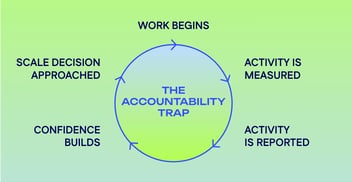
What happens next, in most organisations, looks less like an evaluation and more like a negotiation with the evidence already on the table. The team reviews the data, debates what it means, and arrives at a decision that tends to track how much capital and credibility have already gone into the project, how badly leadership wants it to succeed, and the general risk appetite among the people involved that particular week. Evidence exists in these conversations. How that evidence gets weighed, and by whom, rarely follows any standard at all.
At Bluemorrow, we treat the go/no-go call as a governance design problem: something engineered deliberately, well before anyone is evaluating results that are already sitting in front of them. The organizations we see get this right consistently have usually invested in that surrounding structure long before the moment of decision itself arrives, which is what separates a defensible call from a well-intentioned guess.
This article walks through the specific failure modes that quietly corrupt scale decisions even when solid data exists, lays out a staged evidence framework for what "validated enough" concretely means at each point in the journey, describes the governance mechanisms that make a scale decision defensible to a board or an outside reviewer and covers what needs to change organisationally the moment the commitment to scale is actually made.
Why the go/no-go decision fails even with good data
The go/no-go decision usually fails for a subtler reason than missing data. What tends to be broken is the process that evaluates the evidence that already exists.
In most corporate innovation programs, the same team that designs and runs the validation experiments also interprets the results and makes the case for scale investment. That overlap creates a problem that's easy to miss from the inside: the people with the deepest knowledge of the project are also the people with the strongest stake in seeing it succeed.
The systemic bias problem
This comes down to organisational incentives rather than anyone's individual integrity. The validation team has spent months building the project, defending it through internal reviews, and shaping it into something they genuinely believe in. When results carry any ambiguity, which validation results almost always do to some degree, that history colours how the ambiguity gets read.
The consequence is that go/no-go decisions in corporate innovation settings are routinely made by the people who have the most invested in reaching a positive outcome. Addressing this calls for a change in governance design, something that sits above any individual's judgment or good faith, however genuine that good faith may be.
Why more data doesn’t fix a broken process
The common response to go/no-go uncertainty is a request for more validation: another experiment, a broader pilot, a longer observation window. When the underlying evaluation process is structurally compromised, additional data mostly extends the timeline, adds to the sunk cost already accumulated, and hands the advocacy team more material to interpret in their favour.
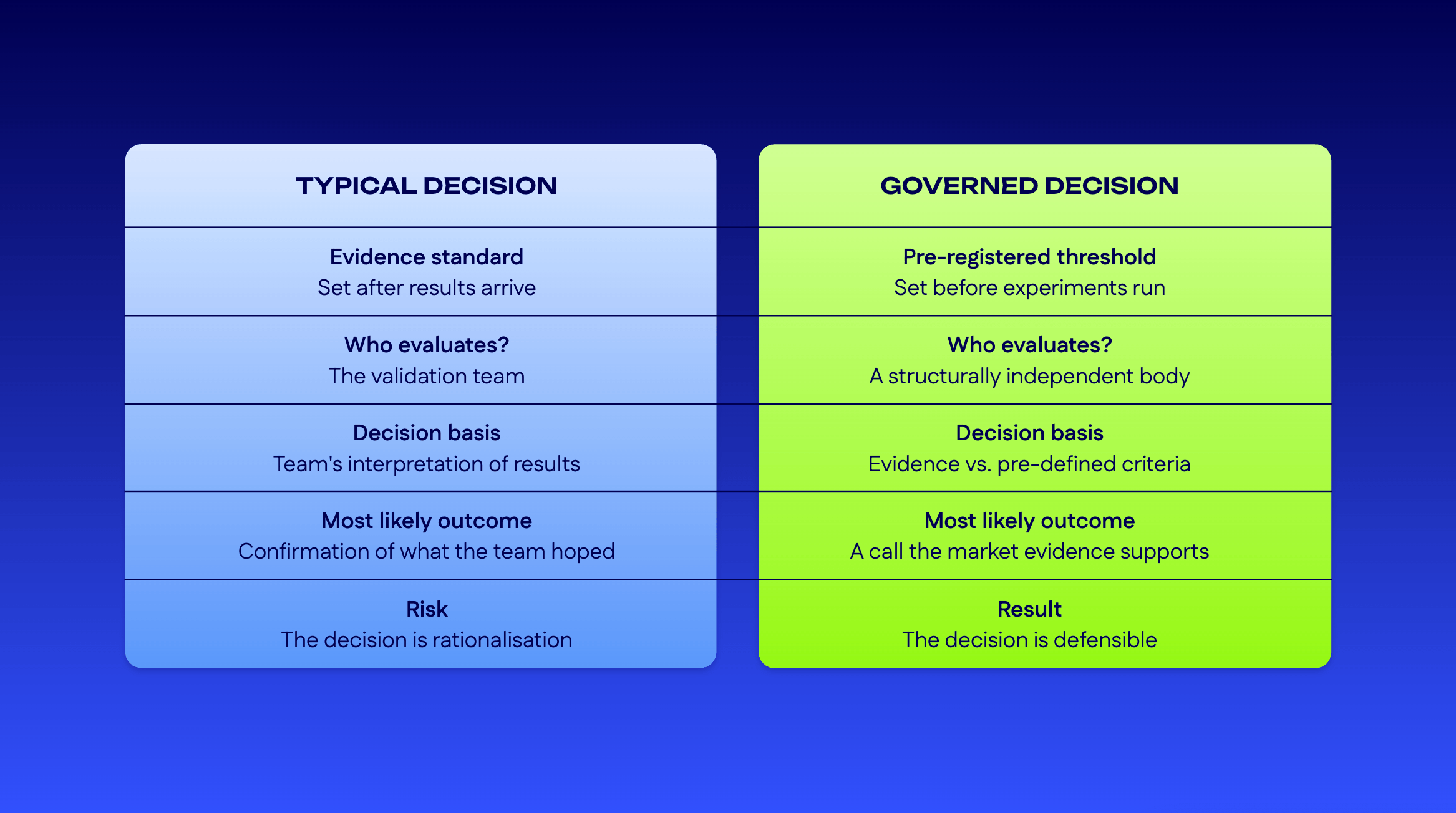
What actually addresses this is pre-defined evidence standards paired with a independently separated evaluation function, both established before experiments begin.
Pre-Registered validation thresholds
Pre-registered validation thresholds function as the single most important governance mechanism in the go/no-go decision, because they define what "good enough" looks like while the team can still think about it with a clear head, well before any experiment produces a result. A standard set after results arrive gets defined at exactly the moment judgment is least reliable: under pressure, with a team already invested emotionally in a positive outcome, and with the actual numbers already sitting in view.
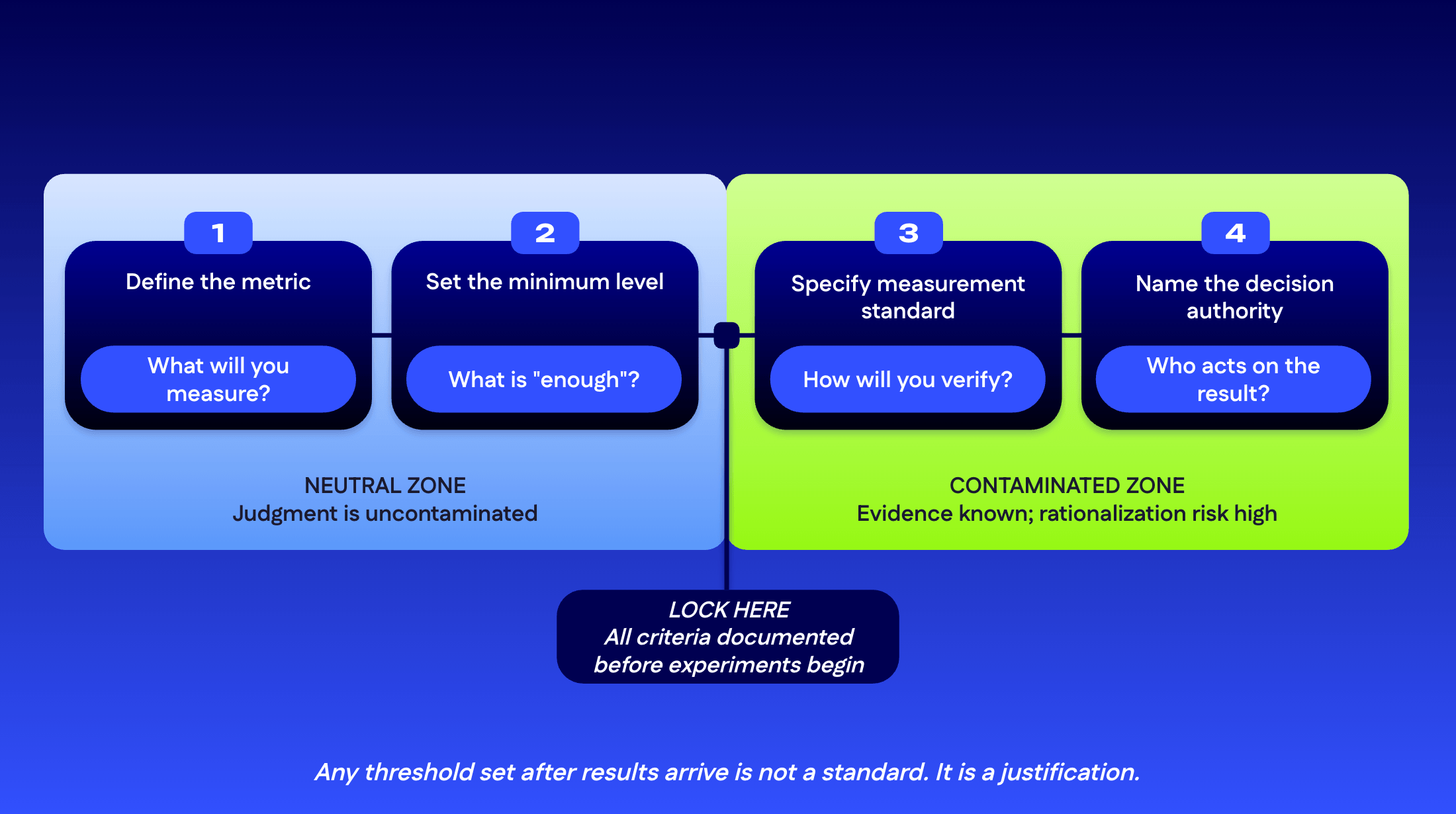
A pre-registered threshold is an evidence criterion that gets defined, documented, and locked in advance. It specifies the metric, the minimum level required, the measurement method, and the decision authority who acts on the result. Setting that threshold before results are known keeps the evaluation objective. Setting it afterward turns the same exercise into rationalisation dressed up as analysis.
What a threshold looks like in practice
The examples below are illustrative, as the specific numbers and criteria will vary depending on your market, stage and organisational context.
A pre-registered threshold works as a decision rule rather than an aspirational target. A well-formed threshold contains four elements:
-
The metric: what you are measuring (e.g., signed letters of intent with price terms)
-
The minimum level: what constitutes sufficient evidence (e.g., five independent LOIs from the target ICP)
-
The measurement standard: how evidence is verified (e.g., independently confirmed, not sourced from existing relationships)
-
The decision authority: who acts on the result (e.g., innovation board, not the validation team)
Define these before the experiment begins. A threshold negotiated after results arrive functions as a justification rather than a standard.
Hard thresholds vs. judgment bands
Some decisions translate cleanly into a binary trigger. Others fall into a judgment band, a range where the evidence is genuinely mixed and calls for structured deliberation rather than a simple pass or fail. Both the thresholds and the boundaries of the judgment band get pre-registered alongside everything else, and the whole approach depends on sequencing: the standard needs to exist before the team sees the data, otherwise what looks like interpretation of results is really the team deciding, after the fact, what level of evidence would have counted as sufficient.
Reading the evidence stack
Reading the evidence stack well starts with a simple recognition: no single metric carries enough weight on its own to justify a scale decision. What earns that weight is evidence that converges across several dimensions at once, with the relative importance of each signal shifting depending on where in the validation journey a concept currently sits. Picture a venture arriving at its scale review with a stack of enthusiastic customer interviews and a commercial picture that's still shaky. Reading that as ready to scale would mean listening to only half of what the evidence is actually saying. Each dimension has to earn its place on its own terms.
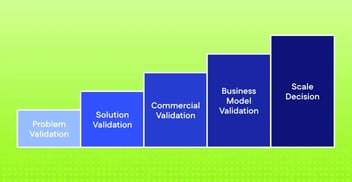
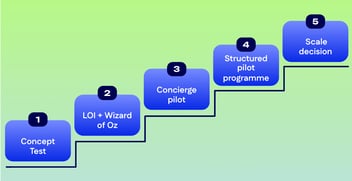
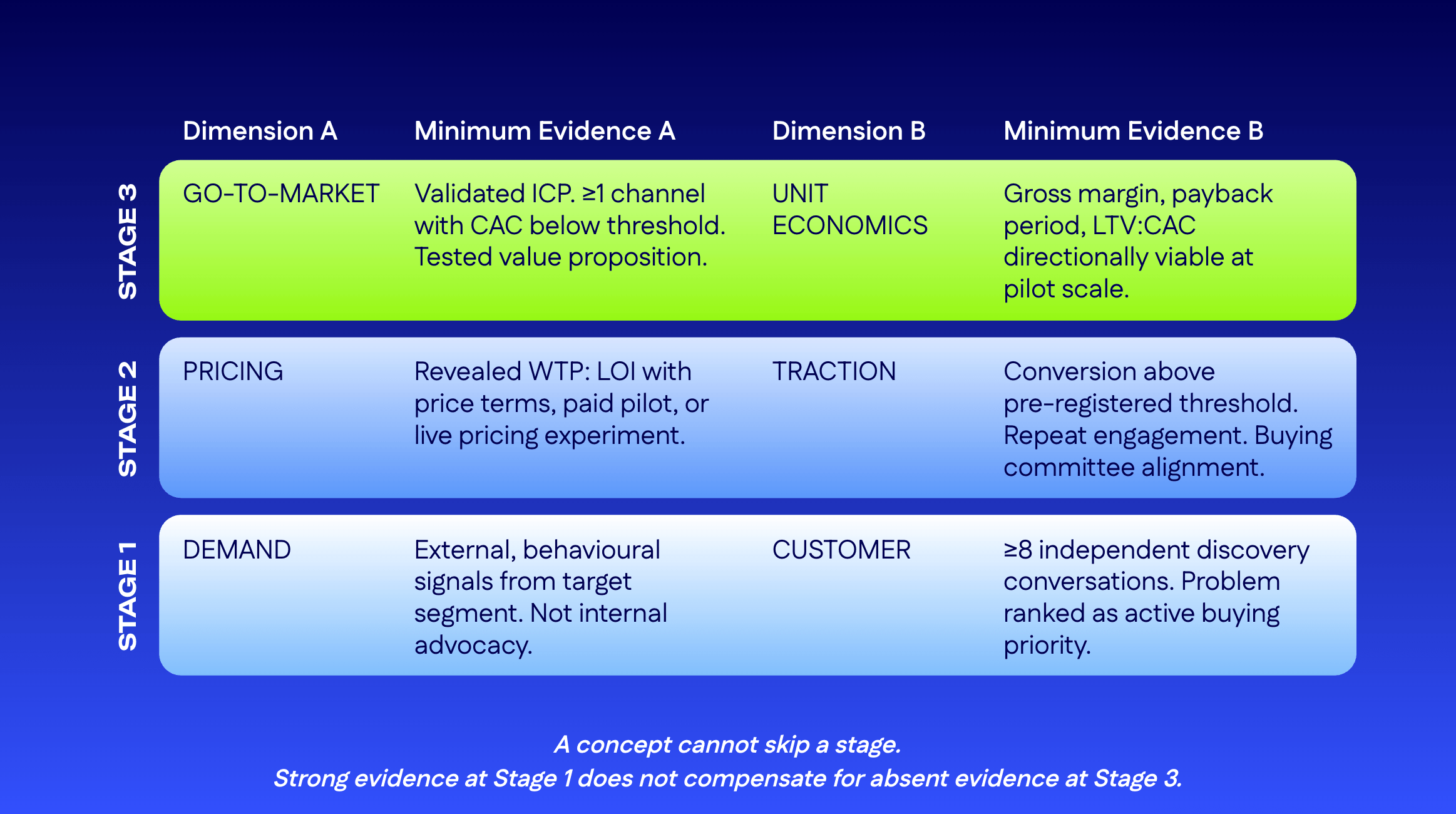
At Bluemorrow, we assess scale readiness against a three-stage evidence stack, with defined evidence requirements at each stage. The stages build on top of each other: a concept moves through Stage 1, then Stage 2, then Stage 3, and a mountain of glowing evidence at Stage 1 says very little about what's actually happening several stages later, at Stage 3.
Stage 1 – Early validation signals
Stage 1 is where a team confirms that a real problem exists and that the people meant to buy the eventual solution experience it as something urgent enough to act on, rather than merely interesting. The evidence that counts here is behavioural: people who have already tried and failed to solve the problem on their own, people actively searching for a solution right now, or people who respond with real urgency the moment the problem is named to them, without any prompting.
What Stage 1 requires in practice: verified pain points surfacing from at least eight independent customer discovery conversations, the target decision-maker ranking the problem as an active buying priority, and demand evidence that comes from outside the project team, separate from the enthusiasm of people already inclined to support it. A venture whose every signal traces back to people already rooting for it hasn't yet cleared Stage 1, however encouraging those signals feel.
Stage 2 – Commercial validation signals
Stage 2 tests something harder than interest: whether customers will actually commit money to the solution, at a price the business model can survive on. Many validation programmes make it this far and stall exactly here, having confirmed genuine enthusiasm while the harder question of willingness to pay remains open.
The evidence that counts at Stage 2 comes from what customers actually do under real conditions, rather than what they say they'd do hypothetically: letters of intent with price terms attached, paid pilots, or live pricing experiments where money or a signature is genuinely on the line. Survey-based willingness-to-pay exercises and ROI calculations sit outside this bar, useful as they are for forming a hypothesis, because they capture stated agreement rather than a commitment a customer has actually made. The gap between what people say they'll pay and what they actually pay when the invoice arrives is one of the most documented, and most consistently underestimated, risks in commercial development. (For the full treatment of why this gap exists and how to close it, see our article on Pricing and Willingness to Pay Validation.)
Traction signals round out the picture at Stage 2: conversion rates that clear the pre-registered threshold, the same accounts coming back for more, and evidence that the whole buying committee is aligned, beyond the enthusiasm of a single internal sponsor.
Stage 3 – Scale readiness signals
Stage 3 confirms that the route to market actually works at economics the business can live with. That means a validated Ideal Customer Profile, at least one channel bringing in customers at an acquisition cost below the pre-registered threshold, and a value proposition that has been tested and converted in practice.
Unit economics need to exist here even at pilot scale, even if the gross margin, payback period, and LTV: CAC figures are still early and somewhat directional. The question worth asking at this stage is whether the business can grow while making money. Plenty of concepts clear Stage 2 and stumble at Stage 3, carrying real, validated demand into a set of economics that simply don't hold together. That outcome calls for redesigning the business model before any capital gets committed, rather than treating it as a signal to abandon the concept altogether.
Continue, Pivot or Stop
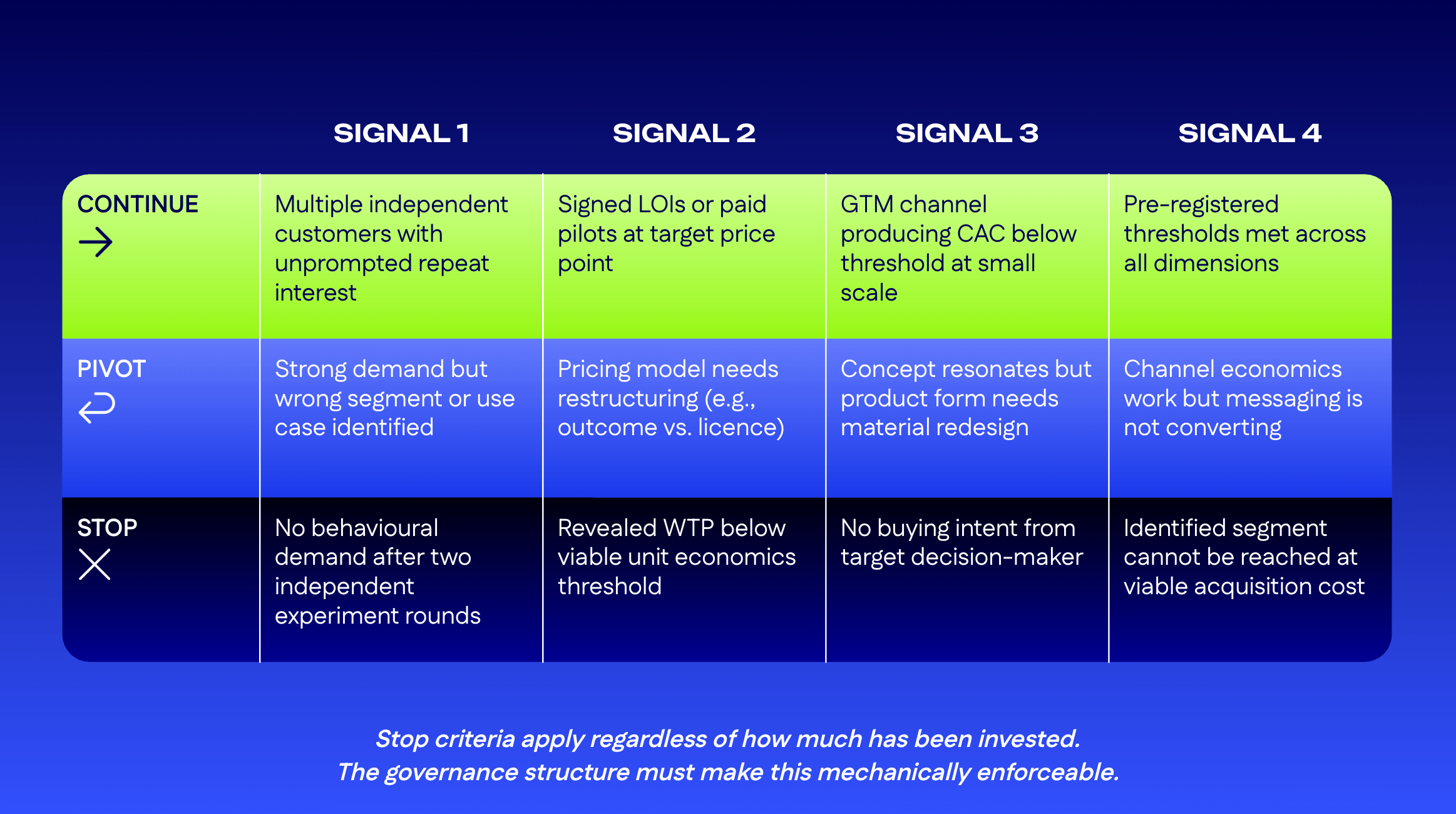
Once the experiments have run, the resulting evidence points toward one of three directions: continuing to scale, pivoting the approach, or stopping the programme altogether. Most organizations enter this moment having spent months designing experiments and remarkably little time deciding, in advance, what each of these three outcomes should actually look like on paper. That gap is exactly what allows a struggling project to keep limping forward long after the evidence has made its point.
Continue signals
A genuine continue signal shows up as evidence converging across multiple independent dimensions at once, evidence so clear it barely needs interpreting to read as positive. The pre-registered thresholds have been met. The people behind those signals came from independent sources, rather than a small, familiar circle the team already had relationships with, and the pattern holds consistently across different customer types and use cases.
Every real-world validation result carries some noise, so a continue signal was never going to feel like the absence of any doubt whatsoever. What it does carry is behavioural commitment from the right people, at a price that actually works, moving through a channel that can scale.
Pivot triggers
A pivot reads best as a course correction grounded in evidence, closer to recalibration than failure. The pattern that justifies one usually looks like real demand showing up, just in a different shape than the team originally assumed: a different customer segment responding, a different product configuration resonating, a different pricing model working, or a different channel converting.
Governing a pivot well means building a redefined validation plan with genuinely new pre-registered thresholds, not carrying the old ones forward under a new name. A pivot that keeps the original evidence standards intact tends to become a rebranded continuation of the same project, wearing the appearance of responsiveness while the same systemic bias in evaluation keeps operating underneath it.
Stop criteria and why they are rarely honoured
A stop criterion is a signal pattern defined ahead of time, one that triggers discontinuing the programme when it appears. In practice, this typically looks like curiosity that never develops into real pain across two independent rounds of experiments, revealed willingness to pay that lands below what the unit economics need, or an absence of genuine buying intent from the target decision-maker.
Organizations are often quite good at writing stop criteria down and considerably less good at acting on them once the moment actually arrives. The reasons tend to repeat themselves: sunk cost, a sponsor who has staked their reputation on the project, team morale, and the simple discomfort of standing in front of colleagues and calling a negative result exactly what it is. Pre-registered thresholds paired with independent review exist precisely because of this pattern. Someone is being asked to call something dead that they have spent months keeping alive, and that's a genuinely difficult thing to ask of anyone close to the work. The surrounding structure needs to carry weight that individual judgment, on its own, tends not to hold.
This pattern has a name in corporate innovation circles: the Zombie Project, an initiative that has quietly accumulated enough evidence to justify stopping while somehow keeping enough organisational momentum to carry on regardless. Our article on Testing Before You Build covers this in depth, naming the systemic reasons it persists and showing what pre-defined success criteria look like once they're actually put into practice.
Building a Governance Architecture that holds up
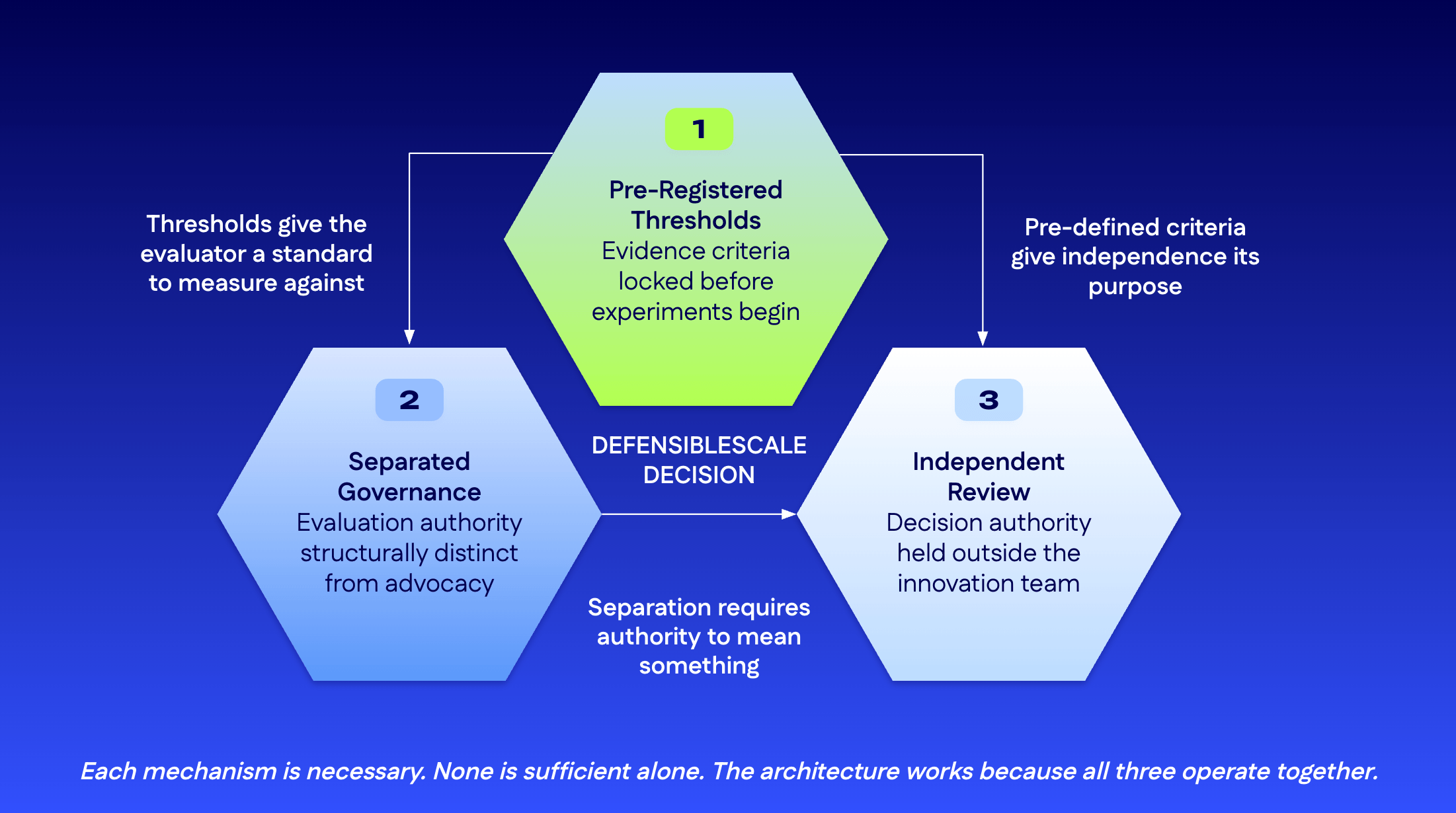
A defensible scale decision needs more than evidence behind it. It needs a structure around it that would hold up to an outside observer looking back at it later: an investment committee weighing whether to fund the next stage, a board asking hard questions, or an audit reconstructing how the call actually got made. That structure rests on three elements.
Mechanism 1 – Pre-registered validation thresholds
As the earlier section covered, this means evidence criteria get defined, locked, and documented before any experiment begins, at the point where judgment is at its most neutral, simply because nobody yet knows what the results will show. This sits at the foundation of the whole governance architecture. The other two mechanisms depend on it entirely, since neither one has anything concrete to measure against until this piece exists.
Mechanism 2 – Separating validation governance from innovation advocacy
The team championing an innovation is poorly placed to govern its own go/no-go decision, however capable or well-intentioned that team might be. What's needed here is a clear separation, where the function generating and interpreting the evidence sits apart from the function evaluating it.
In practice, that means the evaluation gets carried out by people who haven't been running the programme day to day, who carry no organisational incentive toward seeing a positive outcome, and who work from the raw evidence itself rather than a summary the team has already shaped. This is a matter of governance design rather than culture or good intentions, however genuine those intentions are. The structure needs to make bias mechanically harder to act on, which is a different and more durable thing than simply asking people to try harder to be objective.
Mechanism 3 – Independent review: who holds authority to call stop
The third mechanism comes down to decision authority. An independent review function, whether that's an investment committee, an external advisor, or an innovation board, needs explicit decision-making power sitting behind it, rather than a purely advisory role.
An advisory review that lacks real decision authority tends to function as theatre: the body recommends stopping, and the team advocating for the project simply overrides that recommendation. Structural separation only does real work when independent authority backs it up, meaning the independent review function can call a stop even when the innovation team is advocating hard for continuation. Absent that authority, the whole governance architecture is decorative rather than functional.
What each experiment actually buys you
Real options logic gives staged validation investment a useful frame. Each experiment buys a right to proceed to the next stage, a right the team can choose to use or leave unused. As validation moves forward, what actually accumulates is a string of these rights, sitting there waiting to be exercised or left alone depending on what the evidence eventually shows.
Picture a team midway through a validation programme, weighing whether to continue. The question worth asking is whether what's been learned so far has earned the next stage, a question with a concrete, checkable answer rather than a feeling.
Picture the three validation stages as a sequence of purchases. Stage 1 experiments buy the right to conduct commercial validation. Stage 2 evidence buys the right to design a go-to-market approach. Stage 3 readiness buys the right to commit to full-scale investment. At every stage along the way, a team can exercise that right or let it lapse. Letting it lapse costs whatever was already spent on the experiment. Exercising a right that hasn't actually been earned costs a failed scale investment, a bill that runs considerably higher.
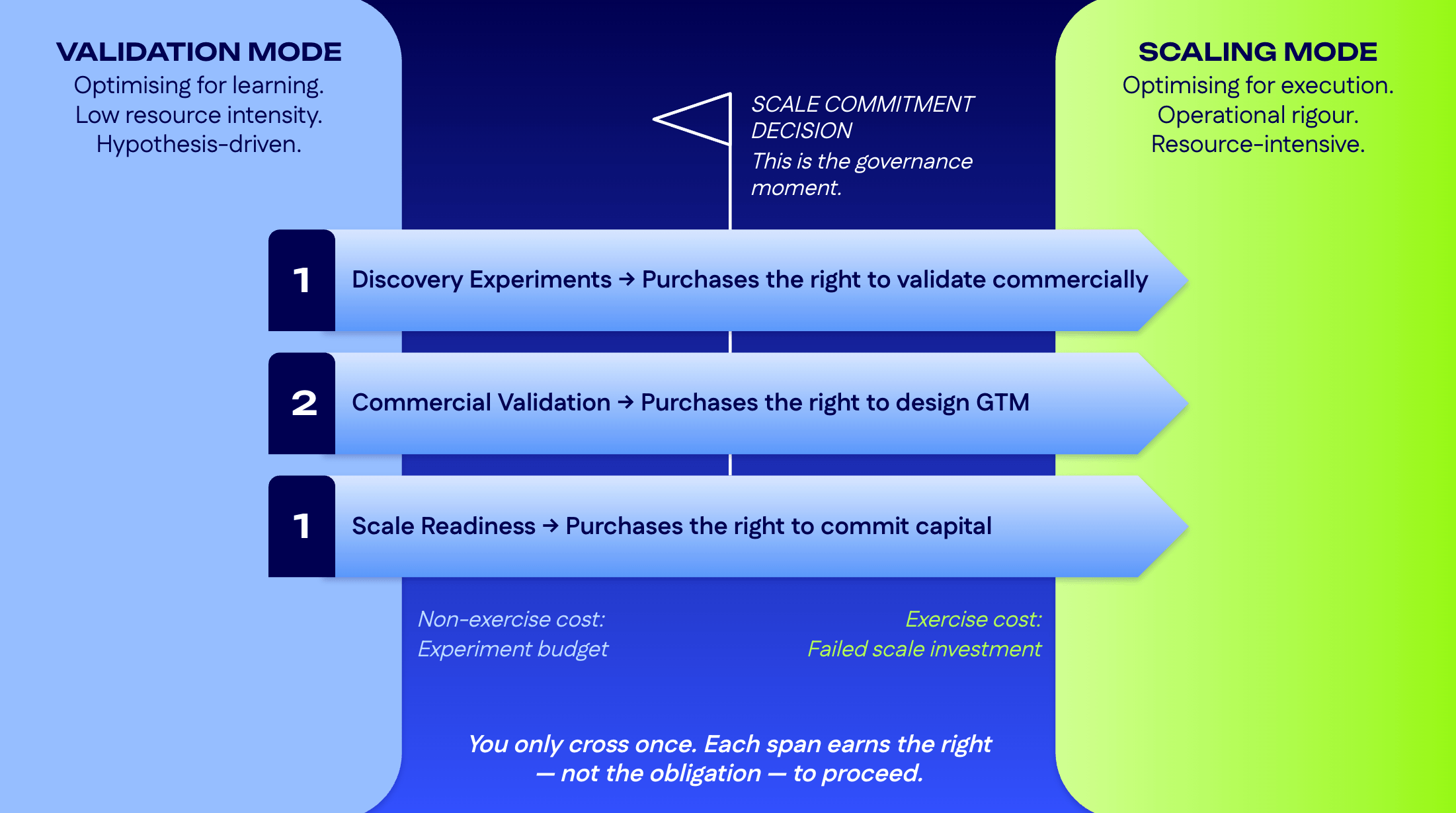
This framing puts a number on what continuing without sufficient evidence really means: exercising a right the evidence hasn't yet earned. It also gives the independent review function a clear job, weighing whether the evidence earns the next option, grounded in the data rather than in how hard the team has worked or how compelling the story sounds.
Sunk cost bias stays fully intact as a psychological pull; adopting this language doesn't touch that. The governance structure wrapped around the decision is what shifts, and that structure makes the bias considerably harder to act on in practice. Picture a team facing a disappointing pilot, weighing a single question: does the evidence in front of us earn the specific investment needed to reach the next stage? Teams tend to answer that question straight, and the decisions that follow tend to hold up better.
Handing off from validation to scale
Plenty of well-validated concepts lose their momentum right at the handoff between the validation team and the organization that's meant to scale them. Governance around the project doesn't wind down once the scale commitment gets made, it shifts into a different register entirely, and the decisions made at that handoff point carry weight comparable to the go/no-go call itself, even though far fewer organizations design them with the same care.
Why the validation team is often the wrong scaling team
A strong validation team tends to be built around hypothesis testing, rapid iteration, comfort with ambiguity, and a lean use of resources. A strong scaling team runs on operational rigour, channel discipline, resource management at a much higher level of complexity, and a fundamentally different relationship with uncertainty. Learning is what the validation team has spent months optimizing for. Execution is what the scaling team needs to optimize for from day one.
Handing the scaling mandate to the validation team by default is one of the most consistent structural errors organizations make at this stage, and it's an understandable one. That team knows the project intimately, they've built the customer relationships personally, and they've usually earned a real sense of ownership over seeing it through. Knowing a project deeply and being equipped to scale it are two separate qualifications, and mixing them up tends to come at a real cost.
What changes at the point of commitment
At the point of scale commitment, four things change fundamentally:
-
Ownership: transfers from the innovation function to a business line, standalone venture entity, or dedicated scaling team
-
Metrics: shift from validation signals (LOIs, pilot conversion, WTP evidence) to growth and unit economics
-
Governance: authority escalates from innovation board to business line leadership or executive committee
-
Resources: move from experiment budgets to operational investment with defined return expectations
Each of these transitions needs deliberate governance design built around the moment of commitment itself. When an organization nails the scale decision but handles the transition carelessly, the project often ends up in roughly the same place as one that was never properly validated in the first place. The harder part of this whole process tends to live in the handoff, more than in the decision that precedes it.
Conclusion
Corporate innovation teams spend enormous energy debating whether to validate a concept in the first place. The genuinely hard question sits one step further down the road, in knowing when that validation has become sufficient, and in settling who actually holds the authority to make that call.
Anyone who has watched a scale decision fall apart under scrutiny recognizes what pre-registered thresholds, separated governance, and independent review are actually doing underneath the bureaucratic surface they might appear to have from a distance. Together, they build the architecture that lets a scale commitment hold up to a board, to the rest of the organization, and to the team itself, especially in the moment the outcome falls short of what everyone had hoped for.
At Bluemorrow, we design this governance architecture with corporate innovation teams before a single experiment runs, which is the point in the process where it actually does its job. We help set the pre-registered thresholds, build the structural separation between the team generating evidence and the team evaluating it, and put an independent review function in place with real decision-making authority behind it.
If your organization is sitting on a concept that's approaching its scale decision, or building out a validation programme and wanting the governance right from the start, book a call with Michael Augsburger. We'll help you design a go/no-go structure that holds up when the pressure to move fast is at its highest.