
Most organizations measure innovation activity. They count pilots, track ideas in the pipeline, report on workshops completed. Then, at some point, someone says it feels like this is working and a scale decision gets made on that basis
That feeling is a liability.
Validation metrics are a decision framework. The difference between tracking metrics and actually being validated is the difference between running an experiment and passing one. This article explains how to set that proof condition before measurement begins, what to measure at each stage of development, and why the assets that should help you most can actually obscure the signal you need.
This builds on the foundation covered in our Market Validation Framework. If you've established that a problem exists and the market is real, the question this article answers is more specific: how do you know your solution has earned the right to scale?
The metrics most innovation teams are already tracking (and why they don't validate anything)
Most innovation teams track metrics that answer a different question than the one a scale decision requires. Internal approval counts, stakeholder satisfaction scores, workshop attendance, ideas progressed through a pipeline: these are legitimate operating measures, and in many organisations they're the backbone of how governance and reporting actually function. They tell you that the team is active, that stakeholders are engaged, and that the process is running as designed. None of that is a substitute for the one thing a scale decision requires: evidence that the market has responded to what you've built, not just that your organisation has kept moving
There's a specific reason these metrics persist. They're easy to report and carry the appearance of rigour without requiring any actual market exposure. If your innovation team reports 47 ideas in the pipeline and eight active pilots, a leadership team can feel that progress is happening. But none of those numbers answer the only question that matters: is there real demand for what you're building, from people who aren't already predisposed to support you?
The problem begins when activity metrics are used as a substitute for market evidence. Tracked and reported with discipline, they create a genuine sense of forward motion inside the organisation, and that sense of motion is real: it reflects how hard the team is working and how well the process is functioning. The risk appears when that same sense of motion gets treated as proof that the market has engaged with what's been built, a question that requires a different kind of evidence entirely.
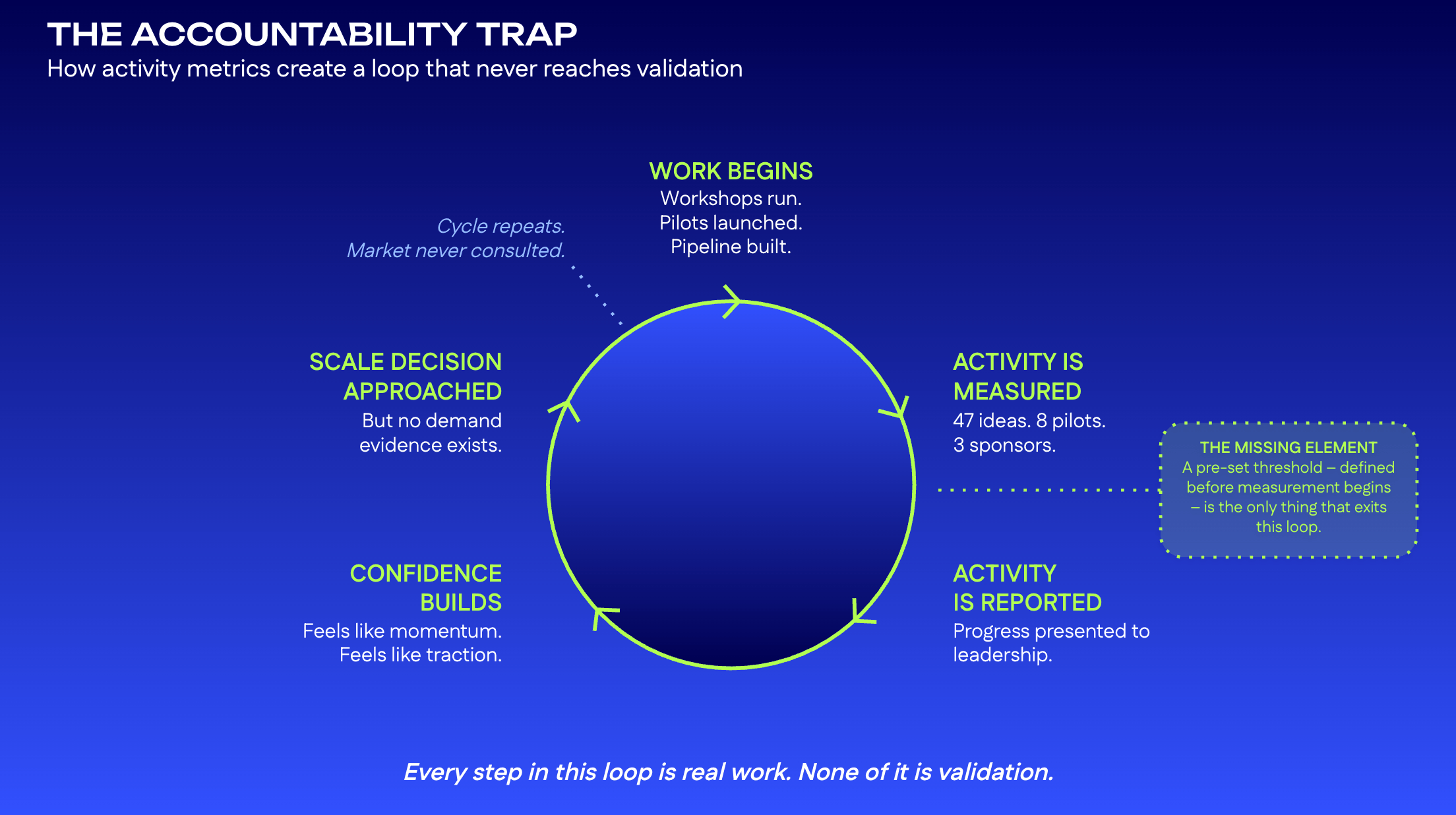
The question worth asking before your next innovation review: can you point to a single metric in your current dashboard that would tell you, unambiguously, that you should stop a project? A measurement system designed only to justify continuation is a storytelling system dressed in numbers.
What “validated” actually means as a measurable state
Validated, as a measurable state, means you've passed a threshold that you defined before the measurement began. A pre-set condition – measured over a defined window, against a defined baseline – produces a clear outcome: the result falls on one side of that line or the other, and that binary sits at the centre of the definition. This holds when the measure behind it is reliable, the sample is large enough to support a conclusion, the experiment is designed in a way that actually tests the hypothesis, and the evidence gathered matches the question being asked. A threshold met on a flawed measure or an inadequate sample produces a number that happens to fall on the right side of a line, which is a different thing from evidence. "This is promising" and "the pilot went well" are assessments. A pre-defined threshold, evaluated under those conditions, is evidence.
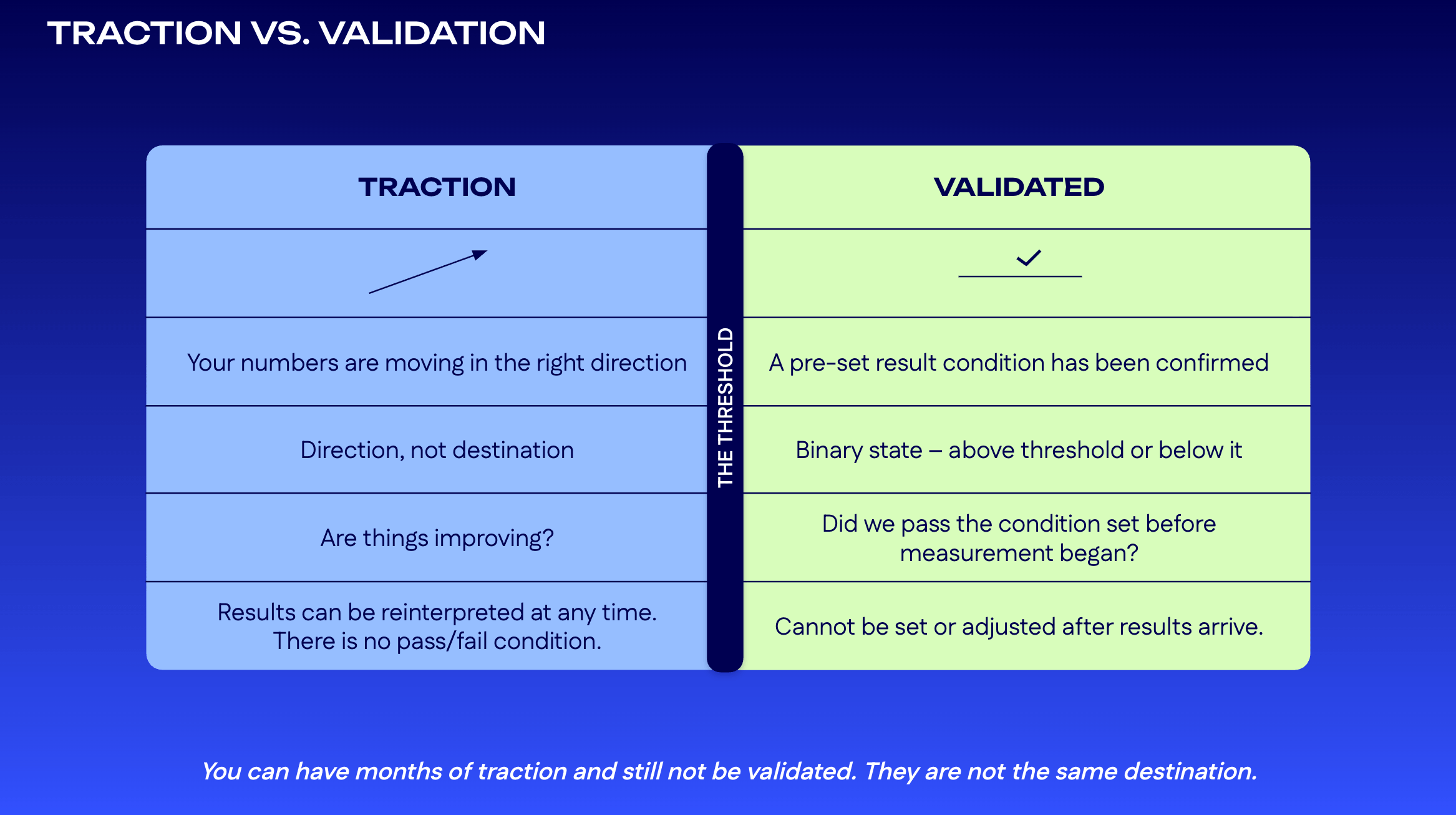
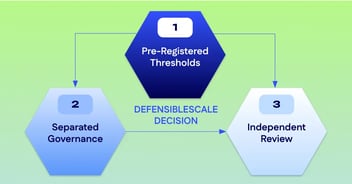
At Bluemorrow, we recommend building this threshold-setting step into a formal pre-commitment process, one we treat as the discipline that separates measurement from interpretation. Before any experiment runs, three questions need answers: what exactly are we measuring, what result constitutes evidence, and over what time period? Document those answers, then bring in a second senior observer, someone with no stake in the project's outcome, to review and sign off on them before the experiment starts. Their role is to confirm the threshold was set honestly, without visibility into how the results might land, which keeps the standard fixed once data starts arriving. Results visible before the threshold is set create the conditions for motivated reasoning, where the standard quietly shifts to match whatever the data already shows.
The practical consequence shows up at investment reviews. When the threshold is defined in Week 1 and the data arrives in Week 12, the conversation is straightforward. When the threshold is defined after the data arrives, the conversation is political.
The demand signal hierarchy
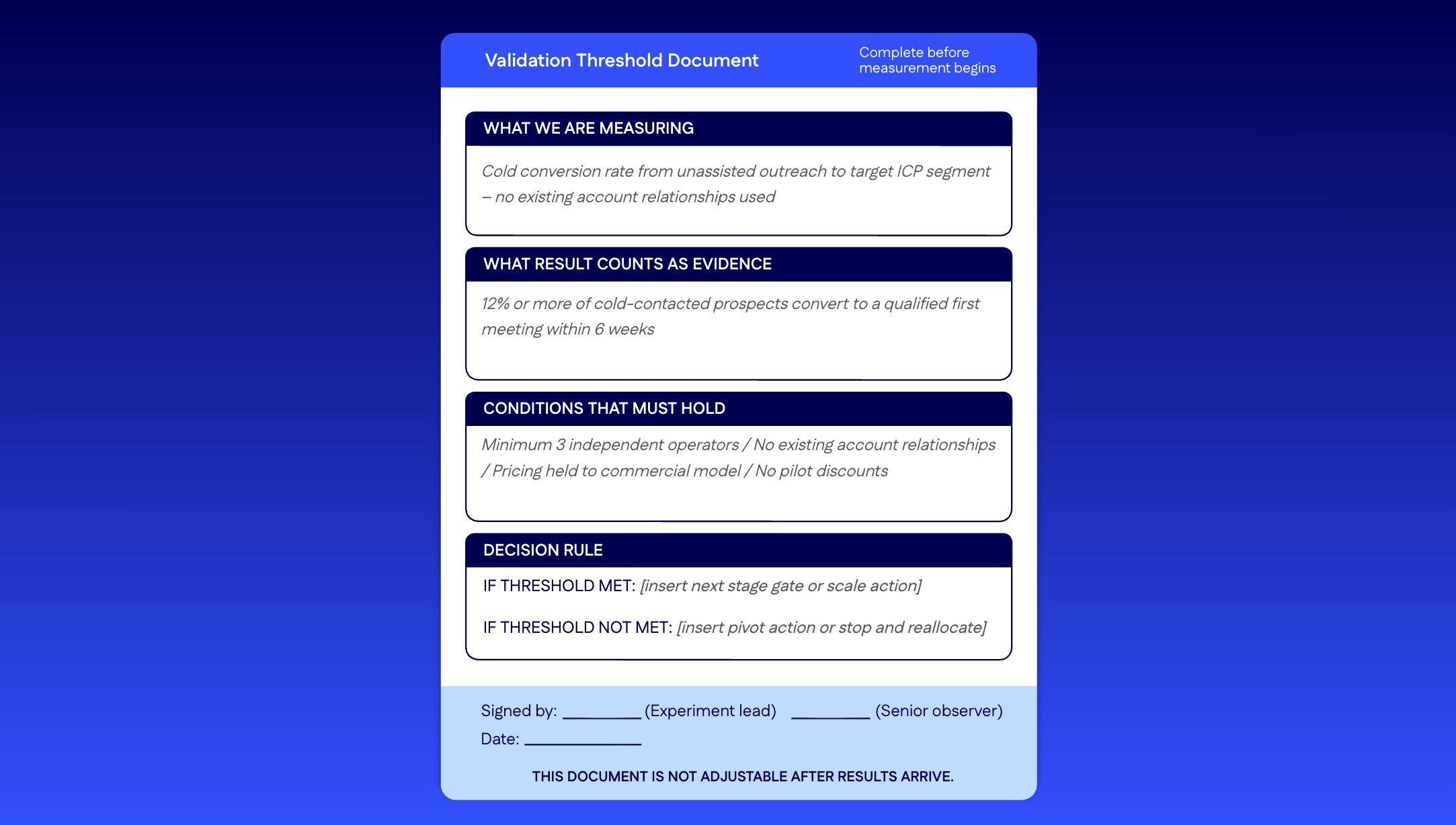
The demand signal hierarchy gives you the four levels at which to set validation thresholds. Each level represents a different quality of evidence, demands a different type of instrument, and tells you something different about whether the market has genuinely responded to what you're offering.
-
Awareness – does the problem register with your target customer without prompting? This is qualitative, and it's the lowest level of signal. It tells you the problem space is real, not that your solution has a claim on it.
-
Interest – will they engage when approached? Meeting acceptance rates, inbound enquiry rates, response rates to cold outreach. Directional.
-
Intent – will they commit resources speculatively? Paid pilots, signed letters of intent, pre-orders. This is where real signal begins.
-
Commitment – will they pay, renew, and refer without being prompted? Repeat purchase behaviour and unprompted referral are the strongest demand signals available.
The problem we see consistently is that organizations validate at the awareness or interest level and call it done. A few customers agree the problem is real. Several take a meeting. That's confirmation that your hypothesis isn't obviously wrong. Intent and commitment evidence is what actually de-risks a scale decision.
One question per stage: stage-appropriate metrics for corporate ventures
Stage-appropriate metrics for corporate ventures start with a single discipline: at each stage of validation, one metric carries the decision, supported by a small set of guardrails agreed in advance. Tracking eleven indicators simultaneously produces noise, so the organizations that validate effectively narrow their focus to one primary decision metric that answers the primary question at each stage. Alongside it, they fix a handful of guardrails, conditions on things like data quality, unit economics, or customer concentration, that stay in place regardless of what the primary metric shows. This keeps the simplicity of a single decision metric while catching the scenario where optimising for that one number starts costing the business somewhere else. Everything beyond the primary metric and its guardrails can remain informational.
This is the One Metric That Matters principle applied to validation, not growth. At the hypothesis stage, the question is whether the problem exists at scale – qualitative demand density answers that.
-
At the early signal stage: will anyone engage without the brand advantage? Cold conversion rate.
-
Channel validation: is the motion repeatable across operators? CAC consistency.
-
Pre-scale: do the unit economics hold at volume? CAC-to-LTV ratio and payback period trajectory.
Each of these stages maps directly to the channel and customer validation work covered in Go-to-Market Validation and Customer Validation. The distinction here is that those articles address what to test – this one addresses how to know when you've passed.
Leading vs. lagging indicators at the validation stage
The leading vs. lagging distinction matters more at the validation stage than at any other point in the development cycle. Lagging indicators – revenue, customer lifetime value, renewal rate – confirm that a threshold was passed. By the time they arrive, the decision has already been made.
Leading indicators – Day 7 retention, pipeline conversion rate, organic referral rate – predict whether you're on trajectory to pass the threshold before the window closes. They give you the chance to course-correct while the experiment is still running.
The practical discipline is this: use leading indicators to make in-flight decisions, and lagging indicators to confirm the decision you already made. Using lagging indicators to validate is like reading the score after the match and asking whether you should have trained harder. The game has ended.
Why corporate assets can suppress the signal you need
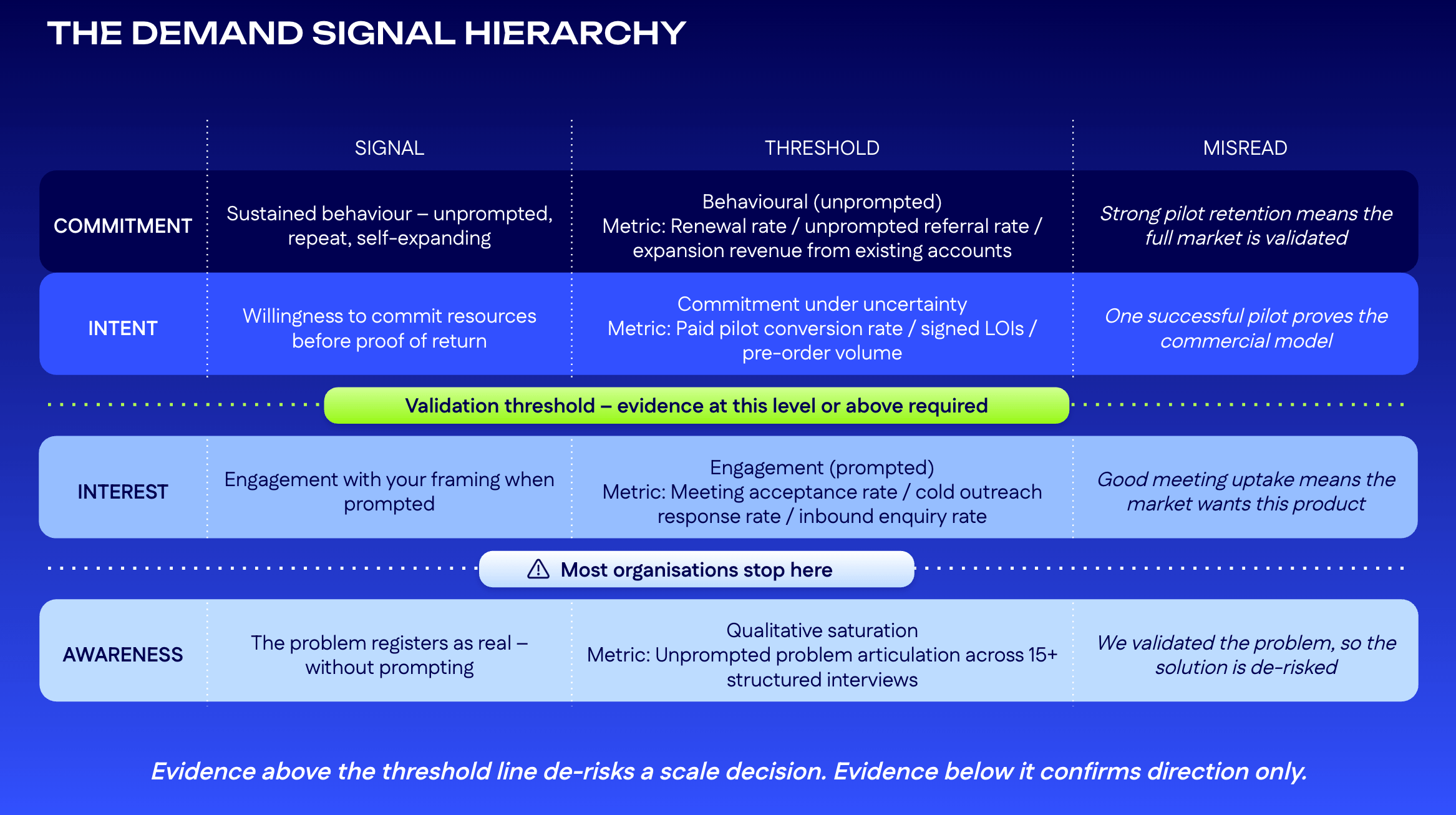
Corporate assets can suppress the validation signal you need in a specific way. When a new venture operates with access to the parent company's brand, established relationships, and existing distribution, it becomes very difficult to isolate whether demand exists for the new product or for the relationship context it's being sold through.
A pilot closes because a sales director has a 12-year relationship with the procurement lead. Another succeeds because the parent brand carries enough trust that customers will trial things they wouldn't otherwise engage with. Both look like positive signals. Neither validates the new venture's commercial motion on its own terms.
What you've validated in those scenarios is the parent company's relationship equity. That scales with the people who held the relationships. So when those people aren't in the room, or when you move to a new geography or customer segment, the signal disappears.
The test is isolation. Can the motion work when the relationship advantage is removed? Does it convert through cold channels, with operators who have no prior connection to the account? These are harder experiments to run. They're also the only ones that tell you whether you have something that can stand on its own terms.
Validation lives in a file, not in a feeling
Scale on evidence demands one thing most organisations find genuinely difficult: holding the threshold you set at the start when the results land just below it. This is where validation discipline either holds or collapses – and it almost always collapses in the same direction.
Results come in at 80% of the threshold. Someone says the market was slow that quarter. Someone else points out that the operator was new. All of those observations might be true. None of them change the result relative to the pre-set condition. The threshold existed to remove this negotiation from the decision.
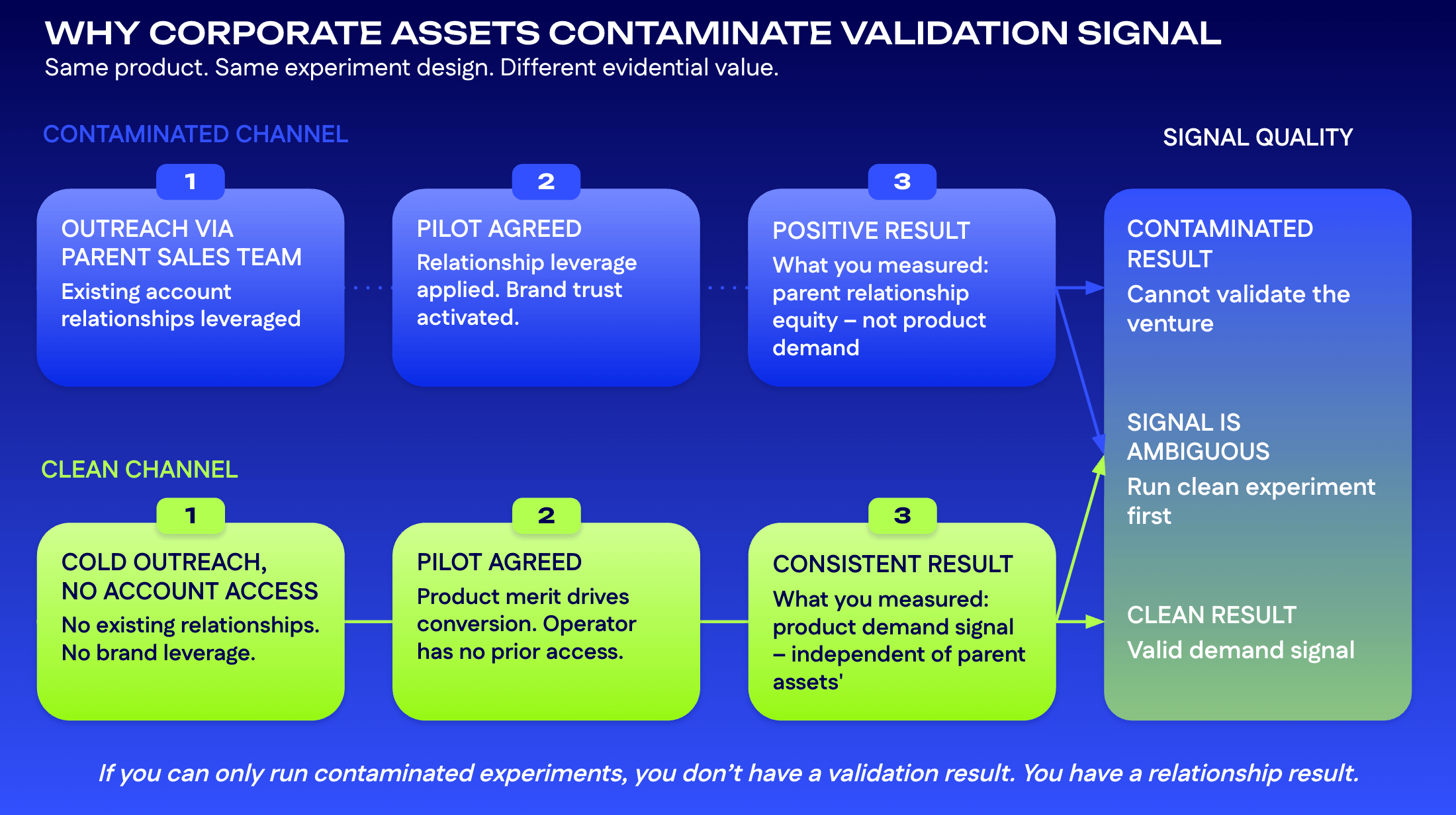
The pre-commitment mechanism that actually works is simple. Document the threshold and the decision rule before the experiment begins, and include a senior observer who signs off on both. When results arrive, the decision meeting is short: either the threshold was met or it wasn't. What follows is a scale commitment or a stop – not a discussion about whether the conditions were fair.
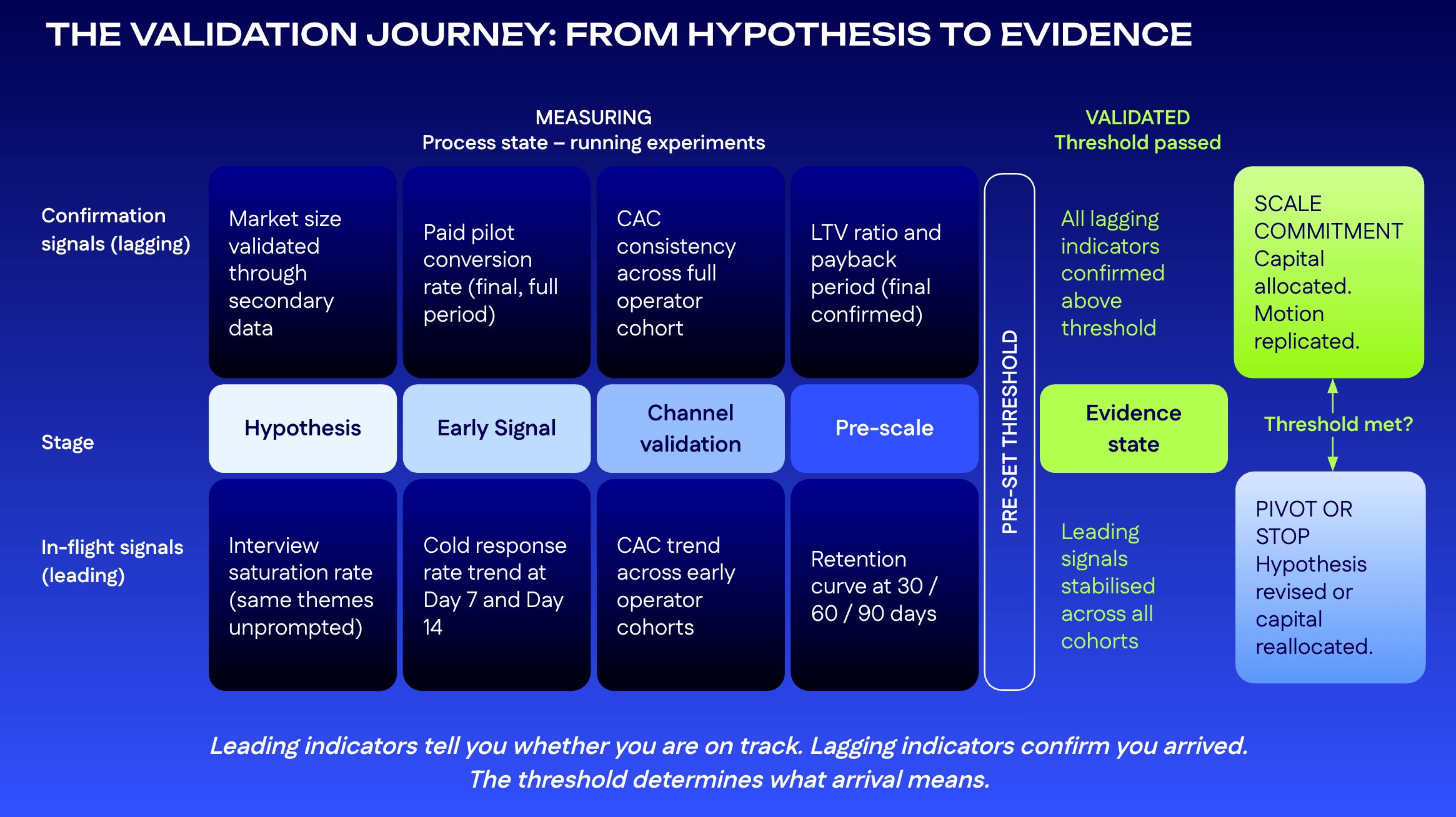
Think of validation as a file, not a feeling. Inside it: a pre-set number, a defined time window, a documented result. The practical work of setting thresholds and designing experiments that isolate the signal happens before any data arrives. Get that setup right, and the scale decision makes itself.
If your innovation programme is approaching a scale decision and the evidence is still in someone's gut, we should talk.
At Bluemorrow, we help corporate teams design the measurement infrastructure that makes that decision defensible – threshold setting, experiment design, and evidence standards that hold up in an investment review.
Book a 15-minute call with Lilian Hörler, our Manager in Innovation & Venture Design — no agenda, just a conversation about where your program stands and what the next step might look like.