
Most innovation teams that run customer discovery come back with encouraging results. Customers recognized the problem, found the concept interesting, said they'd likely use something like this. Three months later, the product goes to market and the signal doesn't hold.
That’s exactly the customer validation failure.
Customer validation is the structured process of finding out whether a real, prioritized problem exists before you design any solution. The goal is evidence that the problem is painful enough and high enough on the customer's priority list to trigger a real purchasing decision.
Corporate discovery processes fail in predictable ways. The team running the interviews is usually also advocating for the project. The customer in B2B is almost never a single person. And most interview techniques are better at producing agreement than generating real behavioral evidence. This article addresses all of those failure modes.
What customer validation is – and what substitutes for it
Customer validation is a discipline. Activities produce outputs: interview transcripts, survey summaries, stakeholder sign-off. Disciplines produce defensible conclusions. The question that actually matters is whether you now have evidence that a real, prioritized problem exists – and most organizations never get there.
For how discovery evidence connects to broader demand signals, see Market Demand Validation: How to Know If a Real Market Exists Before You Invest.
The substitutes that don't count
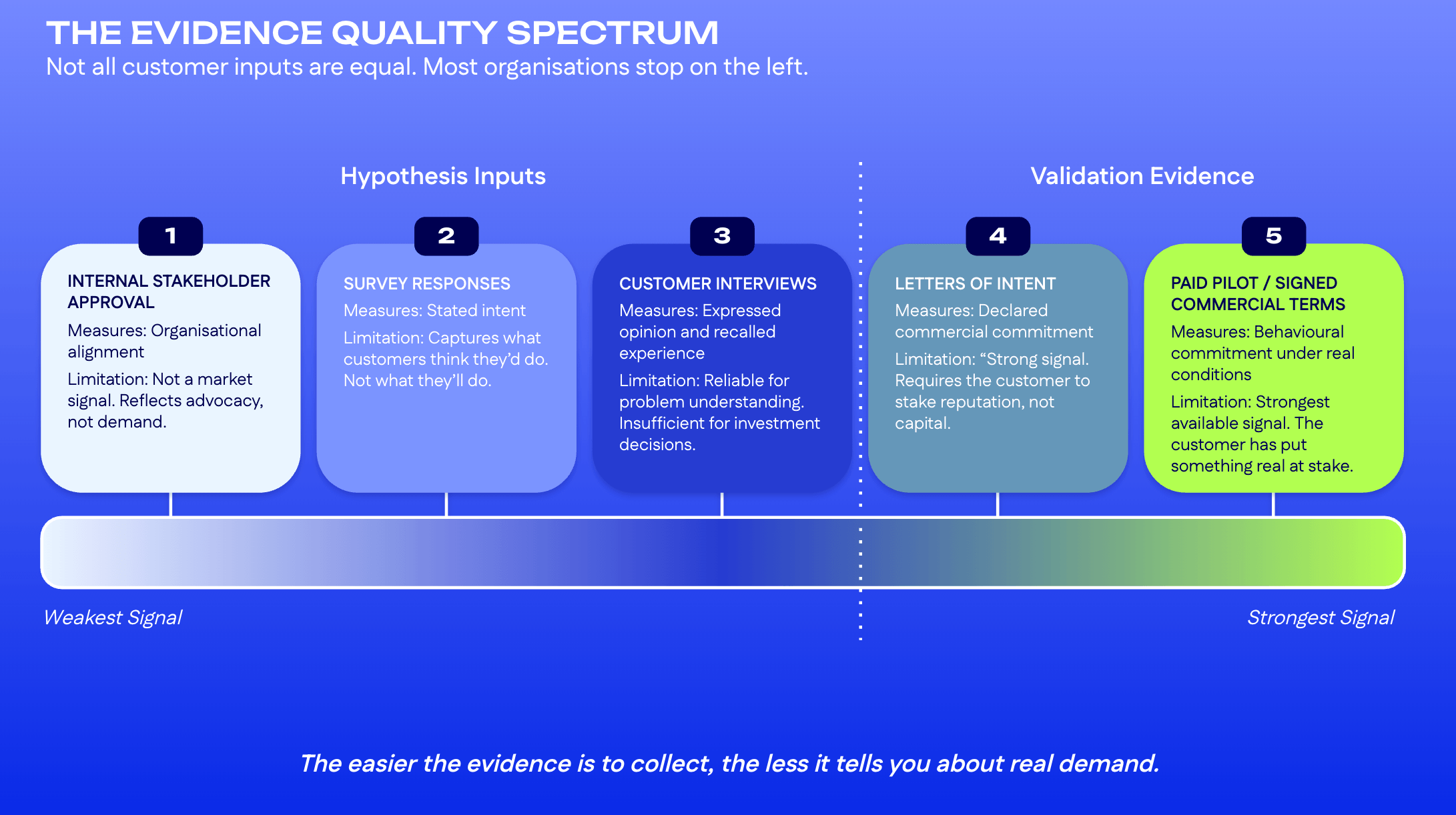
Most substitutes for customer validation feel like evidence precisely because they're familiar. Surveys measure stated intent: what customers think they'd do in a hypothetical scenario. Focus groups produce socially mediated outputs, where individual opinions get flattened by group dynamics, dominant voices, and the human tendency to be agreeable in a room full of strangers.
Internal stakeholder approval tells you something about organizational politics, but it tells you nothing about the market. And feedback from existing customers, while valuable for other purposes, is structurally biased when you're testing demand for something new. Your existing clients are being supportive of a relationship, but they're not committing to a new purchase.
Each of these is useful for something, but none of them is customer validation.
The experiments that generate this kind of evidence are covered in Commercial Validation Methods: How to Choose the Right Experiment for Your Context.
The framework that makes discovery rigorous
Jobs to Be Done is the framework that makes customer discovery rigorous. Rather than asking what customers want, it asks what they are trying to accomplish. That distinction is more predictive than any feature analysis, because the underlying job stays stable even when the solutions that perform it change. It's the right lens for identifying real pain before you build.
The framework originates with Clayton Christensen's work in Competing Against Luck. At its core: customers don't buy products. They hire solutions to do a job.
What Jobs to Be Done means in practice
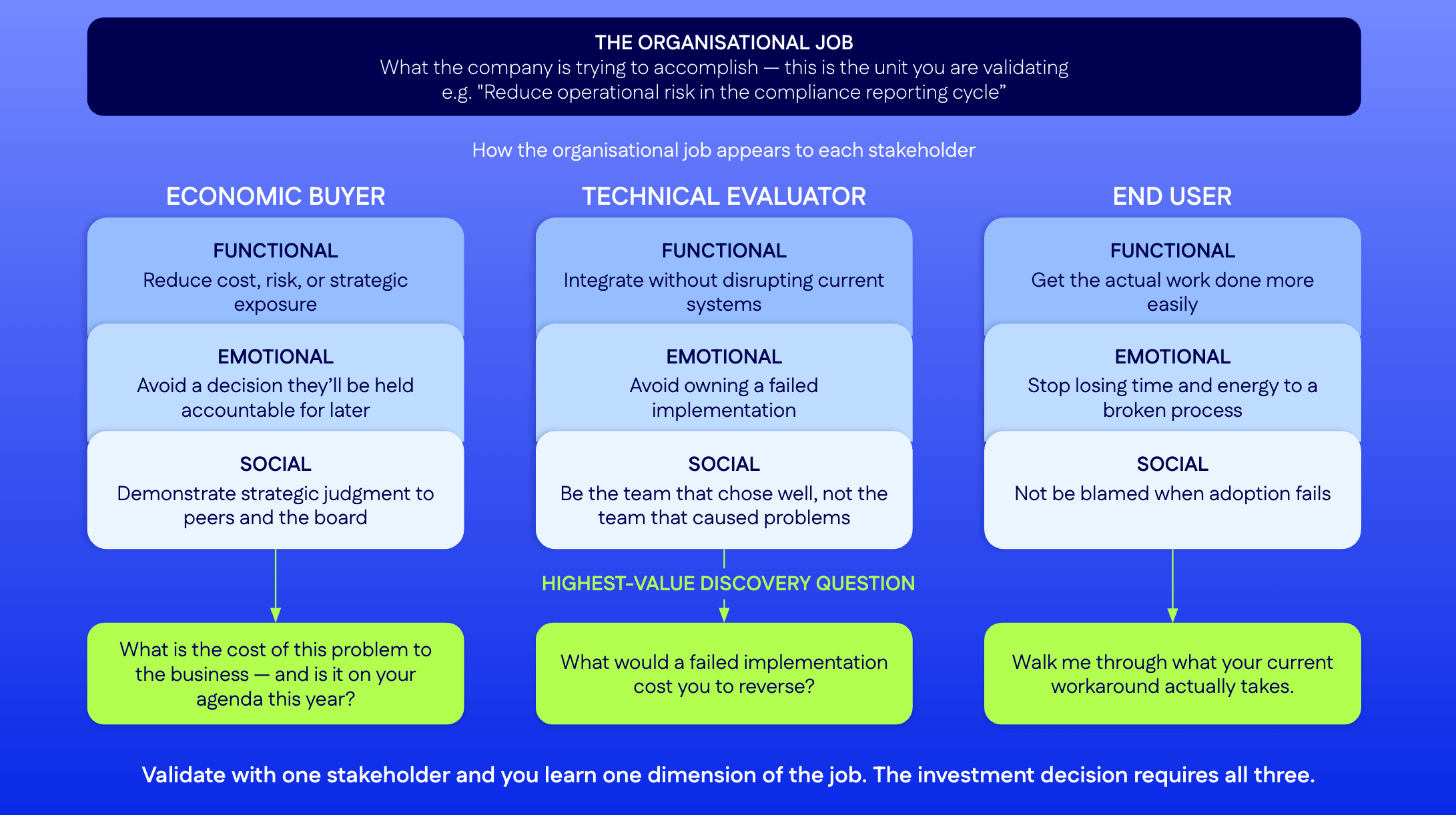
Jobs to Be Done identifies three dimensions in every customer job: what the customer needs to get done (functional), how they want to feel while doing it (emotional), and how they want to be perceived by others (social). In consumer contexts, emotional and social dimensions often dominate. In B2B, functional jobs tend to drive the purchasing decision, but emotional and social dimensions are often what make a buying committee say yes or no.
Customers can't always describe the job clearly. Ask someone why they chose a particular enterprise platform and they'll describe features. Push harder and you'll find the real job: reduce the risk of a regulatory audit, give the CFO confidence, avoid a conversation the CTO doesn't want to have. Those are the jobs that actually govern decisions.
Applying Jobs to Be Done in B2B corporate contexts
In B2B, the job is usually organizational rather than individual. A company needs to reduce operational variance, accelerate a compliance cycle, or demonstrate capability to a board that has started asking questions. Individual stakeholders experience different dimensions of that organizational job depending on their role.
This is where most discovery goes wrong. Framing questions around a proposed solution pulls the conversation away from the customer's actual situation. Start with what the customer is doing today, what it costs them, and what they've already tried. That's where the real job surfaces.
The buying committee is a validation challenge, not just a sales structure
The buying committee in B2B makes customer validation structurally more complex than startup-derived frameworks acknowledge. The person who experiences the pain most directly is rarely the person who controls the budget. The person who controls the budget often doesn't fully understand the operational reality. And the people who'll use the solution every day have a different set of concerns from both.
This is a validation challenge before it's a sales challenge. Discovery with one stakeholder produces a partial picture. Base an investment decision on it, and you're likely to discover the other stakeholders at exactly the wrong moment.
Three stakeholders, three different pain points
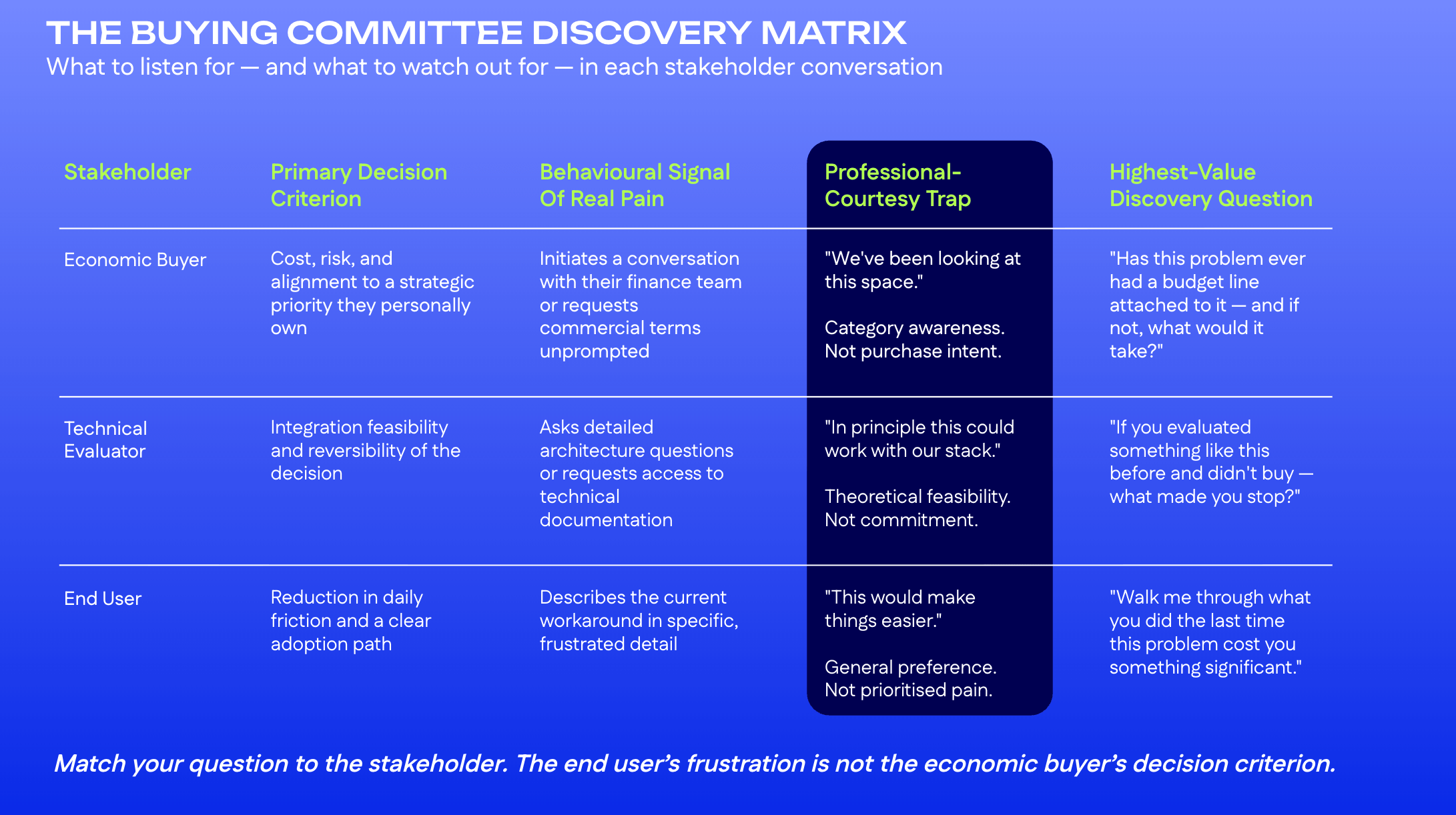
Each of the three stakeholders in a typical B2B buying committee brings different pain, different decision criteria, and a different definition of success. The economic buyer cares about cost, risk, and strategic fit, they need to see a connection to something they're already accountable for. The technical evaluator is thinking about integration complexity and implementation burden. The end user is focused on their day-to-day workflow.
These perspectives don't always point in the same direction. An end user who is deeply frustrated with the status quo might be your strongest advocate. But if the economic buyer sees the problem as low priority and the technical evaluator sees integration as high risk, that advocacy won't close anything.
Map the committee before you run a single interview
Before you design your discovery process, map the buying committee for your target segment. Who holds economic authority? Who owns the technical evaluation? Who will live with the outcome? That mapping tells you whose pain you need to validate, whose objections you need to surface early, and what questions are appropriate for each conversation.
Conflicting signals across the committee are themselves useful data. If end users are enthusiastic and economic buyers are indifferent, you've learned something important about where the real obstacle lives.
The Advocacy Distortion Problem
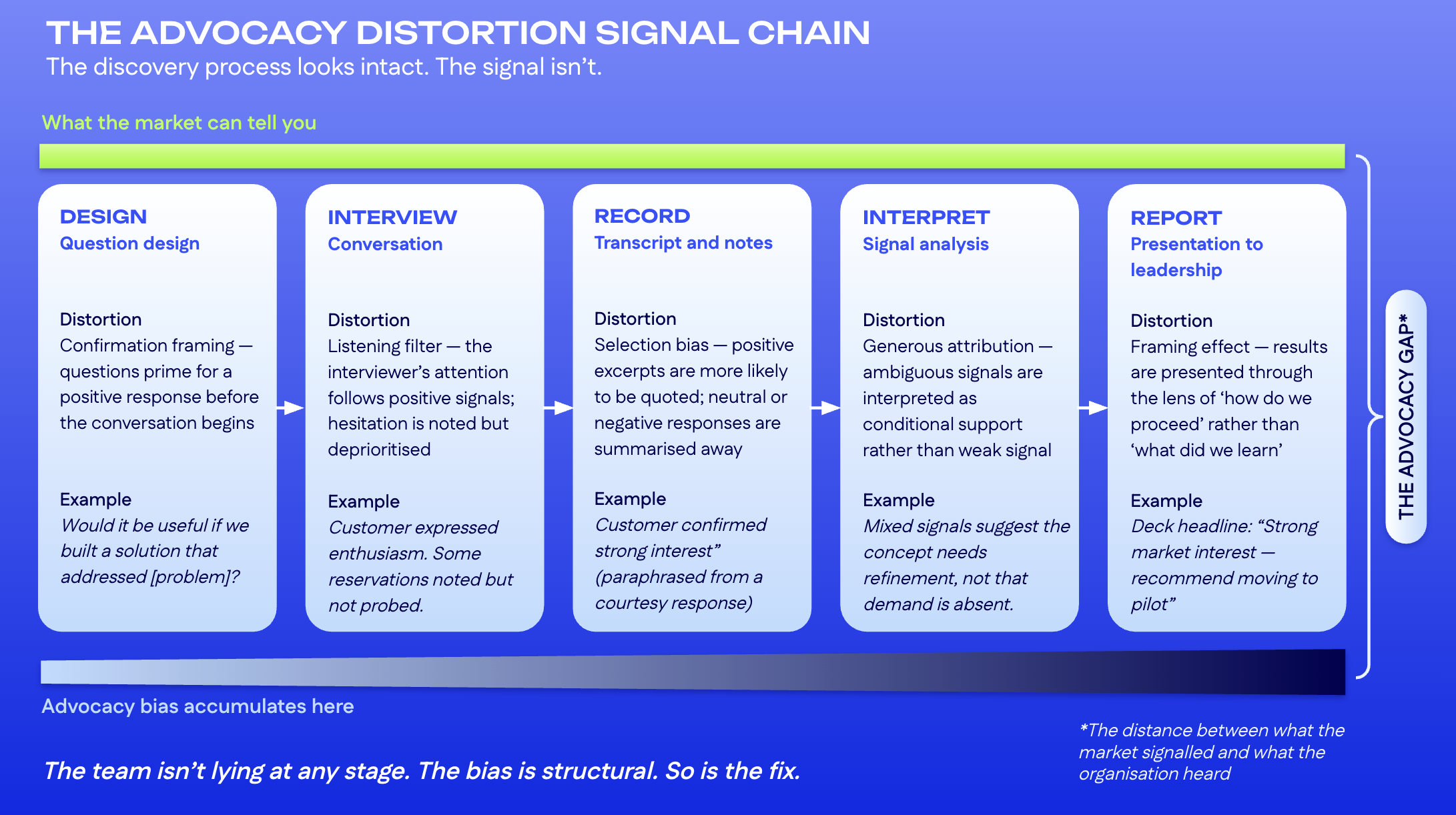
The Advocacy Distortion Problem sits at the center of corporate customer discovery. The team running the interviews is usually also the team that wrote the business case, briefed senior stakeholders, and has reputational skin in the outcome. That structural overlap shapes everything that follows.
People invested in a concept naturally interpret ambiguous signals generously and frame questions toward confirmation. Hesitation gets noted but deprioritised. Signals that challenge the hypothesis rarely make it into the summary deck, absorbed into a narrative that was already forming before the first interview started.
The pattern persists because it is organizationally rational. Corporate innovation teams are evaluated on their ability to advance initiatives, and discovery that produces a clear stop is rarely celebrated, even when it saves the organization from a costly commitment.
How it plays out
The Advocacy Distortion Problem plays out at two stages: question design and signal interpretation.
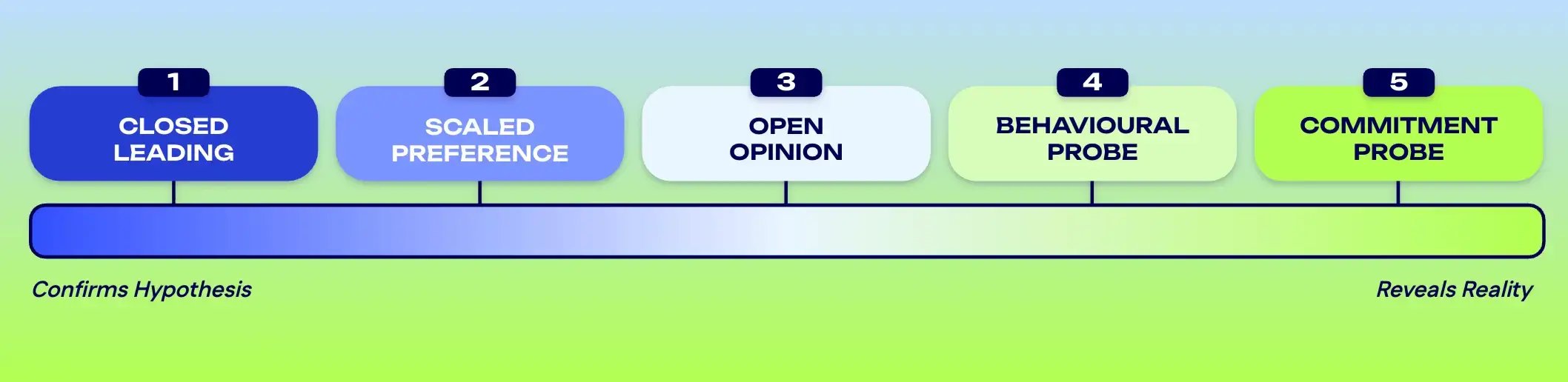
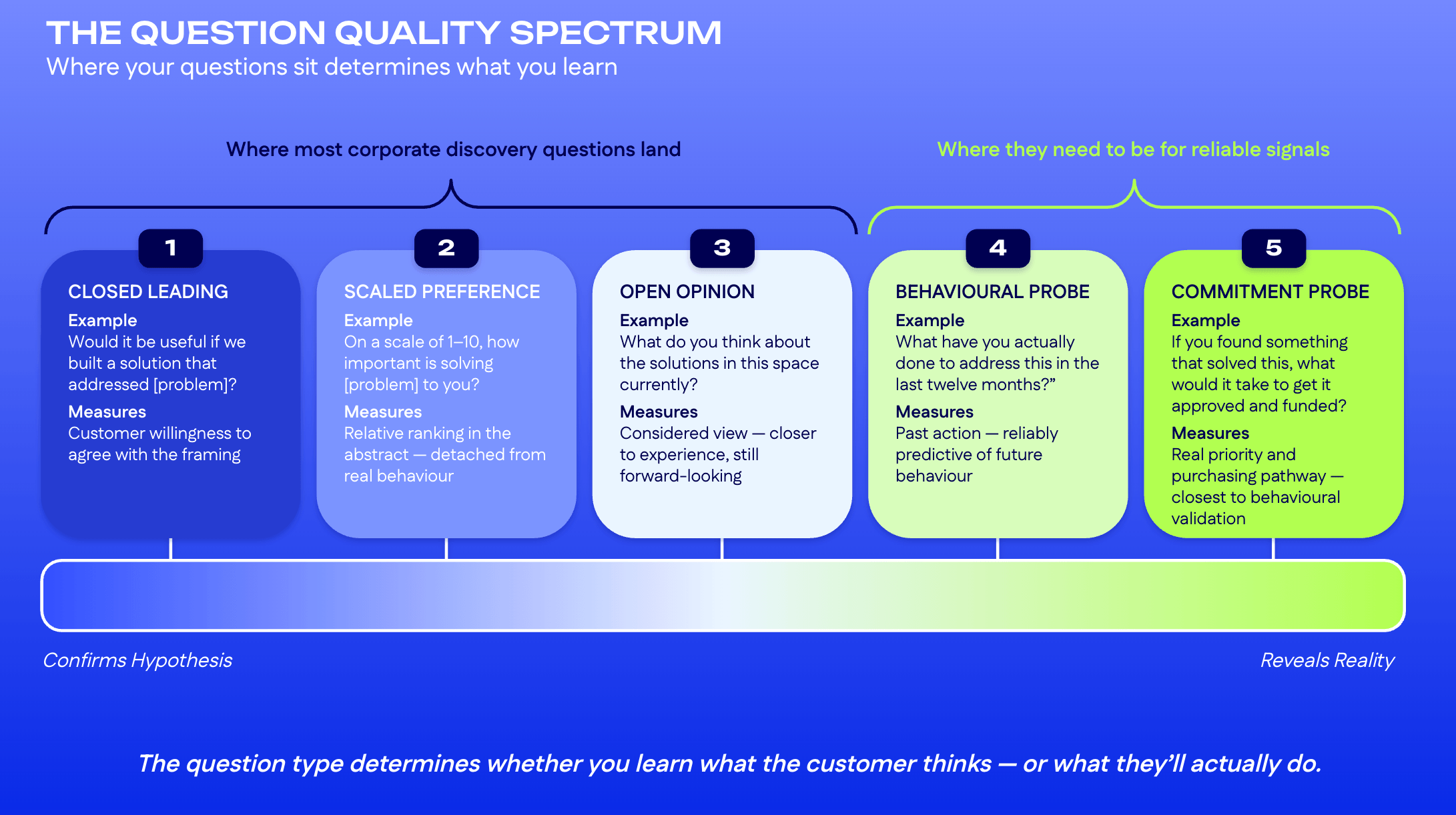
In question design, framing like "Would you find it useful if we built something that..." or "On a scale of one to ten, how interested would you be in a solution that addressed this problem?" pulls the customer toward a positive response before the conversation has found its footing. The answer you get reflects the framing, not the reality.
In signal interpretation, a customer who says "this is interesting, I could see a use case" is being professionally collegial. That kind of response gets regularly transcribed as evidence of demand and the gap between the two is where investment decisions go wrong.
The structural fix
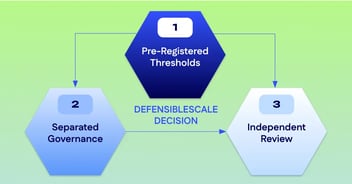
The structural fix to the Advocacy Distortion Problem is a governance intervention. Reminding the team to be more objective doesn't work; the bias is structural. The solution is to separate the people who run discovery from the people who advocate for the project.
At minimum: define your interpretation criteria before the interviews happen. What response patterns would constitute evidence of genuine pain? What would a "no" look like in this conversation? What signals would cause you to stop the project? Set those parameters in advance, and the results have somewhere honest to land.
Designing that governance structure is a core part of our ideation and market validation work.
How to design discovery interviews that generate honest signal
The quality of what you learn in a customer interview depends almost entirely on how the questions are designed. Most discovery conversations are structured around the solution concept, which means they generate feedback on an imagined product rather than evidence about a real problem.
A simple rule: keep the solution out of the conversation for as long as possible.
Question design that reveals rather than confirms
Question design is what separates discovery that surfaces real pain from discovery that confirms what the team already believes. The most reliable questions focus on past behavior rather than future intent. "What have you done to try to solve this problem in the last twelve months?" will tell you more than "Would you be likely to buy a solution for this?". The first describes something the customer actually did. The second invites speculation.
Probe for priority with budget and behavior, not with ratings. Has this problem ever had a budget line attached to it? Has the team evaluated alternatives and decided not to buy? Why not? What would have to change for this to move up the list? Those questions surface priority in a way that "How important is this to you?" never will.
Reading what customers actually mean
Reading what customers actually mean requires getting past professional courtesy, which is the natural default in executive conversations. Experienced leaders are trained to be constructive, collegial, and non-committal. "This is something we've thought about" means they've heard of the category, not that they're in the market. "I could see this being valuable for teams like ours" means the concept is plausible, not that anyone would buy it.
The signals that indicate real pain look different:
-
The customer volunteers specific, recent examples without being asked.
-
They name what the problem has cost them in concrete terms.
-
They ask about timeline or pricing before you raise it.
-
They push back on your framing because they have a better description of the problem.
-
They want to stay on the topic when you try to move on.
Specificity and urgency are what separate a market from an interesting idea.
Pain priority versus pain awareness
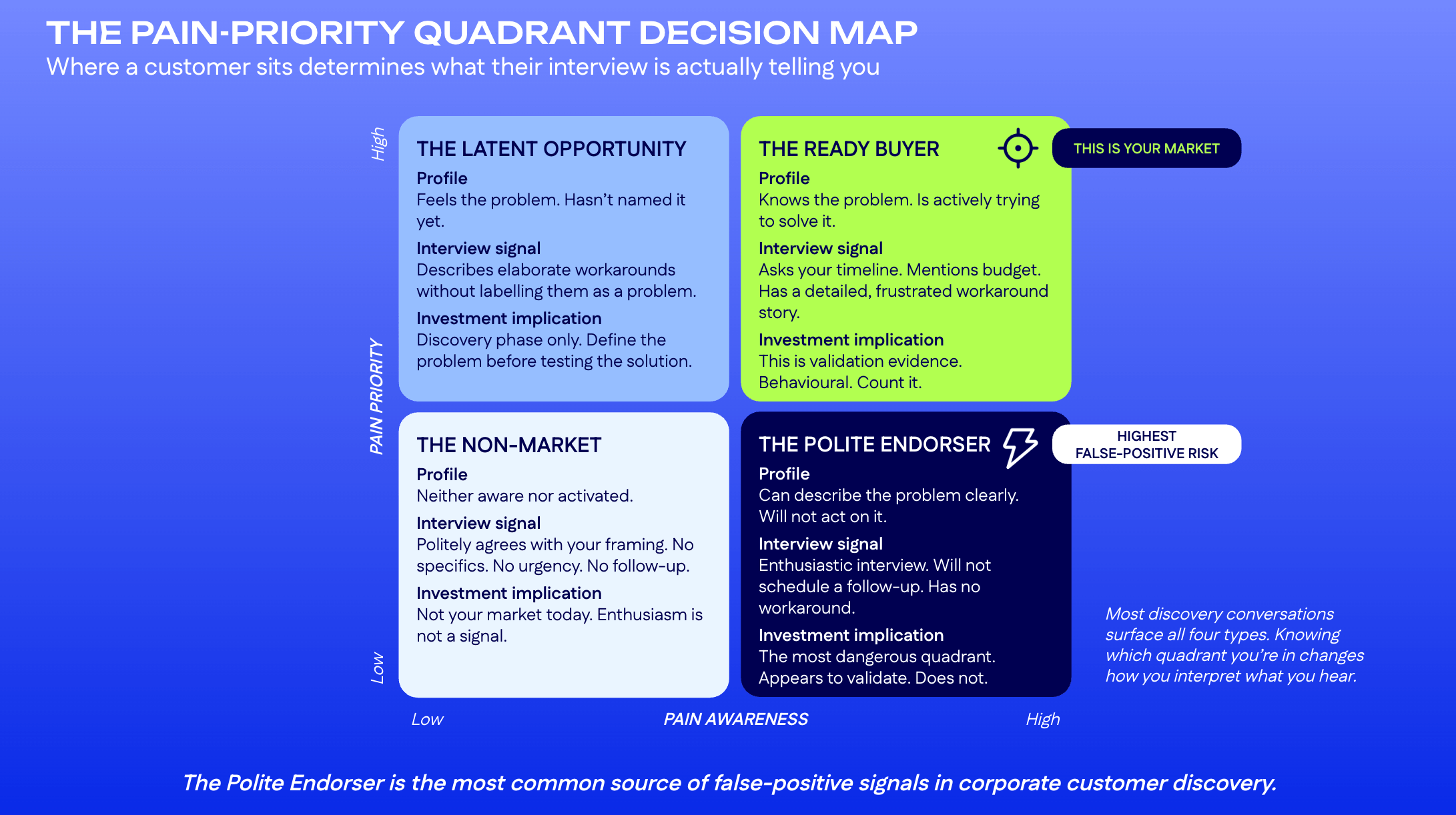
Pain priority versus pain awareness is the most underappreciated distinction in customer discovery. A customer who recognizes that a problem exists is not the same as a customer who is ready to act on it. Conflating the two is the most reliable source of false-positive signals in corporate discovery.
Every market has customers who can describe a problem clearly, validate that it's real and persistent, and still not be a viable buyer. The cost of the status quo is manageable. The risk of changing workflows or vendors is higher than the pain of staying put. They'll give you an enthusiastic interview. They won't sign anything.
To surface priority rather than awareness, bring the conversation to behavior. Has the team ever allocated a budget to address this? Have they evaluated competitors and decided not to buy? Do they have a workaround, and how elaborate is it? A customer with a detailed, hard-won workaround is telling you they've prioritized the problem. They just haven't found a solution they trust yet. That's your market.
What sufficient customer validation evidence actually looks like
Customer validation is complete when behavioral evidence meets a threshold defined before the process begins. Setting that threshold in advance matters because organizations that define "sufficient evidence" after seeing the results will find the threshold the results support – motivated reasoning is a structural risk, and the timing of the definition is the structural fix.
Behavioral evidence in B2B customer validation has a recognizable shape. A customer who schedules a follow-up with their economic buyer. A prospect who asks for commercial terms unprompted. Someone who pushes back on pricing because they are genuinely working out whether it fits their budget.
Signed letters of intent with price terms are the clearest signal available before a paid commitment. Both LOIs and paid pilot agreements require the customer to put something real at stake – reputation, budget, or time – and that cost is what gives the signal its weight. A well-designed discovery process produces one of three outcomes: the evidence meets the threshold and you proceed, it challenges a specific assumption and you pivot, or the signal is absent and you stop. All three are useful. The clean stop, though, is only available to teams that defined what "enough" looks like before the interviews began.
At Bluemorrow, we help organizations move from innovative concepts to validated market opportunities – combining customer insights, market dynamics, and iterative testing to build a business case grounded in real evidence. If your team is ready to put that process in place, talk to Lilian Hörler.