
Most corporate innovation teams reach for the same small set of validation methods regardless of what they're testing or how early they are in the process. Interviews for everything. Surveys when speed matters. A focus group when leadership wants to feel consulted.
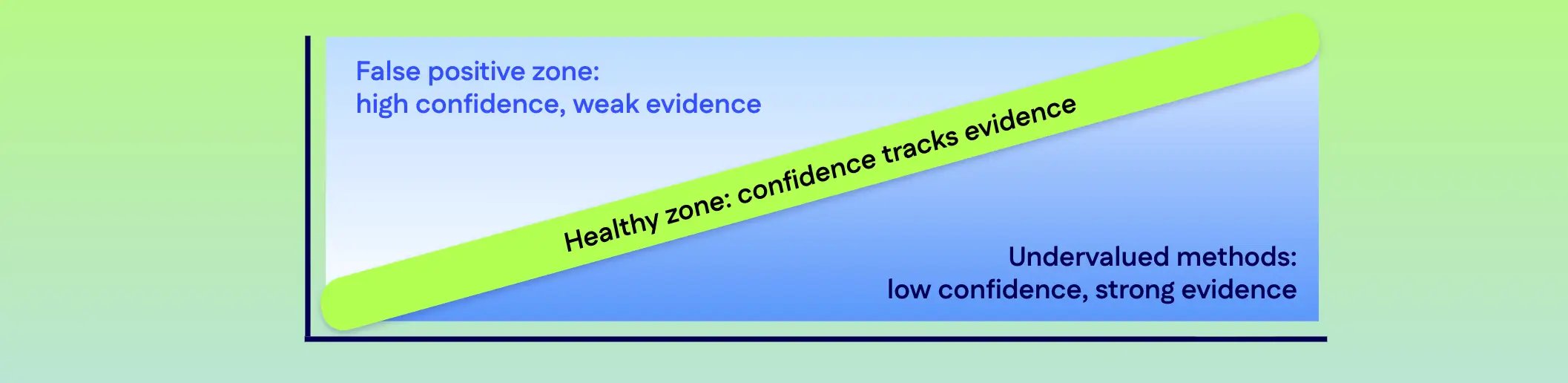
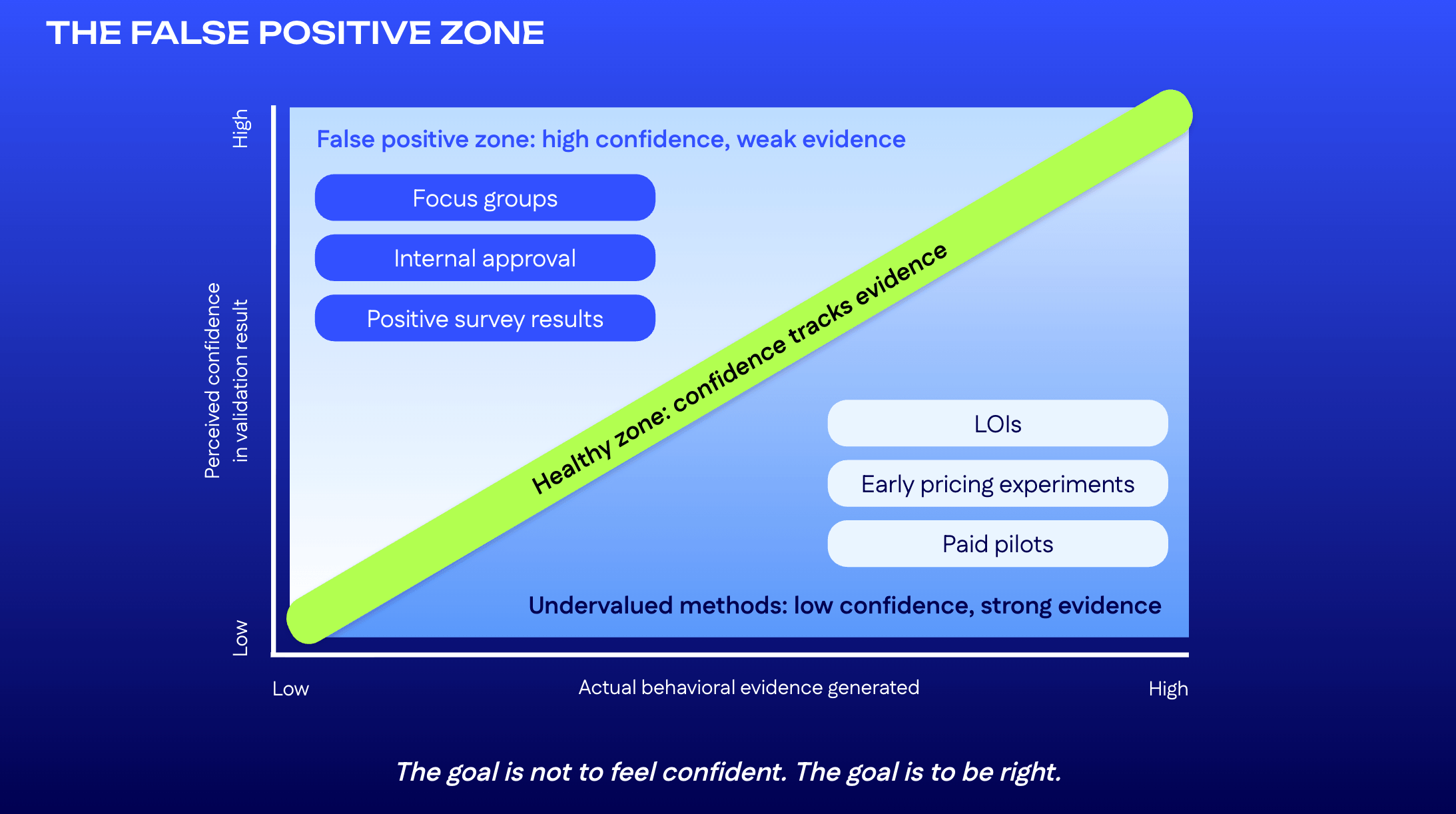
The result is the wrong data, interpreted with false confidence. An 80% positive concept test looks like a green light. But stated preference and actual purchasing behavior aren't the same thing, and conflating them is one of the most common and costly mistakes in corporate innovation.
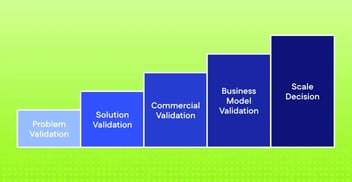
Commercial validation methods are the structured experiments and research approaches you use to generate real-world evidence of commercial viability before committing capital to build. The choice of method determines the type of signal you generate. This article gives you a practical logic for making that choice and for how each method connects to the broader commercial validation framework.
The method is not neutral
The method is not neutral, and choosing the right one matters more than most validation guides acknowledge. Every validation method generates a specific type of signal. And every method has a failure mode that produces confident-looking results from the wrong kind of data.
Interviews reveal motivations and decision logic. They can't tell you how many people share a problem, or what they'll actually pay. Surveys measure stated preferences, which consistently overstate purchasing intent. Landing pages generate behavioral click data, but assume your buyer discovers solutions through web search. Most B2B enterprise buyers don't. Concept tests measure initial appeal, not commitment.
The issue is treating methods output as commercially meaningful regardless of whether the method was designed to answer a commercial question.
Before choosing a method, map the assumptions behind your solution. Every innovation hypothesis rests on a stack of beliefs about the problem, the customer, the price, and the channel. Hypothesis mapping is the practice of making those beliefs explicit – writing out every assumption the business case depends on, and being honest about how much evidence sits behind each one.
Prioritization follows from that inventory. Rank each assumption across two dimensions: how confident you are that it holds, and how much it would damage the investment case if it turned out to be wrong. The assumptions with low confidence and high business impact are the ones to test first – regardless of how easy or uncomfortable they are to test. A team that skips this step tends to test what is accessible rather than what is critical, and accumulates evidence that confirms peripheral beliefs while leaving the load-bearing assumptions untouched.
That priority order determines your experiment sequence. The method comes last – chosen to fit the specific assumption you are testing, the stage you are at, and the organizational constraints you are working within. A customer discovery interview and a paid pilot are both valid methods. Which one belongs in Week 2 and which belongs in Week 14 depends entirely on which assumption carries the most risk right now.
Two families of validation methods
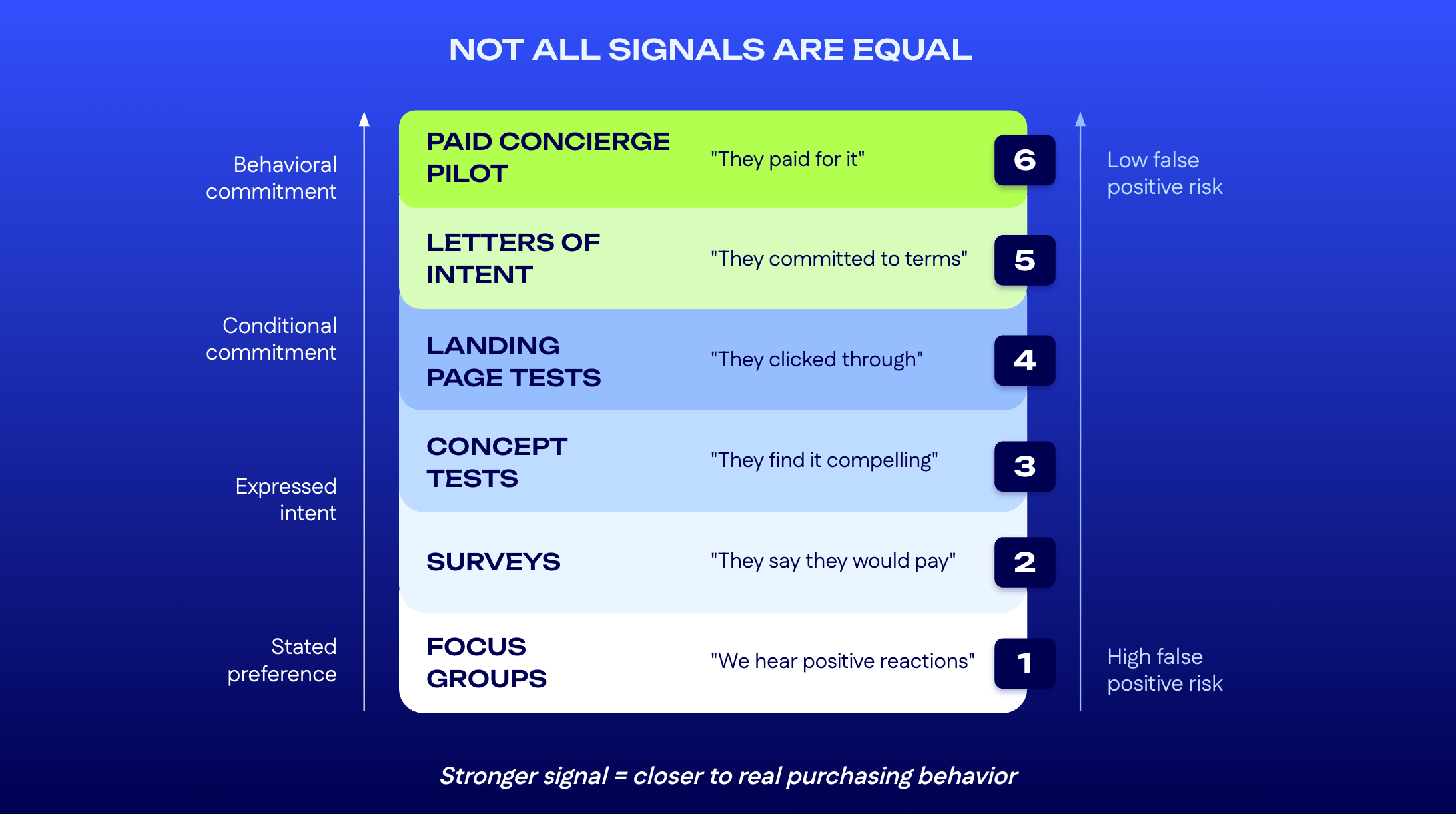
Two families of validation methods underpin almost everything in this space, and understanding the distinction between them is the prerequisite to good method selection. Each is built for a different kind of question, and confusing them is what generates impressive-looking data that doesn't actually answer what you needed to know.
Qualitative methods: what they're for
Qualitative methods, including customer discovery interviews, ethnographic observation, and expert panels, are designed to understand what's happening and why. They're best used early, when the hypothesis itself is still uncertain. What problem are customers actually trying to solve? Why do they behave the way they do – what drives the workarounds they've built, the decisions they make, the alternatives they've already tried and abandoned? How do they decide? What would cause them to switch?
They generate rich insight. But they can't tell you how many people share a given view, or what percentage would convert. Used too late, to answer questions that need behavioral evidence, they produce warm, encouraging signal that sends teams confidently in the wrong direction.
In B2B contexts, qualitative methods also need to reach the buying committee, not just the most accessible contact. Economic buyer, technical evaluator, and end user often see the same problem differently, and a discovery process built around whoever answers the email fastest tends to surface the most agreeable view.
This matters because the assumptions behind a business case rarely rest on a single stakeholder's read of the problem. A technical evaluator might confirm the pain is real while an economic buyer quietly has no budget mandate to solve it. Missing that gap early is expensive, often surfacing months later as a stalled deal that traces back to an interview round that felt encouraging at the time. Mapping who needs to be reached, and what each of them would need to see before they'd act, should happen before discovery design starts, not after the first round of interviews comes back encouraging.
Quantitative methods: what they're for
Quantitative methods, including landing page tests, letters of intent, concierge pilots, and live pricing experiments, generate measurable behavioral evidence. They test what people actually do, not what they say they'd do. That distinction matters because commercial validation is ultimately about behavior – what customers will pay for, not what they find interesting in a presentation.
The catch is that they require a specific, well-formed hypothesis to be useful. Quantitative experiments applied too early, before qualitative discovery has sharpened what you're testing, answer the wrong question precisely. You get clean data on an assumption that was never properly examined.
The sequence matters: qualitative methods refine the hypothesis, quantitative methods test it. In our experience working with corporate innovation teams, most method selection failures happen when these two stages get reversed or collapsed.
Validated demand
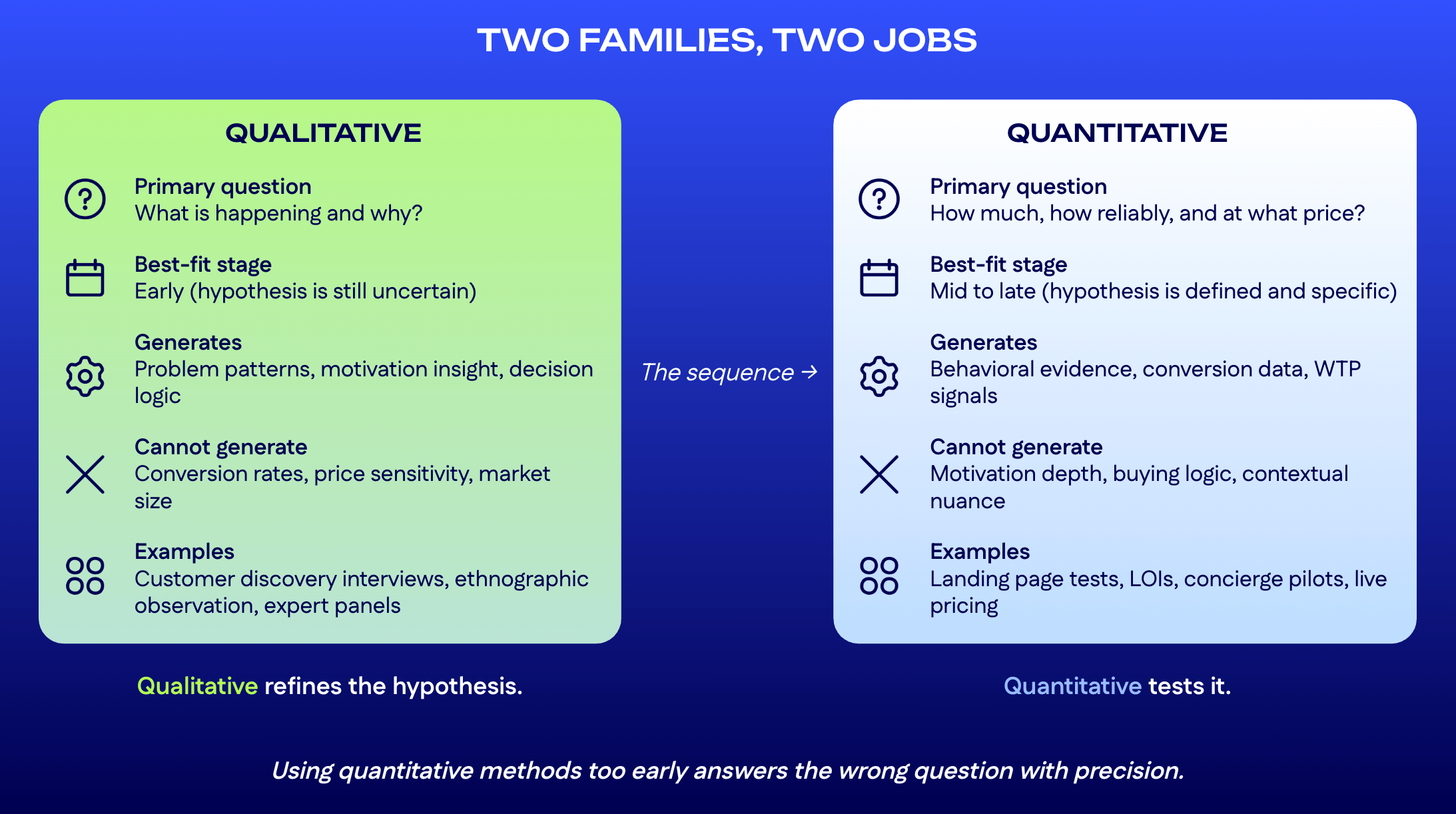
Validated demand is the level that justifies a real capital commitment. Customers have demonstrated through behavior that they’ll choose and pay for your specific offering.
The clearest signal in B2B? A signed letter of intent with commercial price terms. Paid pilot commitments carry similar weight. Both require customers to put something at stake, which is exactly what separates them from a friendly interview.
At this stage, the question shifts from whether demand exists to whether you can build a viable business around it. That’s the threshold for committing meaningful capital.
Core validation methods: a corporate lens
Here's a run through the core validation methods corporate innovators actually use, with the organizational lens that most guides skip. Each method has a use case, a signal strength, and a failure mode. Knowing all three is more valuable than just knowing the method exists.
Customer discovery interviews
Customer discovery interviews are best used at the earliest stage, before any solution design begins. Their job is to surface problem patterns and decision logic – not to confirm assumptions you've already formed.
-
What they test: problem validity, pain intensity, buying behavior, decision criteria
-
When to use them: earliest stage, before any solution design
-
What they can't tell you: market size, or whether customers will actually pay
If you're still at the stage of establishing whether a real market exists at all, market demand validation should come before customer discovery.
The corporate consideration: the people running discovery are often the same people most invested in the project succeeding. That structural conflict biases signal collection in ways that are hard to see from inside the team. Think carefully about who conducts the interviews and who interprets the findings. The process should surface disconfirming evidence as deliberately as it surfaces confirming evidence – and that almost never happens without deliberate design. For a deeper treatment of discovery interview structure and B2B buying committee dynamics, see our article on customer validation.
Concept testing
Concept testing bridges the gap between a problem hypothesis and a solution hypothesis, and it's most useful when you still have design choices to make. Use it to check whether your proposed approach is understood, appealing, and differentiated before committing any engineering resources.
-
What it tests: solution comprehension, initial appeal, first-pass product-market hypothesis
-
When to use it: early to mid-stage, before engineering investment
-
What it can't tell you: behavioral commitment, willingness to pay
The corporate consideration: concept tests run with existing customers reflect the current relationship as much as the concept itself. Make sure you're reaching the actual target segment, which in corporate innovation often means going outside your current account base, even if it's slower and harder to arrange.
Landing page and fake-door tests
Landing page and fake-door tests are among the most cited validation tools in startup circles, and among the most over-applied in contexts where they don't belong. They generate real behavioral demand signals – but only when buyers actually discover solutions through digital channels.
-
What they test: demand signals through behavioral response, click-through, sign-up volume
-
When to use them: mid-stage, primarily for B2C or digital-first B2B offers
-
What they can't tell you: whether organizational buyers will move through procurement
The corporate consideration: in enterprise B2B, buying behavior isn't web-native. Decision-makers don't discover solutions through Google searches, and click-through rates don't predict procurement outcomes. Running a test under your parent brand can also create market expectations you aren't ready to meet. More on that when we get to the confidentiality section.
Letters of intent (LOIs)
Letters of intent ask a named customer to commit to purchase terms before the product exists. That's what makes them one of the strongest commercial signals available in B2B validation – and one of the most consistently underused.
-
What they test: willingness to commit at named price terms, before the product exists
-
When to use them: mid to late stage, especially in B2B contexts
-
What they can't tell you: whether that commitment converts to a signed contract. LOIs aren't binding.
The corporate consideration: LOIs are the strongest commercial signal available in B2B validation short of a paid contract, and they're consistently skipped because they feel premature. They're not. If a potential customer won't sign an LOI at terms that work for your business model, that's information you need before spending six months building.
Concierge pilots
Concierge pilots test the hardest validation question: does the value proposition actually hold when it's delivered? Unlike earlier-stage methods that test interest or intent, a concierge pilot tests real delivery – with a real customer and a real cost.
-
What they test: whether the value proposition actually delivers in practice, at real customer cost
-
When to use them: late-stage validation, before a scaled product build
-
What they can't tell you: whether you can deliver at scale with the same unit economics
The corporate consideration: a concierge pilot is a validation instrument, not an operational launch. Define success criteria, duration, and exit conditions before it starts. Without those definitions, it becomes what we call the Infinite Pilot Problem: a program that never ends because success was never specified upfront. For a full treatment of pilot design and pre-defined success criteria, see testing before you build: pilots, prototypes, and experiments.
Live pricing experiments
Live pricing experiments test the single most important commercial question: what will someone actually pay, right now, for what you're offering? They're consistently the most avoided method in corporate contexts – and one of the most informative.
-
What they test: actual willingness to pay at specific price points
-
When to use them: mid to late stage, once demand has been qualitatively established
-
What they can't tell you: long-term price sensitivity or volume behavior at scale
The corporate consideration: this is the most powerful and most avoided method in corporate contexts. The common objection is that it's 'too early' or that the product 'isn't ready.' That's the point. A customer who pays, even for an imperfect product, is a stronger commercial signal than any number of survey respondents who said they would. The methods for testing price – from Van Westendorp to conjoint analysis to pre-orders – are covered in depth in pricing validation and willingness to pay.
How to choose: the method-context matrix
The method-context matrix is the practical tool for choosing the right validation approach, and it comes down to four variables. Answer these questions before any experiment is designed.
-
What are you testing? Problem existence, solution appeal, price, or channel.
-
What stage are you at? Early hypothesis or late-stage go/no-go.
-
What type of market are you in? B2C, enterprise B2B, or platform.
-
What organizational constraints apply? Brand exposure, procurement timelines, competitive risk.
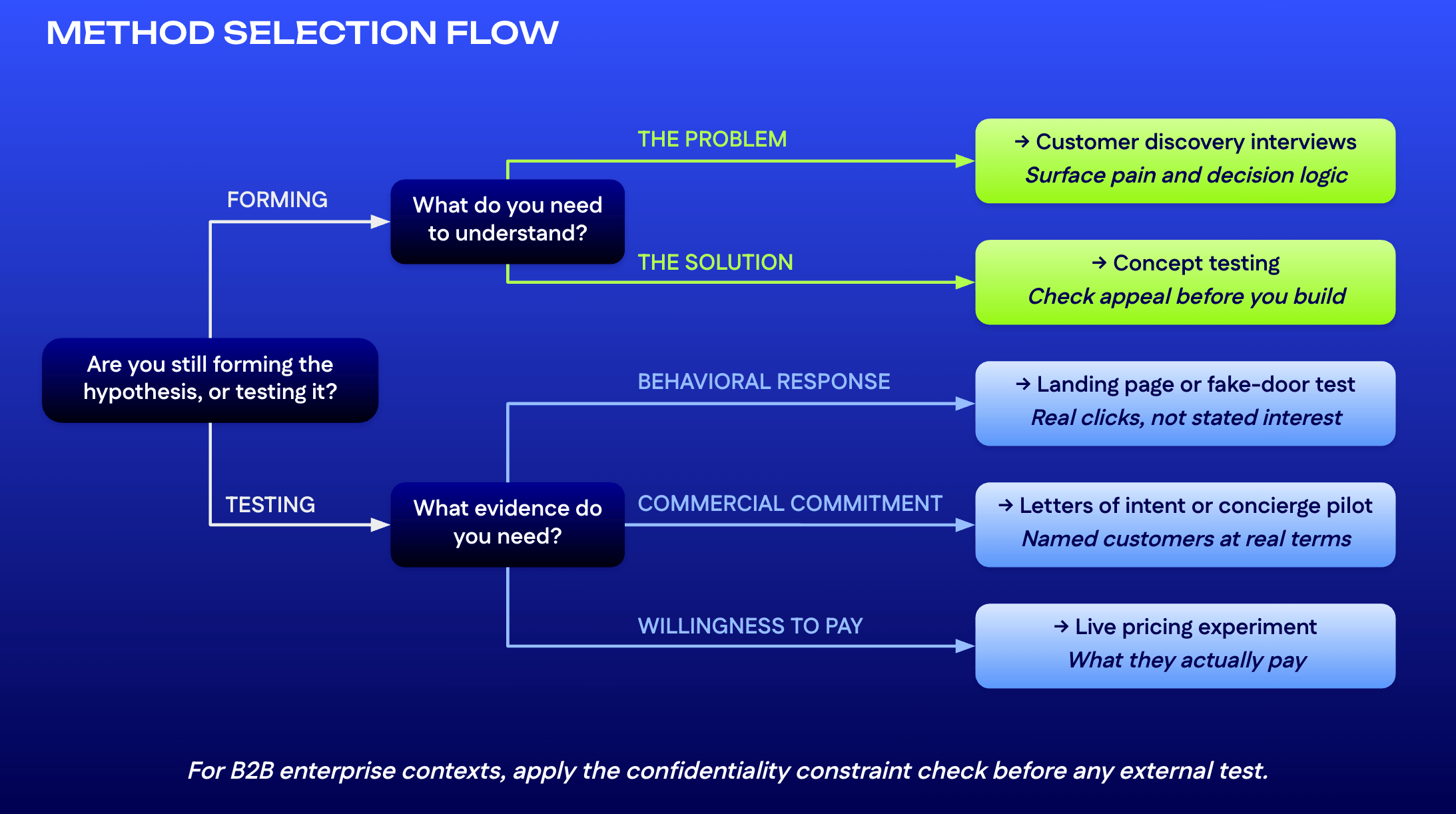
The most common selection error is using early-stage qualitative methods to answer late-stage commercial questions, or applying B2C digital experiments in B2B relational contexts where buying behavior works differently. A startup might run a fake-door test for a new enterprise software product. A corporate innovator with an existing brand, a procurement process, and a buying committee that needs a formal business case can't just do the same thing.
Context is the primary input into method selection.
The confidentiality constraint
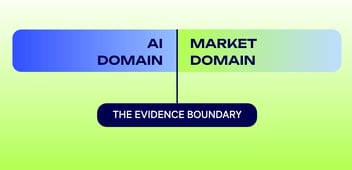
The confidentiality constraint is the obstacle that validation guides aimed at startup founders never address, because it doesn't exist for them. Corporate innovators face a genuine design challenge: you need real external market signals to validate anything meaningful, but testing externally risks alerting competitors, creating premature market expectations, or exposing IP before it's protected.
So how do you generate genuine external signals without handing competitors a roadmap? That tension doesn't have an easy answer, but it does have a design response.
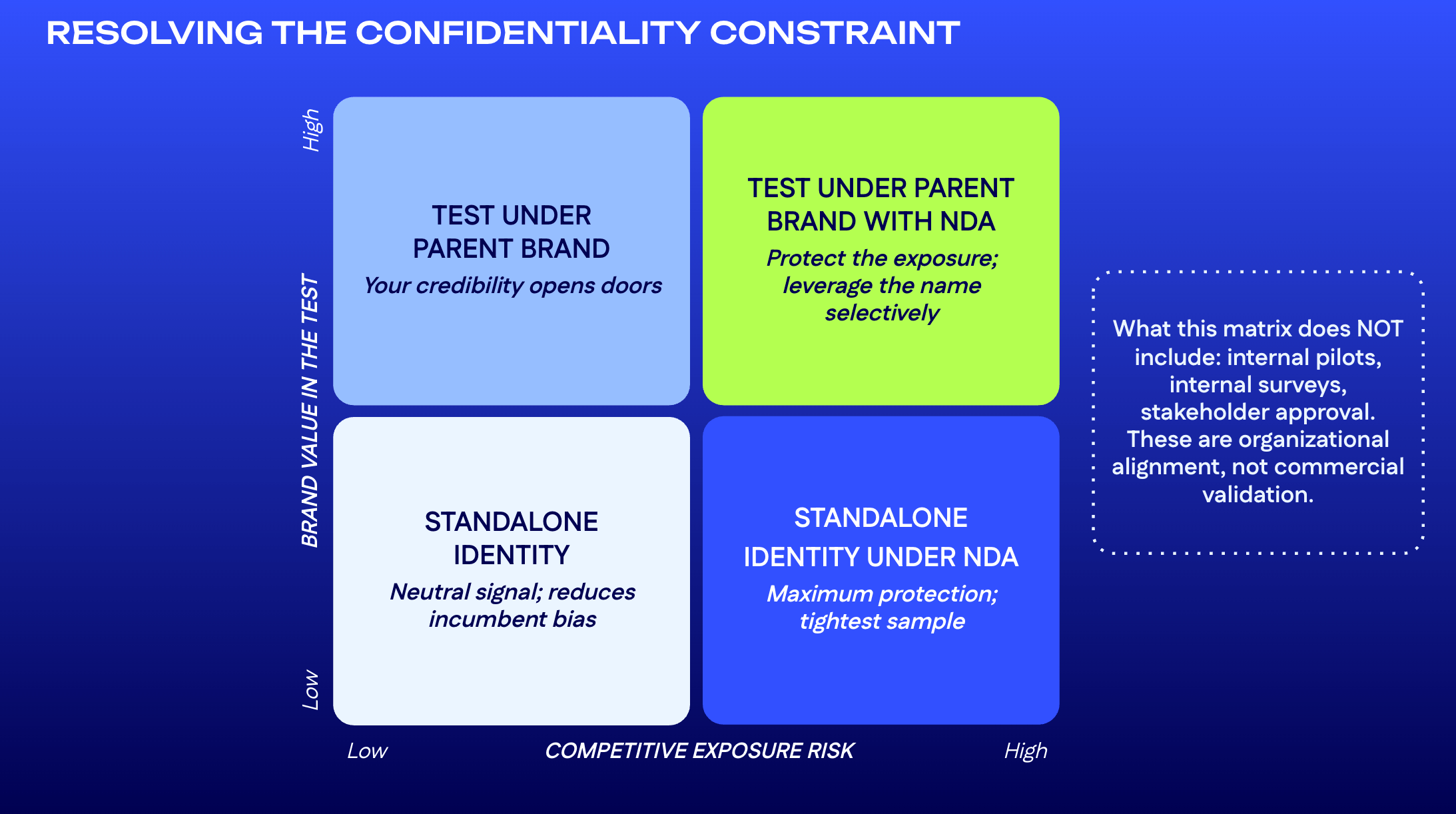
The first question is whether the experiment should run under the parent brand or a standalone identity. Use the parent brand when it's a commercial asset, when enterprise buyers will take you more seriously because of who you are. Use a standalone identity when competitive exposure is the primary risk, or when testing a concept that might be seen as cannibalizing your existing offer.
The second question is what can be tested publicly versus only under NDA. In deep-tech, industrial, and regulated contexts, NDA-only validation is often the only viable path. It limits your sample and introduces selection bias, so account for that when interpreting results.
What you can't do is resolve the confidentiality constraint by defaulting to internal validation. Internal stakeholder approval, internal pilots, and internal surveys aren't commercial validation. They're organizational alignment. Confusing the two is how corporate innovation programs generate confident decisions based on evidence that has never left the building.
Sequencing methods across validation stages
Sequencing methods across validation stages is how individual experiments become a coherent commercial argument. Validation is a series of progressively higher-commitment tests, each one designed to generate the evidence that justifies moving to the next.
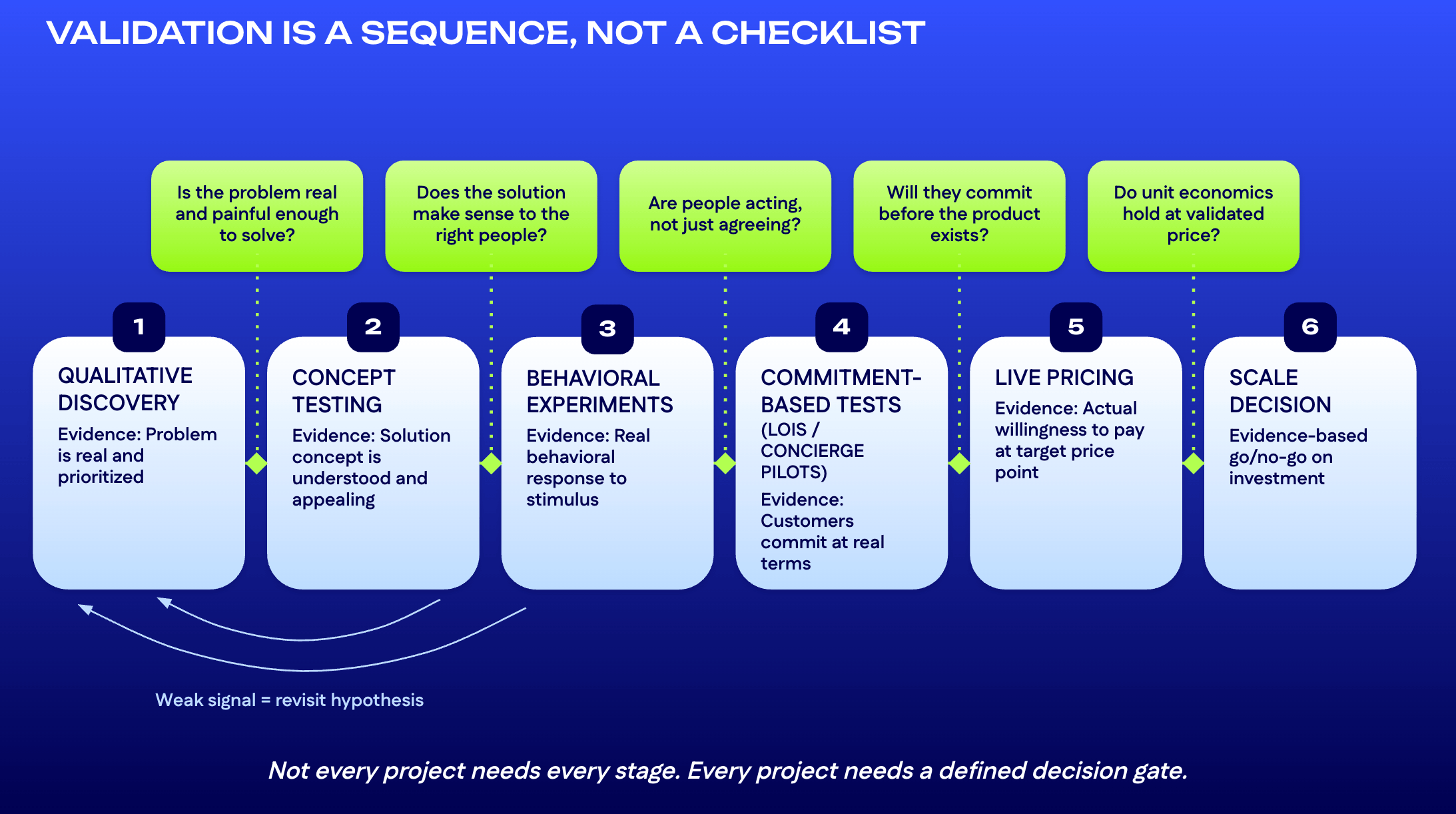
The logical flow: qualitative discovery to sharpen the hypothesis, concept testing to check initial solution appeal, behavioral experiments to get real response data, LOIs or concierge pilots to generate commitment-based evidence, live pricing to confirm commercial viability. Not every project needs every stage. Every project needs a defined sequence and a clear answer to what evidence is required before advancing.
What happens when two experiments run at the same time and return conflicting signals? You get confusion. Two simultaneous experiments are harder to interpret than one sequential experiment producing a clean decision. Speed at the cost of legibility isn't speed. It's noise.
Choose the method that answers the question you actually need to answer at this stage, in this market, with these constraints. Not the one your team is most comfortable with. Get that distinction right and your validation process generates evidence. Get it wrong, and it generates the appearance of evidence.
Not sure which validation method fits where you are right now?
At Bluemorrow, we work with corporate innovation teams to map their assumptions, prioritize what to test first, and design experiments that generate evidence the investment case can actually stand on.
If your team is mid-validation and the method choices feel unclear, book a 15-minute call with Henning Bär — no agenda, just a conversation about where you are and what the next experiment should look like.