
Most companies spend months validating their product and almost no time validating their route to market. Then they scale. A product that solves a real problem will still fail commercially when the organisation cannot reach the right buyer, at the right cost, with the right message – and that failure shows up in the revenue line, not the product roadmap.
Go-to-market validation is the work of confirming, through real market behaviour, that your assumptions about who buys, how they're reached, and what they respond to are actually true before you commit capital to scale. The output is evidence from real buyer interactions – specific enough to support a scaling decision, not just a launch plan. Get that evidence in place, and scaling stops being a gamble and becomes a decision, made with the numbers in hand rather than confirmed only once the results are already in.
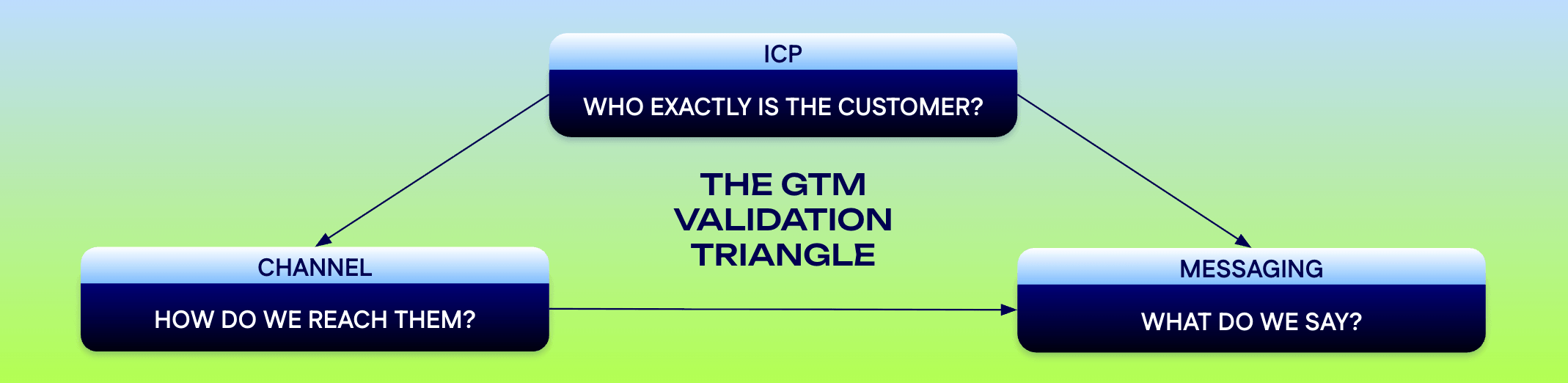
So how do you know whether your GTM is validated or still a hypothesis? At Bluemorrow, we use three questions as our practical lens for answering that, the three places where evidence from real buyer interactions tends to separate a working go-to-market from an assumed one. Each needs an answer grounded in real buyer behaviour before any scaling decision is rational.
GTM validation is not GTM strategy
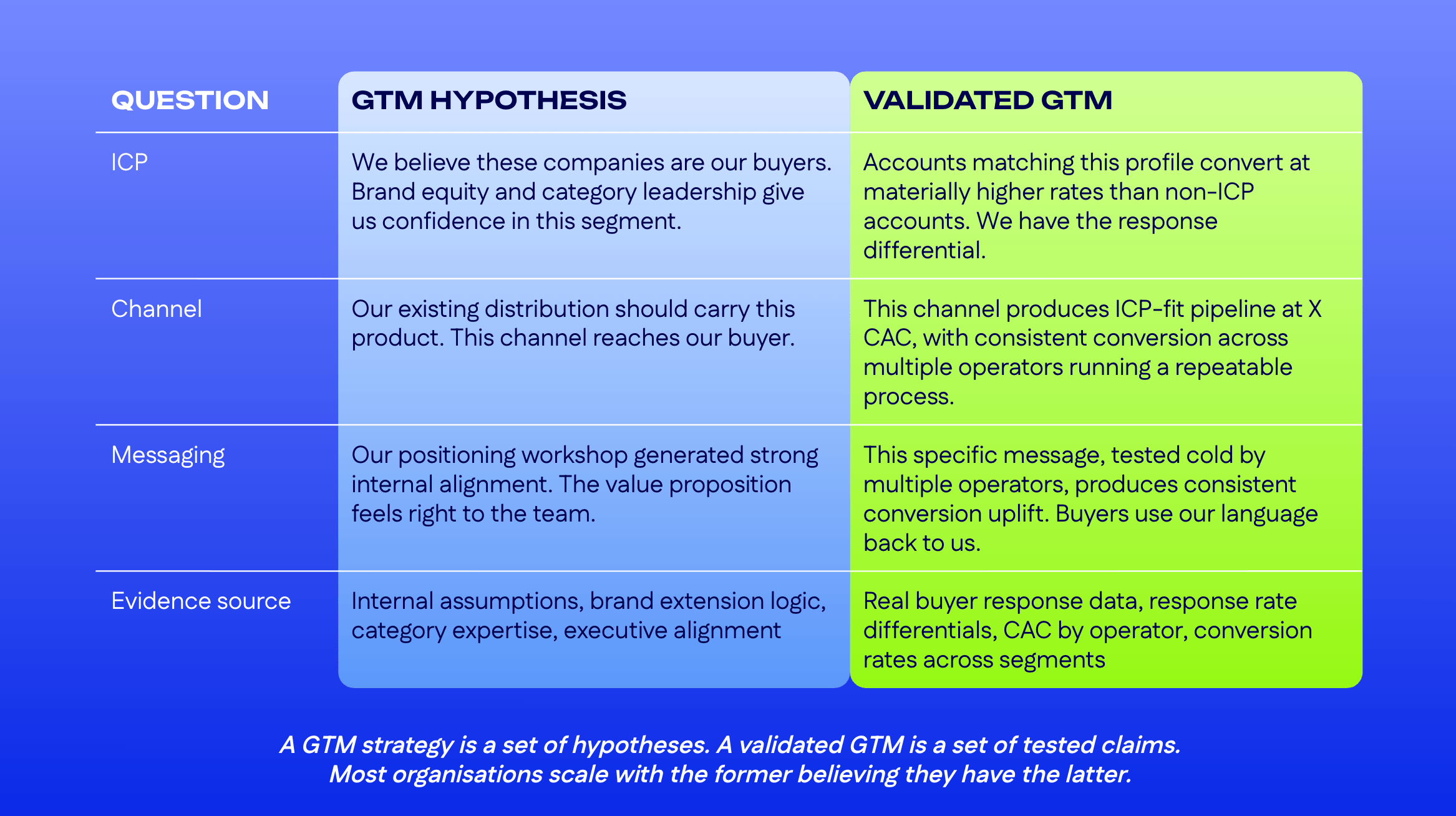
GTM validation is not the same discipline as GTM strategy building. A GTM strategy documents who you think will buy, how you plan to reach them, and what you expect to resonate – a coherent set of hypotheses. A validated GTM replaces those hypotheses with tested claims backed by evidence from real buyer behaviour. Organisations arrive at a launch with the first and proceed as though they have the second.
Steve Blank's customer development model drew this distinction precisely: customer validation – his second stage – means establishing a repeatable, scalable sales model. A motion that works and holds its economics without heroic effort at the volume you intend to run.
The diagnostic is straightforward: can you answer these three questions with data from real buyer interactions – who exactly converts, through what route at what cost, and to what message framing? Where any answer draws on belief rather than observed behaviour, the GTM remains a hypothesis.
The corporate compounding factor
For corporate innovation teams, the risk compounds in a specific way. The assets that should reduce GTM risk – existing brand equity, established distribution channels, a capable sales force – can actively suppress the signal you need. They make it harder to isolate whether the new venture's motion can stand on its own.
Clayton Christensen documented this mechanism The Innovator's Dilemma (1997): incumbents structurally underinvest in new ventures' go-to-market because the existing organization routes resources toward existing revenue patterns. Awareness of that pull is the starting point for designing around it.
The three GTM questions that require evidence
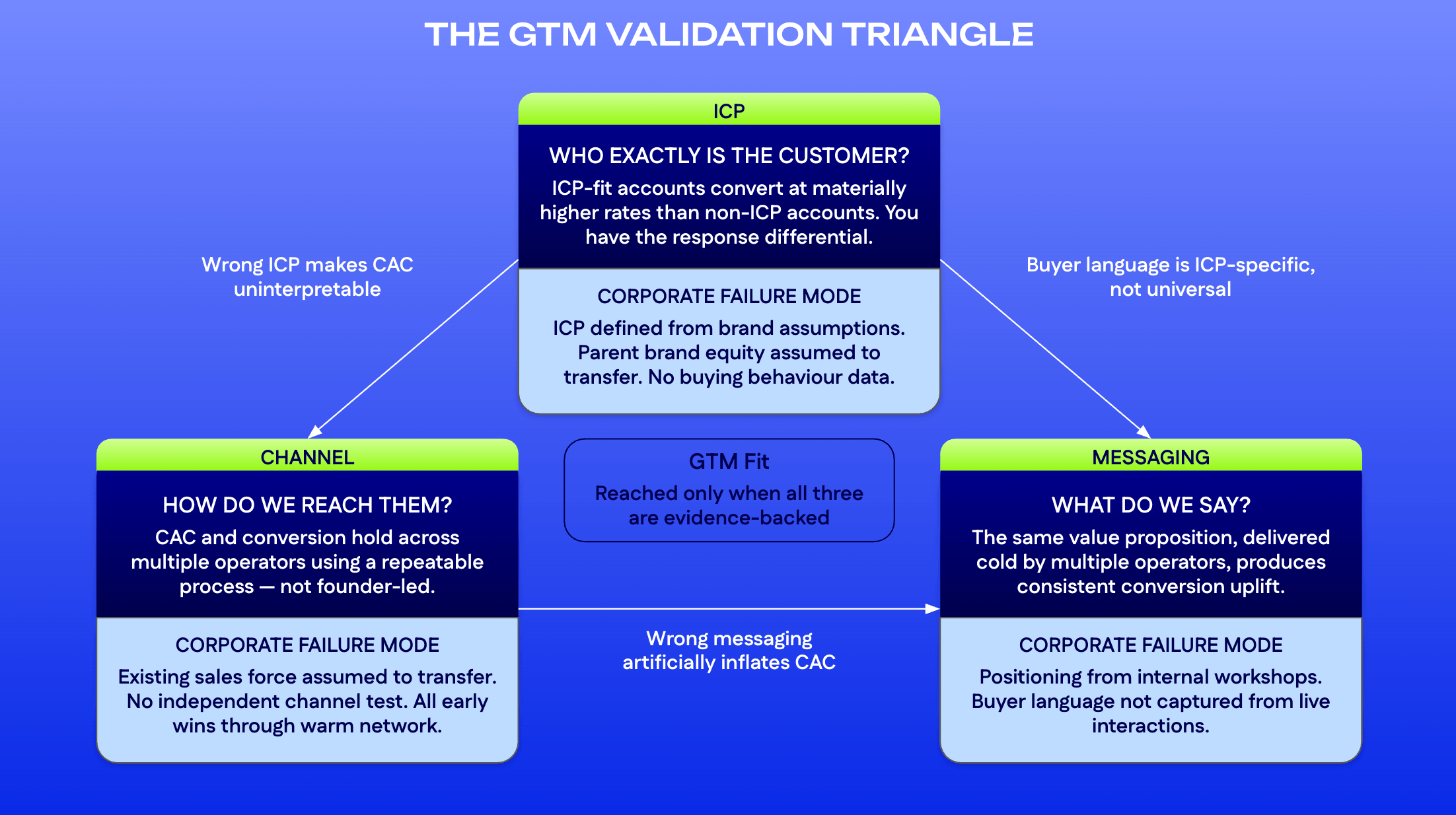
The three GTM questions that require evidence are about proof. Before any scaling decision, your GTM must produce a documented answer to each: who exactly responds and converts, through what route at what cost, and to what message framing. Each has its own validation method and a corporate-specific failure mode worth knowing.
Who exactly is the customer?
ICP validation answers one question: does your customer profile actually predict who converts? The profile has to do real work – conversion rate, sales cycle length, expansion behaviour. A profile that describes a segment without predicting commercial outcomes is a starting point, not a validated ICP.
Build the profile from your strongest evidence: the accounts with the shortest sales cycles, the highest expansion revenue, the lowest churn. Then test it with structured outbound to accounts that fit and accounts that do not, and measure the response differential. A predictive ICP produces a clear gap between the two groups.
The corporate failure mode is defining the ICP from assumptions about brand resonance rather than observed buying behaviour. Brand equity from the parent business opens doors in existing categories. In a new category, the ICP has to be earned from market data collected independently.
How do we reach them?
Channel validation answers which specific routes connect with this buyer, at what acquisition cost, through a process that can be systematised. The evidence comes from actual operation at the volume and with the process you intend to run – not from a channel preference survey or a pilot run by the founding team.
Early customers often come through a venture lead's personal network, a relationship owner's existing contacts, or the effort of one exceptional operator willing to bend the process to close each deal. That produces a low CAC number, but the number reflects personal effort rather than a repeatable motion. Validated channel economics means cost and conversion rate hold when multiple operators run the same process, without that one person on every call or the service model bent to win each deal.
The corporate failure mode is assuming the new venture can travel through the same channels as the core business. An enterprise sales force built for multi-year renewal cycles operates differently from what a new-category product requires. Channel validation means testing the route independently, with the economics calculated from that independent motion.
What do we say?
Messaging validation has one test: does this specific value proposition framing produce consistent conversion uplift in cold conditions, regardless of who delivers it?
A/B testing of outbound sequences, landing page variants, and conversation openers gives you the cleanest read on this when the volume supports it. Many enterprise ventures won't have that volume, so the practical sequence is staged: collect buyer language qualitatively from live conversations, turn it into a specific message hypothesis before testing anything, run a controlled test where the numbers allow it, and where they don't, weigh the effect size you do see against how adequate the sample actually is and what happens downstream, such as whether those conversations move on to a next step. Either way, the signal to look for is a response pattern that holds across multiple operators. A conversion rate that lives in one person's pitch confirms that individual's skill, not the messaging.
Positioning built in internal workshops tends to carry the language that feels right inside the organization, shaped by people who know the product deeply and describe it in terms that make sense to their colleagues. Buyers often describe the same problem in different terms, closer to the specific, situational language of what's actually going wrong for them day to day. Messaging validation starts with collecting that buyer language from live interactions, then testing whether it drives outcomes at scale. For a structured approach to those conversations, see our article on Customer Validation Methods.
Channel economics as a validation signal, not a dashboard metric
Channel economics as a validation signal means using CAC payback as a gating criterion before scaling, not a number to monitor after you've already committed. The question is: do the economics hold with a repeatable process, at the volume we intend to operate, without exceptional effort?

Research across more than 14,500 SaaS companies puts the median CAC payback at 6.8 months. Under 12 months is the accepted threshold for a healthy GTM motion; above 18 months and you're building a cash-consumption problem into the model before you scale it. Early-stage companies often achieve 2-5 month payback on first cohorts because early adopters convert easily and that effort is unsustainable at volume.
The validation question is: will it hold when we systematise this motion, hire the second AE, and the founder stops closing deals personally? If the honest answer is “probably not”, you don't have validated channel economics. You have a hypothesis that still needs testing.
What should you see before calling the economics validated? Three to nine months of repeatable signal from a single channel. Conversion rates consistent across multiple operators. CAC calculated from deals won through the intended process, not through exceptions and extraordinary effort.
Six signs your GTM is still a hypothesis
Warning signs appear in the data before they become expensive, but only if the organisation is looking for them. Most scan for signals that confirm the strategy is working. The signals that point in a different direction tend to get rationalized away before they reach a decision-maker.
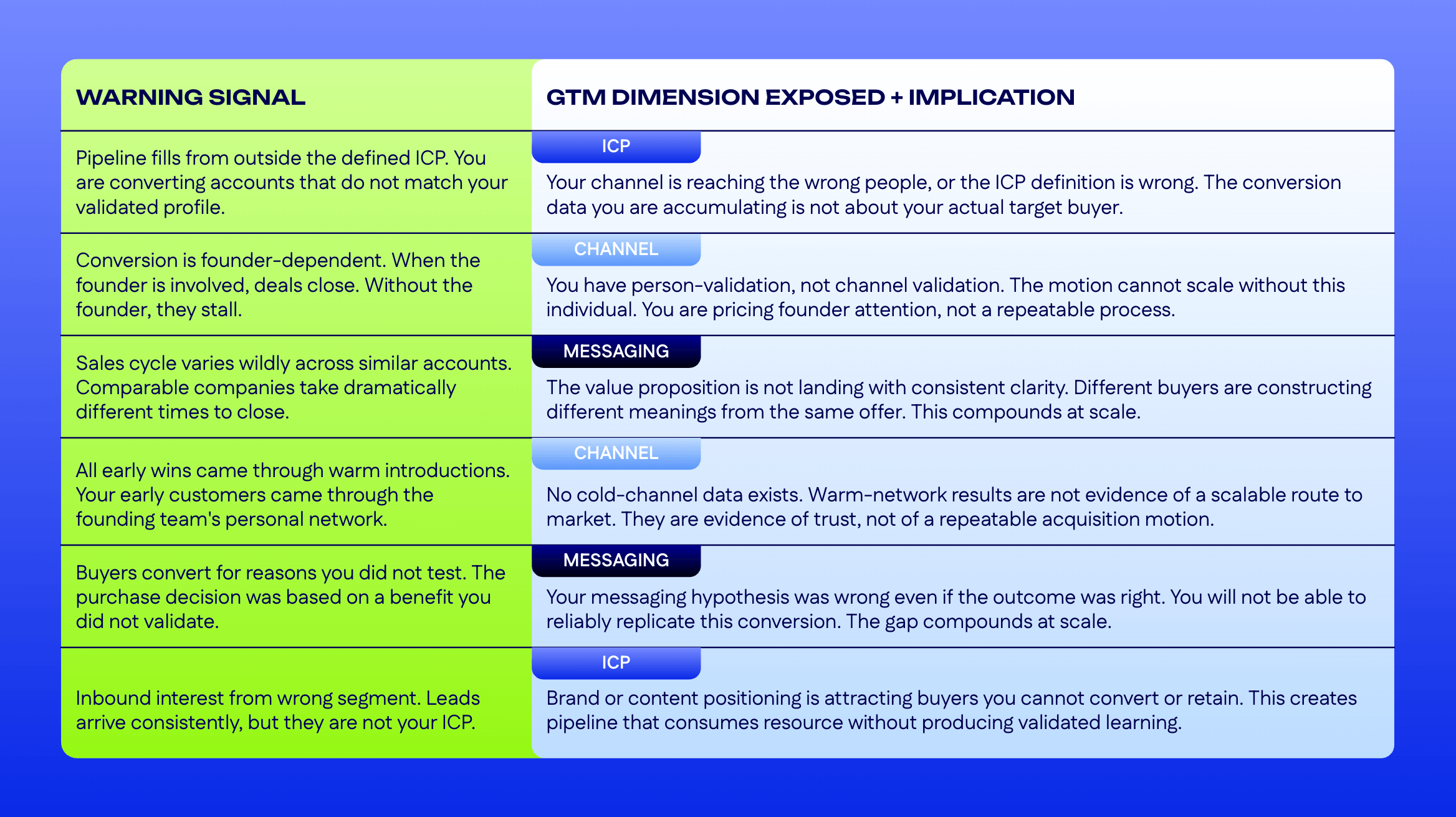
These are the patterns to watch for before you commit to scale:
-
Pipeline fills from outside the defined ICP. Activity is generating, but the accounts showing up don't match the profile. Either the channel is reaching the wrong people or the ICP definition needs revisiting. Either way, the conversion data you're accumulating doesn't tell you what you need to know.
-
Conversion is founder-dependent. Close rates are materially higher when specific individuals are involved. This is person-validation, not GTM validation. A scalable motion can't depend on irreplaceable people.
-
Sales cycle varies wildly across similar accounts. Inconsistent cycle length in accounts with the same ICP characteristics is usually a messaging problem – the value proposition isn't landing with consistent clarity.
-
All early wins came through warm introductions. Warm networks are a useful starting point but they're not channel validation. What does the cold-outreach data say? If that number doesn't exist, neither does your channel evidence.
-
Buyers convert for reasons you didn't test. If customers consistently describe their buying decision in terms you didn't anticipate, your messaging hypothesis was wrong even if the outcome was right. That gap matters at scale.
-
Inbound interest comes from the wrong segment. Your content or brand is attracting buyers outside the ICP. At scale, this becomes an expensive CAC problem – you're paying to attract people you'll either fail to convert or fail to retain.
Which of these patterns is already showing up in your pipeline? Most organisations find at least one, often two. Finding them now, before the scaling decision, is the point.
What validated GTM looks like in practice
What validated GTM looks like in practice is a set of documented, evidence-based answers to the three questions – and confidence that those answers will hold when you add people, budget, and operational pressure.
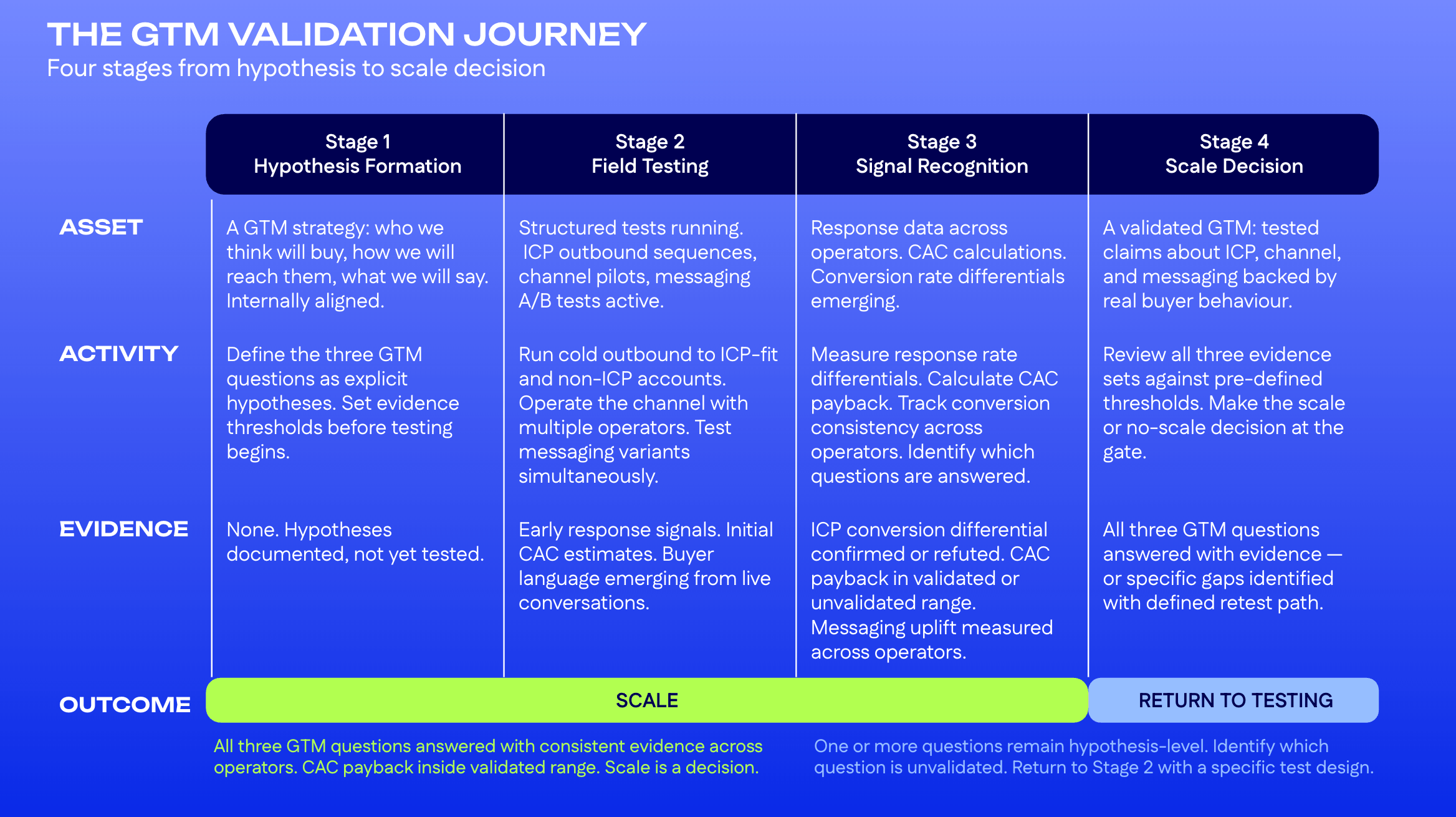
The threshold, in practical terms: repeatable pipeline from the defined ICP through a specific channel, with conversion that holds when different operators run the process, and CAC payback that supports the model. Geoffrey Moore's point matters here: if every validated data point comes from early adopters already looking for what you're building, you've validated one segment's motion – not the one that determines commercial scale.
For a corporate innovation team, validated GTM means the new venture has been tested with enough independence from the parent to confirm it can stand on its own. The parent's assets may add value, they often do, but the motion can't require them. A venture that closes deals primarily because the parent brand opens doors is running on borrowed GTM, not a validated one.
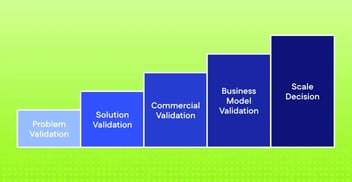
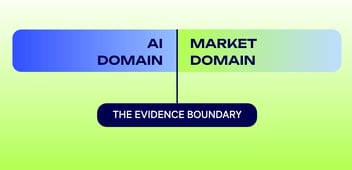
When the three questions have documented answers and the economics hold without exceptional effort, scaling stops being a gamble and becomes a decision. For the evidence standards that underpin this distinction across the full validation journey, see Commercial Validation for Corporate Leaders. To understand how AI tools can accelerate the front-end without substituting for market contact, see Commercial Validation in the Age of AI.
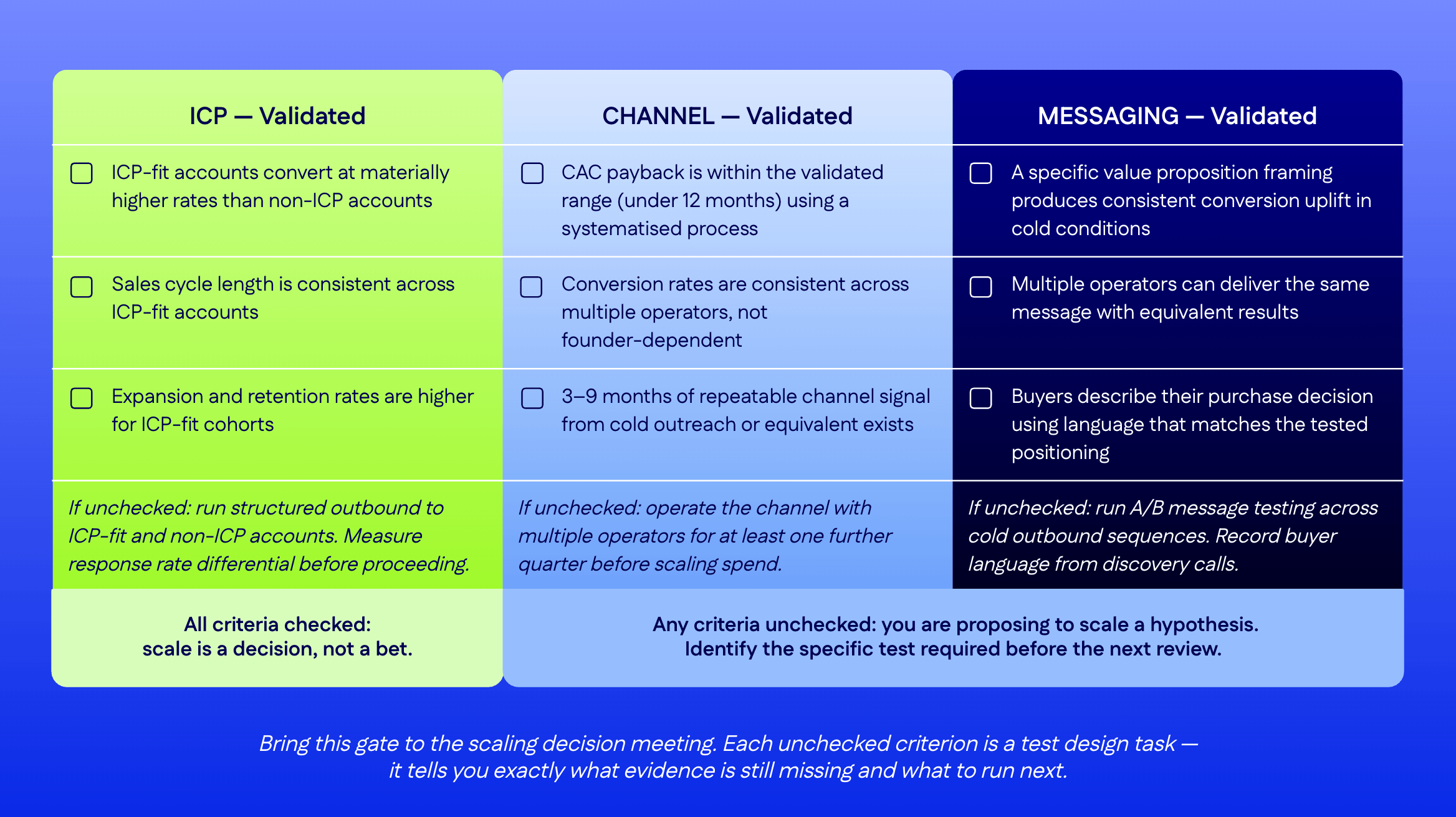
Scale on evidence, not on confidence
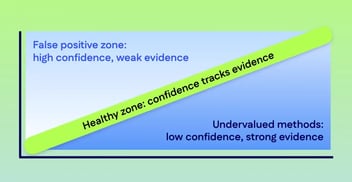
Scale on evidence, not on confidence – that discipline is what separates organizations that build durable market positions from those that exhaust capital proving a thesis they were never sure of. The gap between a GTM hypothesis and a validated GTM is the gap between a scaling bet and a scaling decision.
The organizations that get this right have done the work of distinguishing what they believe from what they have seen: for every assumed channel, a data point; for every ICP definition, a conversion differential; for every value proposition, a response rate.
At Bluemorrow, we help corporate innovation teams build the evidence base that turns a GTM hypothesis into a scaling decision, through an evidence audit of what you've already gathered, test design across ICP, channel, and messaging, an operator-replication test to confirm the motion holds beyond one person, and an investment-ready GTM evidence file for the scaling decision itself. Talk to Michael Augsburger to explore how that could work for your organization.