
Every large organization can build things. The harder question is which things are worth building at scale, and with what evidence. Pilot testing answers that question at a fraction of the cost of full development, if you treat it as a capital allocation discipline rather than a research stage.
At Bluemorrow we work with senior innovation and strategy leaders who need defensible build-or-kill calls, not decks full of signals. This piece lays out how we think about pilot testing: the toolkit of corporate experiments, the one failure mode that quietly sinks more programmes than any other and the governance frame you can take into an investment committee. You'll leave with a clearer sense of which experiment fits which decision and when evidence is enough to commit.
Why pilot testing matters in corporate innovation
Pilot testing matters in corporate innovation because at enterprise scale, the cost of building an unvalidated product is enormous compared with the cost of testing one assumption at a time. A failed launch not only burns capital, but also years of strategic attention and credibility with the board.
We see the same pattern constantly. Internal stakeholder approval feels like validation, so the project gets funded. Six quarters in, nobody can produce behavioural evidence that customers want the thing at a price that clears margin. Pilot testing is the structured alternative. It turns a bet on a hunch into a sequence of smaller, decidable investments, each one earning the right to make the next.
So where does the real work sit? In sequencing those decisions well and governing the outcome of each one before the next is authorised. We unpack the fuller picture in our article on commercial validation.
What a corporate pilot really is and what it isn't
A corporate pilot is a staged commercial experiment designed to test a specific assumption at a defined cost, with a pre-committed decision at the end. The point is to produce a decision. That framing changes everything about how you design the test and it's why so many pilots in large organisations produce charts but not conclusions.
Pilot vs. beta vs. MVP vs. minimum viable concept
Pilot, beta, MVP and minimum viable concept get used interchangeably, which is how teams end up arguing about scope without knowing it. Each one tests something different and mislabelling the test is the first step toward testing the wrong thing.
- Beta is a near-finished product being polished with a friendly user group.
- MVP is a stripped-down version of a product you intend to ship, cut down enough to learn what matters.
- Pilot is a time-bounded commercial trial in the real market, with real customers and, usually, real money.
- Minimum viable concept, or MVC, is the thinnest representation of the offer that still produces a commercial signal, often with no product built at all.
A slide deck, a landing page, a service brief, a signed letter of intent with pricing in it. That's often enough to learn what you need.
Methodology rehearsal vs. commercial test
A pilot that only tests whether your research method works is not the same thing as a pilot that tests whether the market will pay. The distinction matters because corporate teams sometimes borrow pilot design from academic research, where the goal is checking that a study protocol holds up before scaling the sample. That goal has nothing to do with what a commercial pilot needs to prove. A commercial pilot checks whether a market will respond with money, time, or signed commitments. The first tells you your questionnaire works. The second is what your board is paying for.
The corporate experiment toolkit
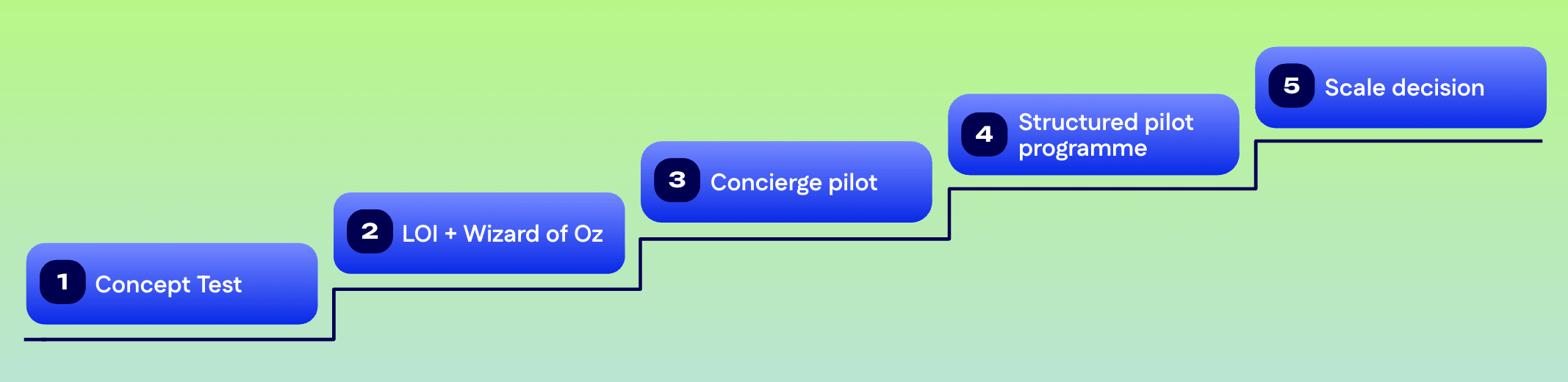
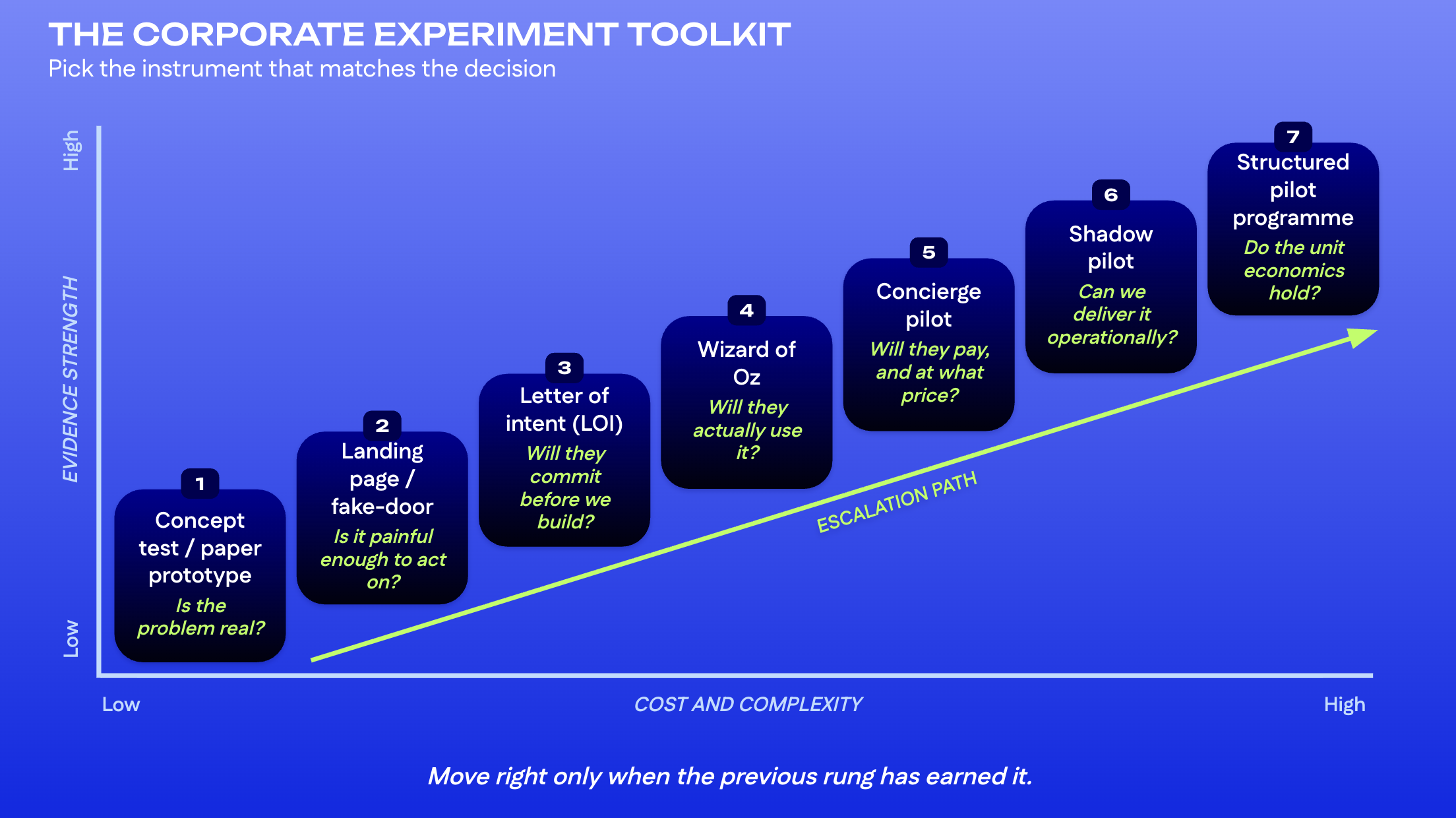
The corporate experiment toolkit is the set of staged tests available once a pilot-style method is the right fit for the decision at hand. What each method is, and how to choose among method families more broadly, is covered in our guide to corporate commercial validation methods. What matters here is cost and commitment: picking the right instrument means matching what you are willing to spend against what the next decision is worth.
Concept tests and paper prototypes
These sit at the cheap end of the toolkit, which is exactly why they get skipped. A slide deck or a landing page costs almost nothing to build, so there is rarely a good reason to commit engineering budget before running one. Treat a low-cost test as a mandatory gate, not an optional nicety, before any spend you cannot recover.
Wizard of Oz and concierge pilots
These sit in the middle of the toolkit. Concierge pilots, already covered in our methods guide, sit alongside Wizard of Oz tests here because both skip the technology build: in a concierge pilot we deliver the service manually to a small set of paying customers, and in a Wizard of Oz test the user thinks they're using an automated product, but humans are doing the work behind the scenes.
Both produce behavioral evidence at a fraction of build cost. The strongest signal these tests capture is willingness to pay, which we unpack in our guide on pricing validation.
Shadow pilots and structured pilot programmes
These sit at the expensive end. A shadow pilot runs a new process alongside the existing one without customer impact, useful when the risk being tested is operational rather than commercial. A structured pilot programme is the real commitment. It runs with paying participants against a fixed end date, and it closes on a decision that was already waiting. Both belong only when the next commitment is large and largely irreversible, which means the success criteria covered below need to be locked before either one starts.
Matching the experiment to the decision
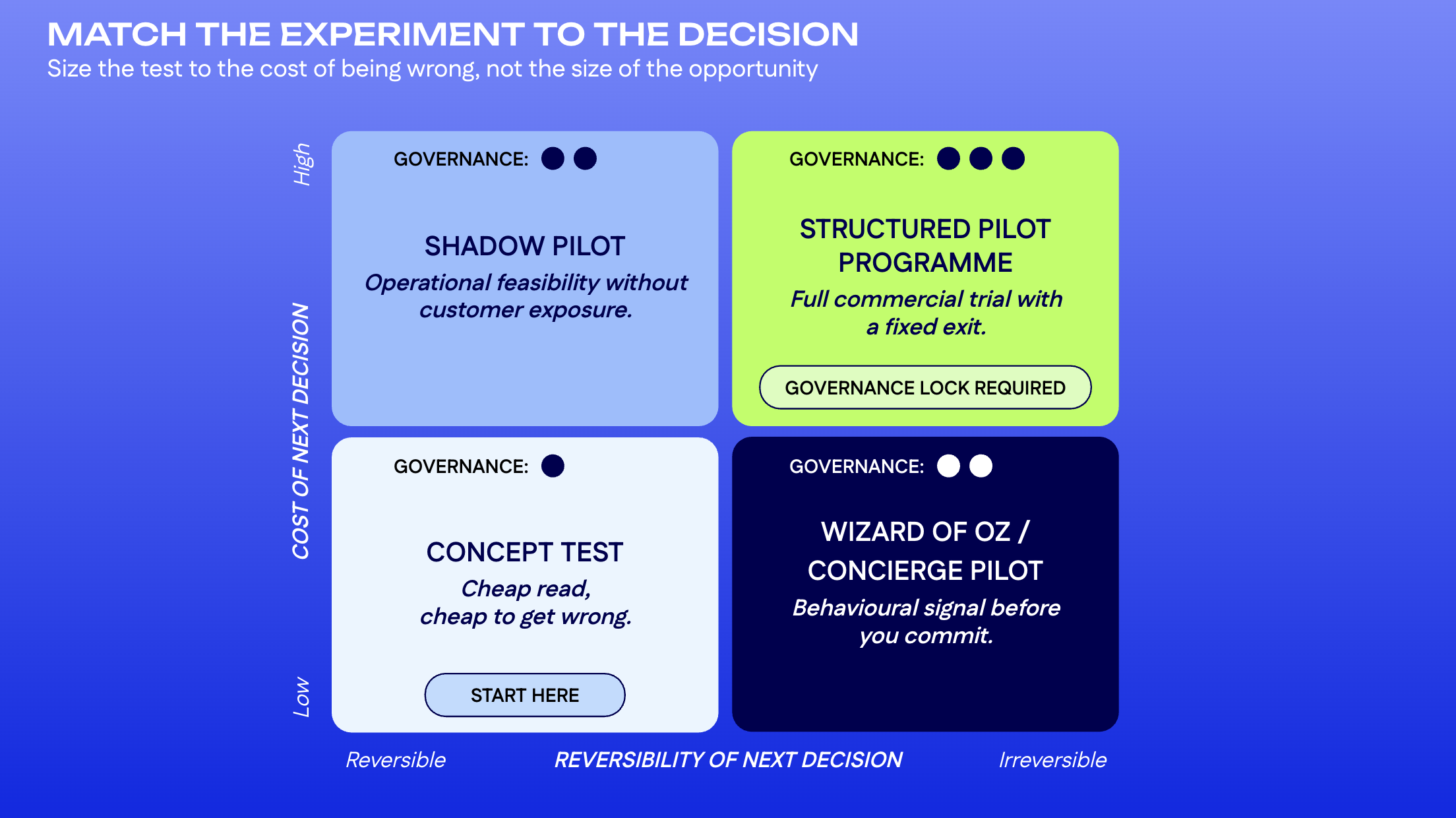
Matching the experiment to the decision is how you avoid spending structured-pilot budget on a question a paper prototype could have answered. Size the test to the cost of being wrong about the next decision, not to the size of the eventual opportunity. Most teams get this backwards.
So which test fits which call? A rough guide we use:
-
If the next decision is cheap and reversible, run a concept test.
-
If it requires a real customer commitment but nothing built, run a Wizard of Oz or a concierge pilot.
-
If you're committing to hire, build, or enter a regulated space, run a structured pilot.
The decision sets the instrument.
The infinite pilot problem
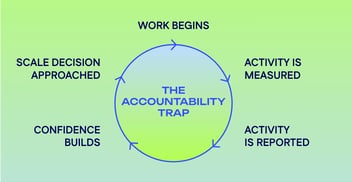
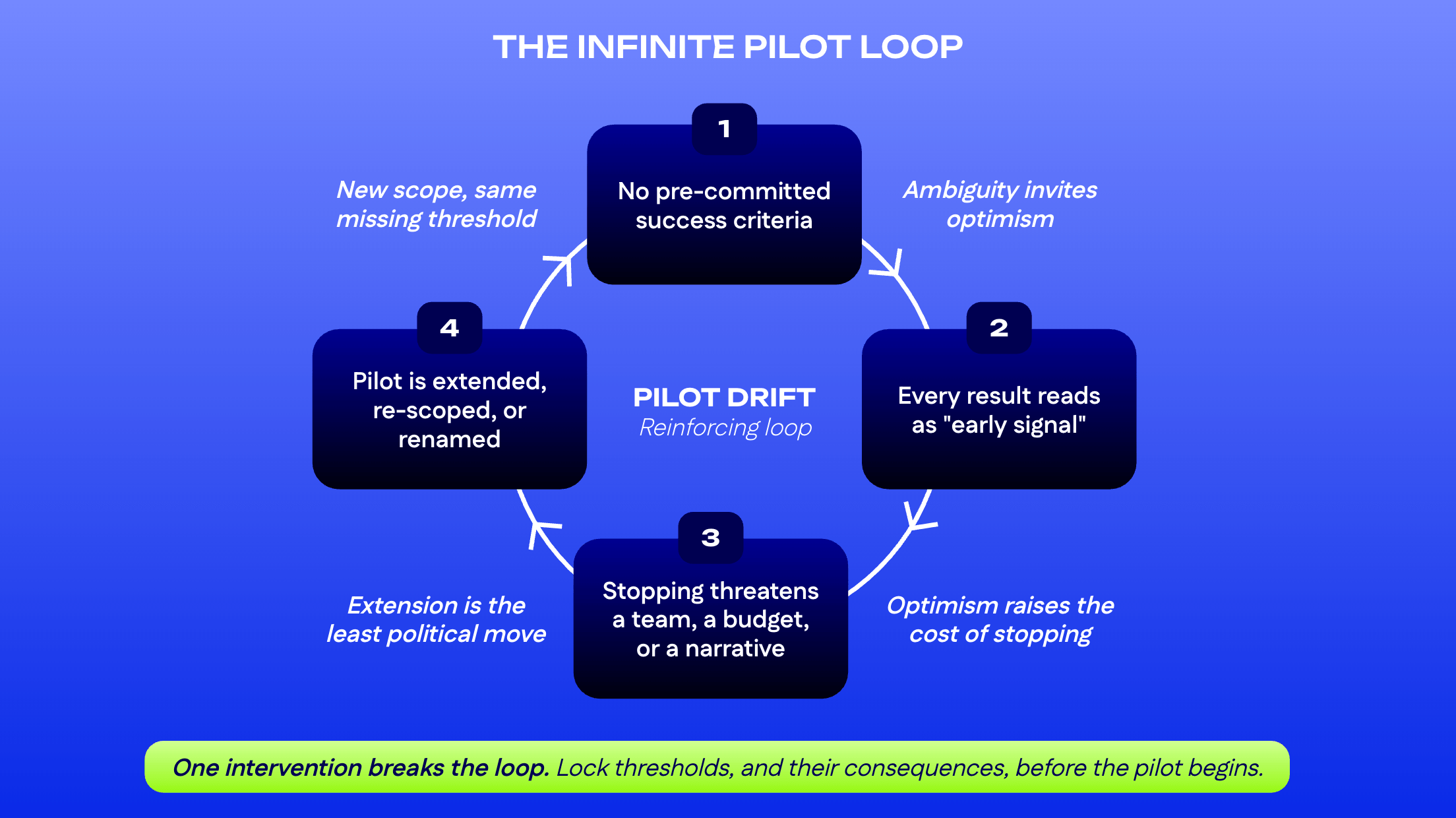
The infinite pilot problem is the most recognizable failure mode in corporate innovation. Pilots drift when they launch without pre-committed success criteria. With no defined end state, they become a way to keep optionality open by never deciding anything, and they accumulate cost that nobody flags as waste because the program is still technically alive.
Why pilots drift
Pilots drift because the incentives point that way. A pilot that produces a negative result ends a program, which ends a budget, which ends a team. Nobody in the governance chain wants to be the one who calls it. So the pilot gets extended, re-scoped, renamed and quietly replanned. The organization keeps believing it is validating, when what it is actually doing is avoiding.
Pre-defined success criteria as the remedy
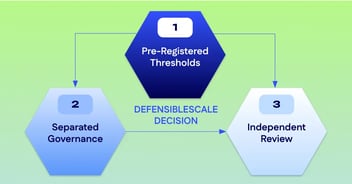
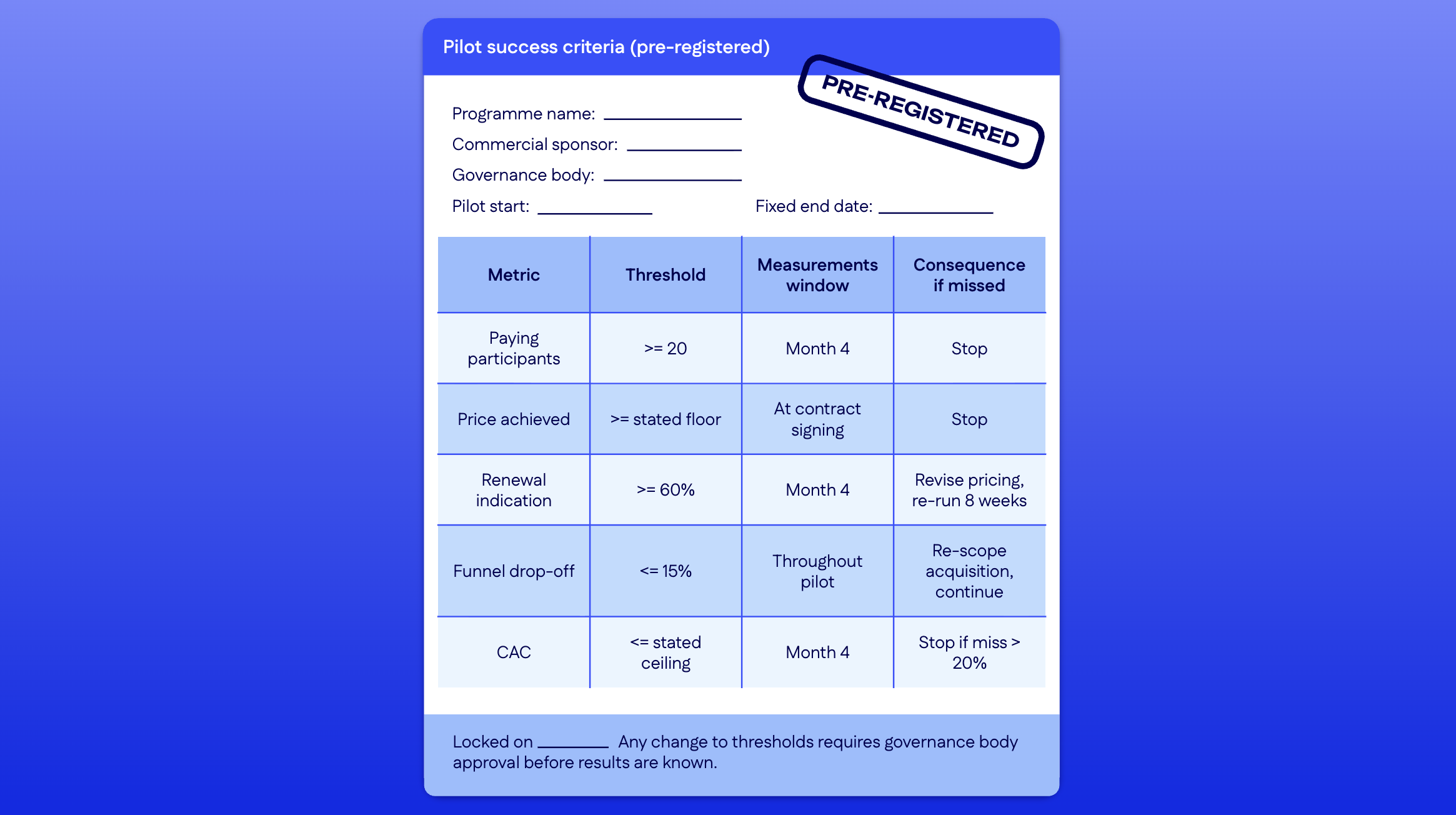
Pre-defined success criteria remove the ambiguity that lets pilots drift. You set the thresholds before the experiment runs, you write them down, and you make them visible to the governance function rather than only to the project team. The discipline is structural.
What good criteria look like in practice: by month four, the pilot has 20 paying participants at a price above a stated floor, a renewal indication above 60%, and funnel drop-off under 15%. Miss by more than 20%, the programme stops. Specific, written, consequence named.
Defining the thresholds also sets the stage for the traction and validation metrics that will feed the go/no-go call at the end of the pilot.
Staging investment with a real options view
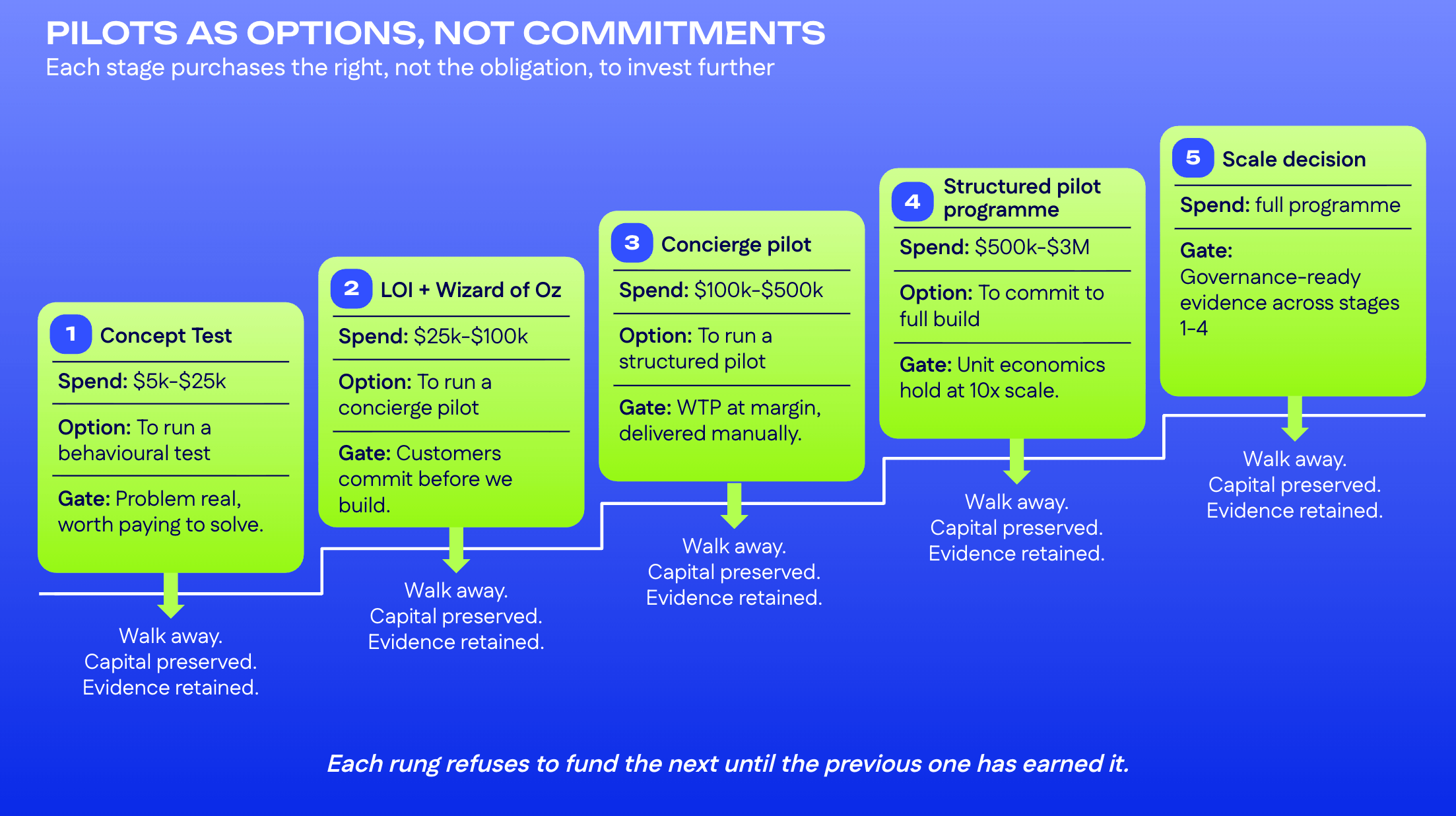
A pilot behaves like a financial instrument as much as it behaves like an experiment. Each one buys an option, the right but not the obligation to invest further, and the price of that option is whatever the pilot cost to run. That framing changes what counts as success. A pilot that comes back with a clear no has still done exactly what it was supposed to do, because the option was priced correctly and then left unexercised, and the capital saved by walking away is the actual return on that investment.
Most programs lose this discipline the moment a pilot comes back with a partial or ambiguous result, rather than a clean yes or no. The instinct at that point is almost always to extend the pilot a little longer, gather a bit more data, and postpone the decision, instead of pricing the option honestly and making the call with the evidence already in hand. Governing pilots as real options means setting, before the pilot ever starts, what evidence would be strong enough to justify exercising the option and investing further, and what evidence would be weak enough to let it expire. Holding that line matters most precisely when a partial result is tempting the team into asking for a longer look.
Designing pilots that produce decisions
Designing pilots that produce decisions is different work from designing pilots that produce data. Data is cheap. A defensible commit, kill, or pivot call is what senior leaders need from the process and the pilot has to be engineered backwards from that outcome.
Pre-register thresholds before the pilot runs
Pre-registering thresholds before the pilot runs is the single most effective protection against motivated reasoning. Once you have seen the data, you can always find a story that supports continuation. The only time to define what success looks like is before you know the answer. Lock the thresholds, version them, and share them with governance.
Separate advocacy from evaluation
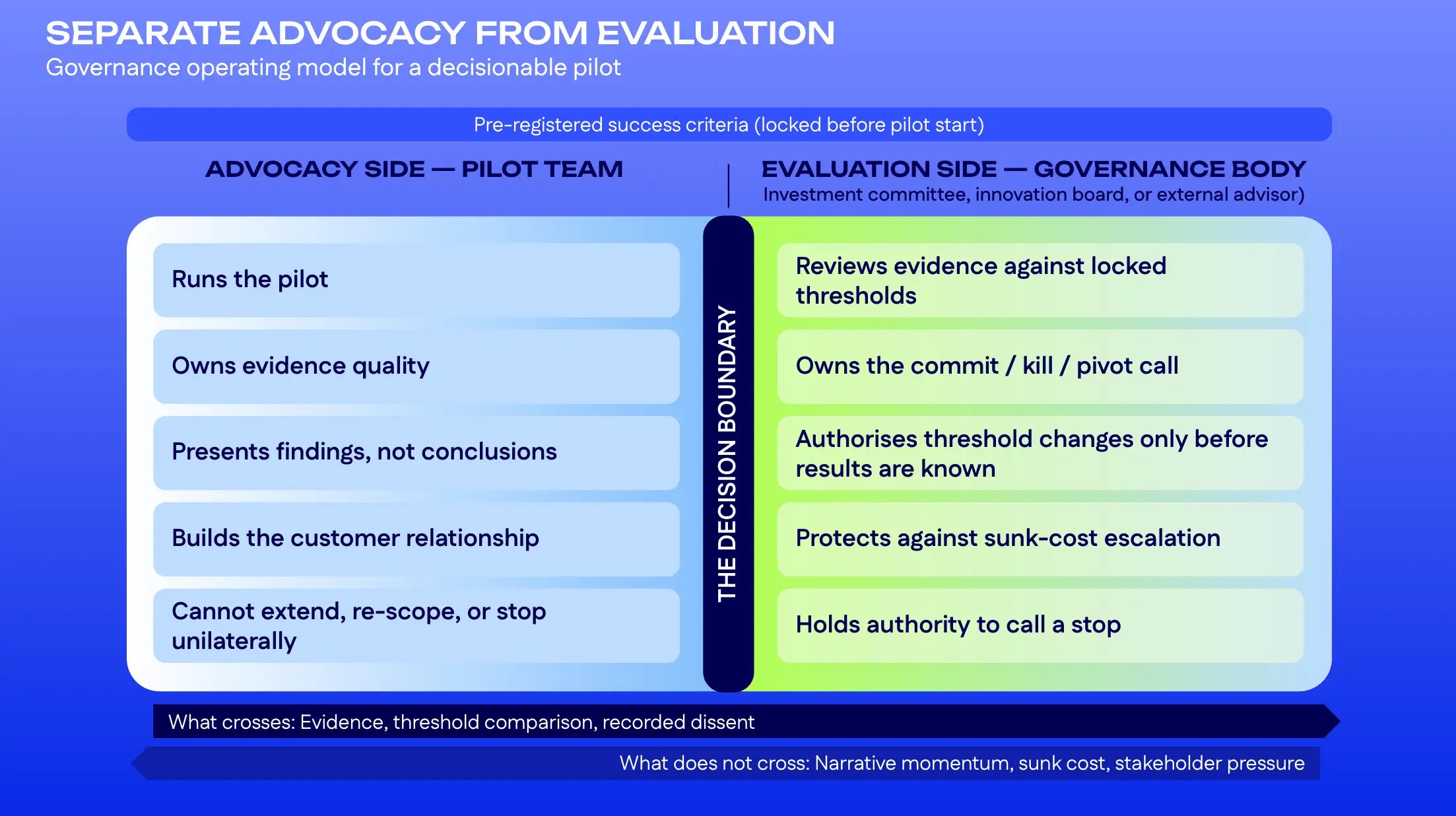
Separating advocacy from evaluation is the governance move that protects against sunk-cost escalation. The team running the pilot is also the team advocating for the underlying project. Asking them to judge their own evidence is asking them to do something humans aren't built to do. The cleaner setup puts an independent body between the evidence and the decision. Who owns the call? An investment committee, an innovation board, or an external advisor with authority to stop the programme.
Put it in one document
A pilot only produces a defensible decision if the pieces that make it defensible are written down somewhere, not scattered across a slide deck, a Slack thread, and someone's memory of the kickoff meeting. The hypothesis being tested, the method chosen to test it, the threshold that was agreed before anyone saw a result, and who has the authority to call it, all of that belongs in one place, set before the pilot starts.
We built a one-page pilot test card for exactly this. Download it, fill it in before your next pilot begins, and keep a copy on file for whoever ends up reviewing the result.
[Download the pilot test card]
The handoff from pilot to scale
The handoff from pilot to scale is the moment most corporate innovation programs either earn their value or quietly dissolve it. A successful pilot doesn't automatically justify full scale investment. It justifies the next defined stage of commitment, on terms set before the pilot began.
Who runs the scale effort is a separate question from who ran the pilot, and treating them as a single continuous team is a common source of failure. The validation skillset differs from the scaling skillset. We go deeper on this transition in our article on moving from validation to scale.
Pilots are a sequence of purchases. You are buying information and you are buying the right to make a bigger bet later. Govern them the way you would govern any capital allocation process, write the success criteria down before you start and keep advocacy and evaluation on separate sides of the table. The firms that get this right run better pilots and they stop earlier when the signal tells them to.
If you want a sharper view of your current validation portfolio and where the pilot governance gaps are, we'd be glad to help. Book a meeting with Henning.