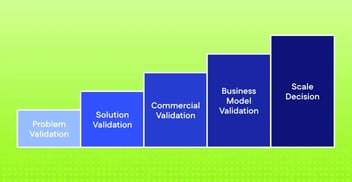

Every year, corporate innovation teams invest significant time in market research. TAM/SAM/SOM projections, competitive benchmarking. But those activities answer a different question from the one that actually governs investment decisions.
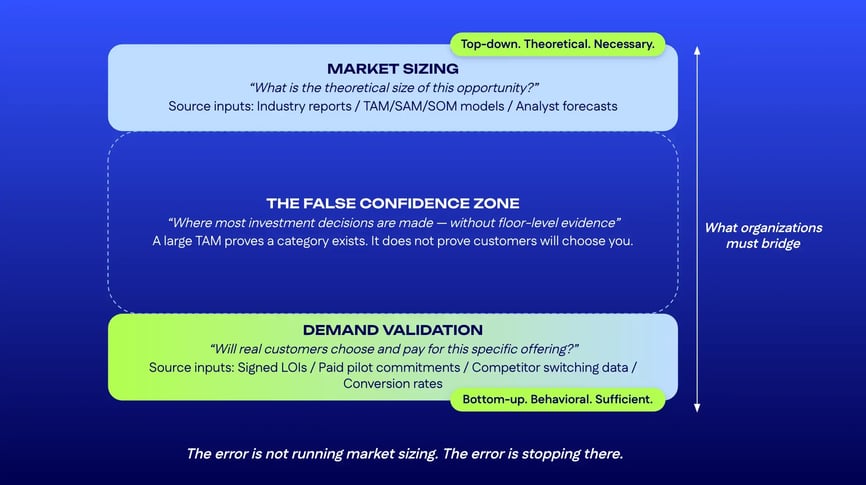
Market sizing tells you how large a theoretical opportunity is. Market demand validation tells you whether real customers will actually choose and pay for your specific offering. One is a research exercise. The other is commercial proof.
The gap between the two matters because investment decisions get made on the basis of these documents. When market sizing substitutes for demand validation, the risk being underwritten is far larger than it looks. New product failure rates sit consistently between 70 and 95 percent depending on the sector. Most of those failures were validation failures.
This article explains what genuine market demand validation looks like, how to read the signals worth trusting, and how to spot the most common failure mode we see in corporate contexts. By the end, you’ll have a clear framework for collecting demand evidence that supports real investment decisions.
What is Market Demand Validation?
Market demand validation is the structured process of gathering behavioral evidence that a sufficient number of real customers will choose and pay for your specific offering. At a price point and volume that makes the business model genuinely viable, not just theoretically interesting.
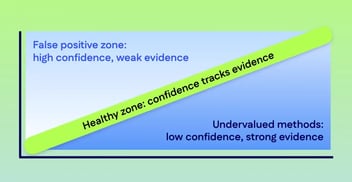
Most organizations treat market sizing as a proxy for this. A TAM analysis, a projected share figure for the investment committee. It creates a coherent narrative. But it’s not validation evidence.
-
Market sizing is a ceiling estimate. It tells you how large a category could theoretically be.
-
Demand validation is floor-level evidence. It tells you whether customers in your target segment will actually take a specific commercial action with your organization, at a price that works.
Both matter for an investment decision. The error is using the first as a substitute for the second.
So what does real demand evidence actually look like, and how is it different from the research most organizations already have? That distinction causes real problems in practice. Organizations that conflate the two build investment cases on assumptions. The committee sees strong numbers. The product goes to market. The numbers don’t translate.
The three levels of demand
The three levels of demand represent three distinct states of evidence, each requiring a different validation approach and supporting a different investment decision. Demand exists on a spectrum, and what counts as evidence at one level won’t cut it at another.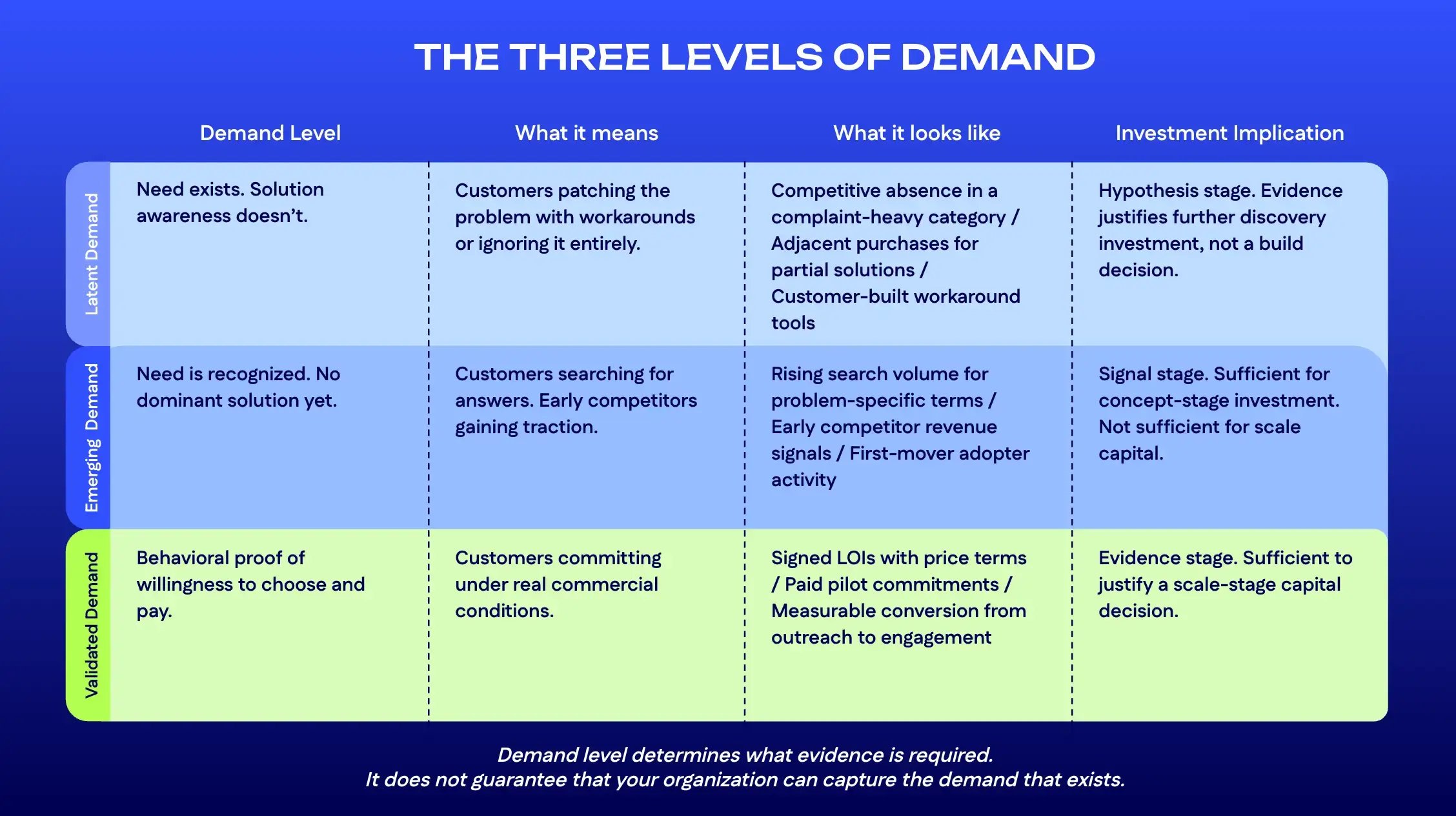
Latent demand
Latent demand exists when customers have a genuine unmet need but no awareness that a solution could exist. They’re patching the problem with workarounds or just living with it. Demand is real. It just has no market expression yet.
The signals are indirect: adjacent solutions customers already pay for to partially address the problem, or competitive absence in a category where complaints are loud. Validating latent demand takes more work because you’re not testing recognition of a known category. You’re testing whether customers will recognize and prioritize the problem at all when a solution is framed for them.
Emerging demand
Emerging demand is when the need is recognized and early solutions are entering the market. Customers know what they’re looking for. Competitor traction is starting to show. Search volume is growing. Early adopters are making choices.
For corporate innovators, this is the most actionable starting point. The market is open, behavioral data is collectible, and no dominant player has won the positioning yet. The window is real and time-bound.
Validated demand
Validated demand is the level that justifies a real capital commitment. Customers have demonstrated through behavior that they’ll choose and pay for your specific offering.
The clearest signal in B2B? A signed letter of intent with commercial price terms. Paid pilot commitments carry similar weight. Both require customers to put something at stake, which is exactly what separates them from a friendly interview.
At this stage, the question shifts from whether demand exists to whether you can build a viable business around it. That’s the threshold for committing meaningful capital.
The Portfolio Extrapolation Trap
The Portfolio Extrapolation Trap is the most common failure mode in corporate demand validation, and the least discussed. It occurs when an organization uses existing customer demand for a current product as evidence of demand for a new offering. The logic feels sound on the surface. The commercial consequences are predictable.
The pattern’s familiar. A large organization has a successful product with an established customer base. A new offering gets proposed, something adjacent or built on existing relationships. Someone in the room says: “We’ve got 30,000 enterprise clients. There’s clearly demand for this.”
That statement conflates relationship access with demand signal. Having 30,000 clients tells you those organizations trusted you enough to buy what you already built. It tells you nothing about whether they’ll pay for something new.
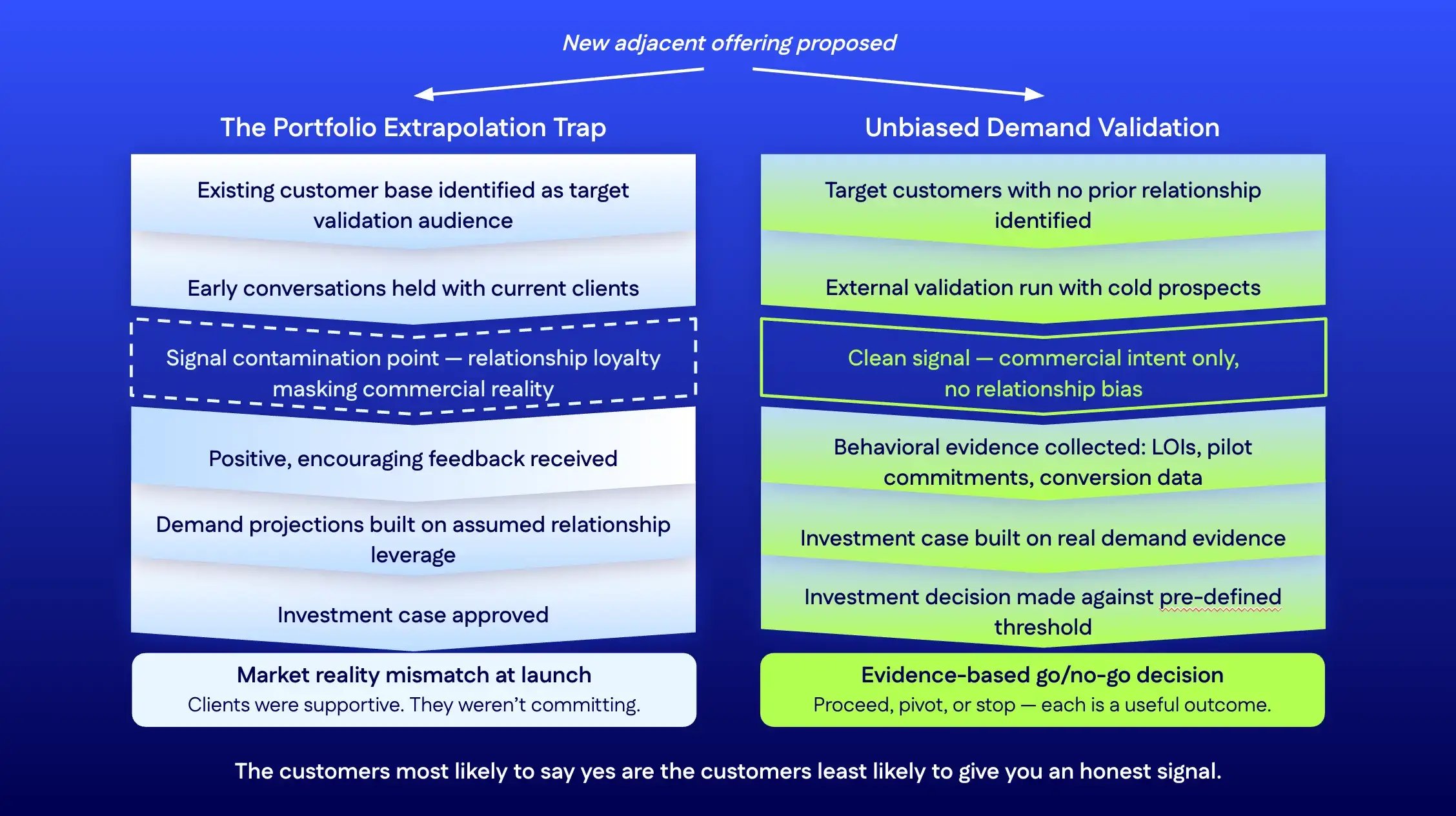
The structural reason this trap persists isn’t carelessness. Corporate innovation decisions are made by people who know the existing business well, and who’re evaluated partly on how effectively they leverage it. Extrapolating from portfolio strength to new-product demand is organizationally rational behavior. Your existing customer relationships are real assets. But the assumption that those assets automatically translate into demand for a new offering? That’s where the logic fails.
The consequences play out the same way every time. Demand projections get built on assumptions about relationship leverage. Early conversations with existing clients generate politely encouraging signals. The investment case looks strong. Then the product hits the market and runs into a reality the organization wasn’t positioned to see: those clients were being supportive, but they were supporting a relationship. They weren’t committing to a new purchase.
The fix? Validate new offering demand with customers who have no prior relationship with your organization. That’s uncomfortable, especially for teams whose competitive advantage is the existing client base. But unbiased signal is what investment decisions require. Feedback from existing relationships is structurally biased toward encouragement, regardless of actual commercial intent.
What Real Demand Signals look like in corporate B2B
What real demand signals look like in corporate B2B is different from what standard startup frameworks describe. Most validation models were built for consumer markets (B2C), where signals are faster and cheaper to collect. In B2B, the signals are harder to reach, take longer to surface, and are far more reliable when you find them.
Behavioral signals vs. research signals
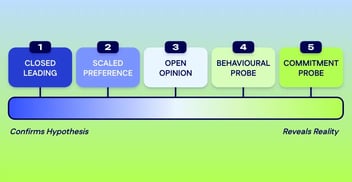
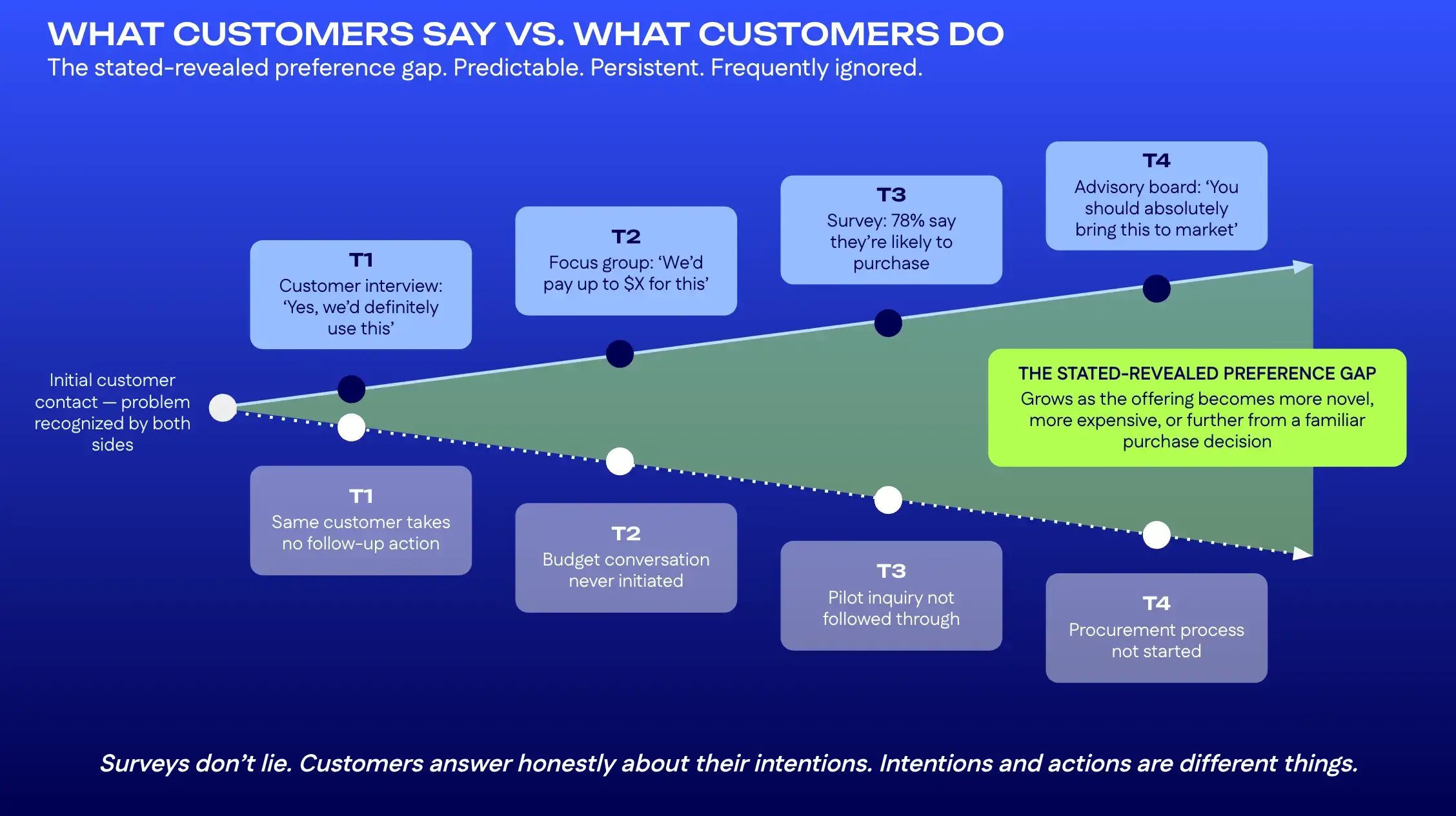
There’s a well-documented gap between what customers say they’ll do and what they actually do. Behavioral economics has established this as a predictable feature of human decision-making, not an occasional quirk. The implication is direct: research signals measure stated intent. Behavioral signals measure real action. They’re not the same thing.
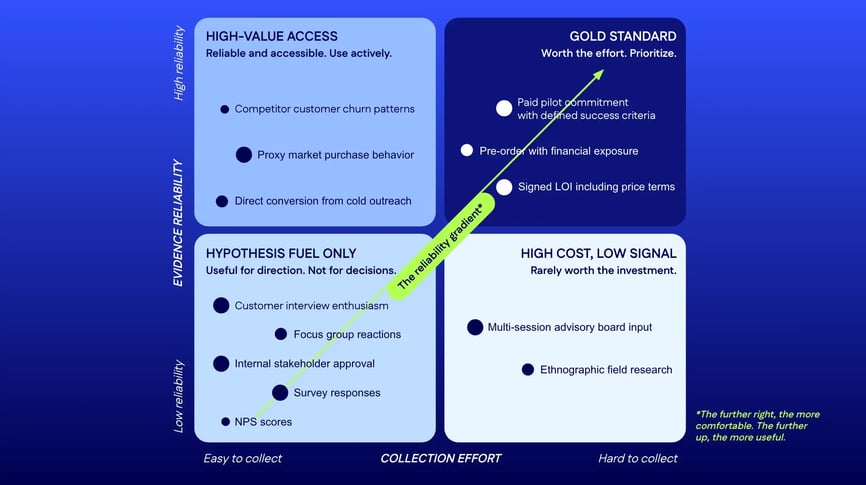
Research signals, including survey responses and focus group reactions, are useful for understanding the problem space and building hypotheses. They’re not validation evidence. If you’ve sat through an enthusiastic focus group followed by a weak product launch, you know exactly what we mean.
Behavioral signals are evidence of real choices under real conditions. The clearest form in B2B is a signed LOI with commercial price terms. Paid pilot commitments carry the same weight. Both require customers to put something at stake, which is what separates them from survey responses.
Demand signals worth tracking in B2B corporate contexts
In B2B corporate contexts, behavioral signals take forms that standard startup frameworks often miss. Here’s what we look for:
-
Competitor traction tells you that customers in your target segment are already paying someone to solve this problem. If a provider in your category has real revenue, demand isn’t theoretical anymore.
-
Customer switching patterns show you where active dissatisfaction lives. When customers move from one provider to another, they’re making a costly, deliberate choice. Understanding what drove that decision will tell you more about demand intensity than any survey ever could.
-
Proxy market behavior shows what customers already pay for when your specific category doesn’t exist yet. Adjacent solutions that partially solve the problem signal genuine willingness to pay for a complete one.
From signals to investment decision
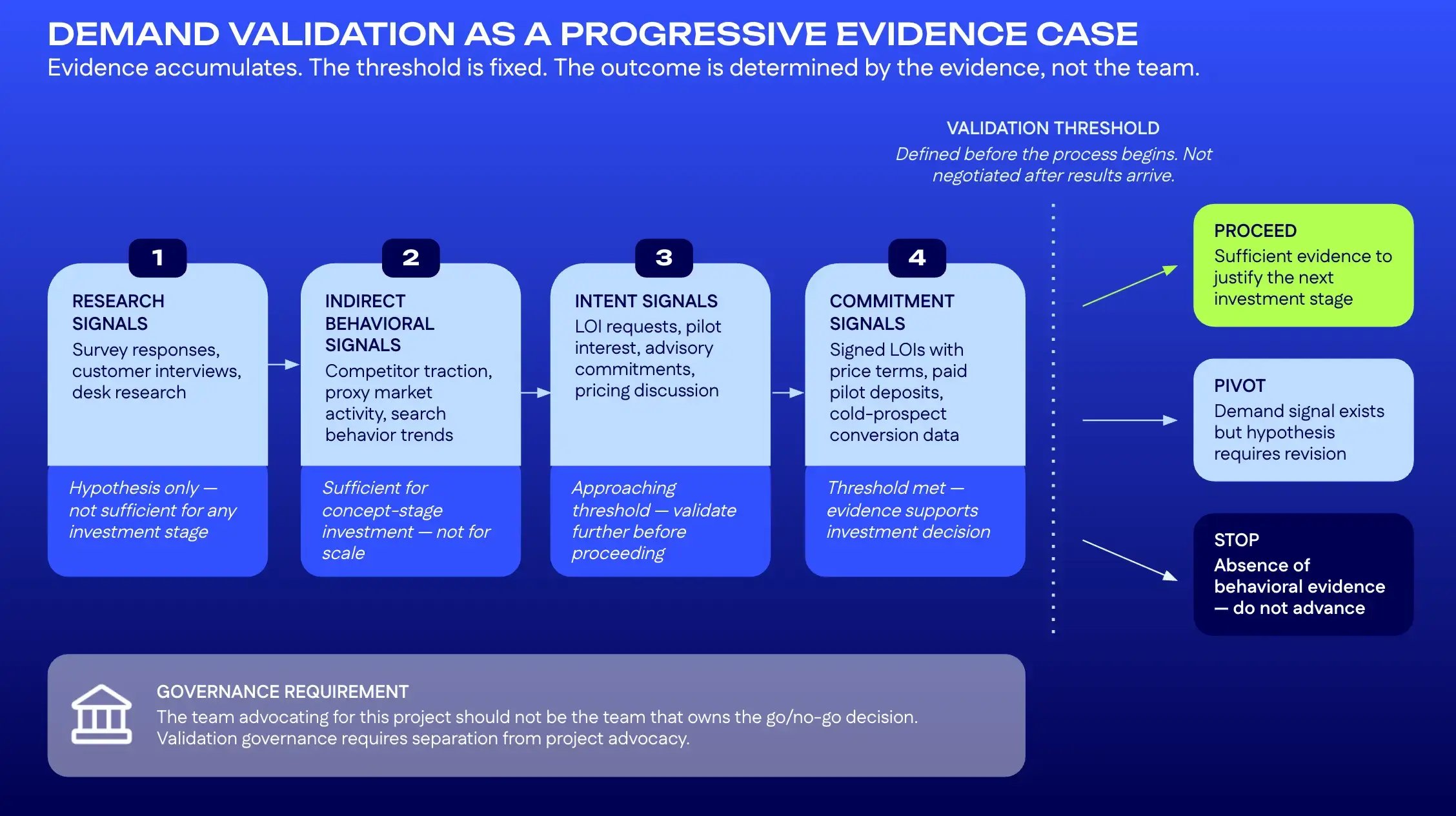
The move from signals to an investment decision is where most validation processes break down. Not because the evidence is ambiguous, but because the threshold was never defined. Demand validation doesn’t produce a single clear answer. What you build is a progressively stronger case, evidence that either meets your pre-defined threshold or doesn’t.
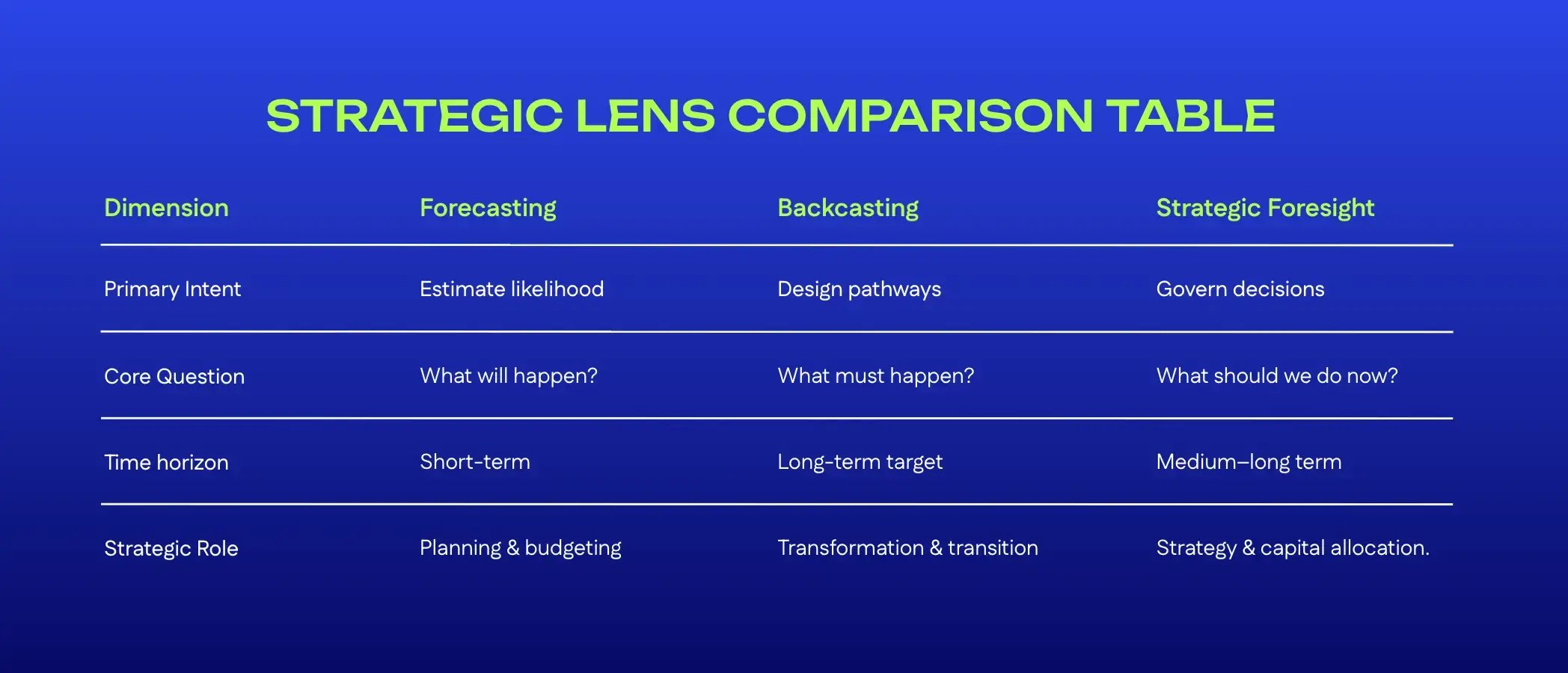
The threshold principle matters as much as the signals. If you define it after seeing results, you’ve created the conditions for motivated reasoning, where the organization interprets evidence to reach a conclusion it already wants. Define what counts as sufficient evidence before you start.
What does that look like in practice? Answering three questions upfront gives your validation process structure it can actually hold to:
-
What behavioral signals, at what volume or conversion rate, would we accept as evidence of validated demand?
-
What would tell us that demand exists but we can’t capture it with our current positioning?
-
At what point would we stop and make a go/no-go call?
When results arrive, the evidence either supports your hypothesis or it doesn’t. If it doesn’t, the signal either challenges a specific assumption or falls below the minimum threshold altogether. Each outcome is useful. But the last one, the clean stop signal, is only available to teams that set stopping criteria in advance and kept validation governance separate from project advocacy.
These questions connect directly to the broader commercial validation framework. For a full overview of how demand validation fits within the complete commercial validation process, see Commercial Validation: How to validate new business idea. For the experiments that generate these signals, see Commercial Validation Methods: How to choose the right experiment for your context. To see how demand evidence combines with customer discovery, see Customer Validation: How to identify real pain points before you build a solution.
The question that governs investment decisions is whether real customers will choose and pay for your specific offering, at a margin the business model can sustain.
Demand validation gives you the evidence to answer that before you commit meaningful resources. Know what level of demand you’re testing for and prioritize behavioral signals over stated intent. Resist the pressure to treat portfolio strength as a proxy for new-product demand.
Set your evidence threshold before the process starts. Then let the market tell you what the organization needs to hear.
Not sure if your demand evidence is strong enough to invest?
If you're working through a demand validation question right now, book a 15-minute call with Henning Bär, our Partner Venture Building & Studio.
At Bluemorrow, we help corporate teams collect the behavioral evidence that investment decisions actually require – from signal design through to go/no-go criteria. No agenda, just a conversation about where your validation process stands.