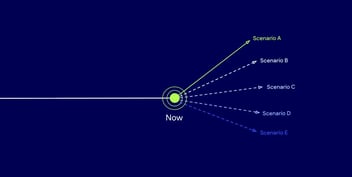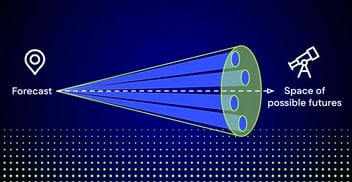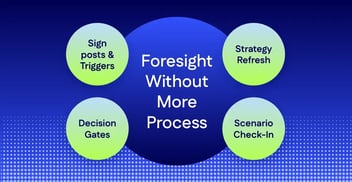

Uncertainty is no longer episodic. It is structural. Most leadership teams know this, and many have invested in strategic foresight as a response. Yet despite horizon scans, trend reports, and scenario workshops, foresight often fails to change real decisions.
The reason is not a lack of tools. It is how strategic foresight methods are used.
Strategic foresight methods are meant to help organizations anticipate change, explore uncertainty, and prepare for multiple futures. But when they are treated as isolated techniques, rather than as a system that supports leadership choices, they produce insight without consequence.
In this article, we focus on how senior leaders should actually use strategic foresight methods. We assume you already understand the fundamentals of foresight. Our goal is to help you select the right methods, connect them into a coherent approach, and govern them so they inform strategy, investment, and transformation decisions that matter.
Why foresight methods fail when treated as a toolbox?
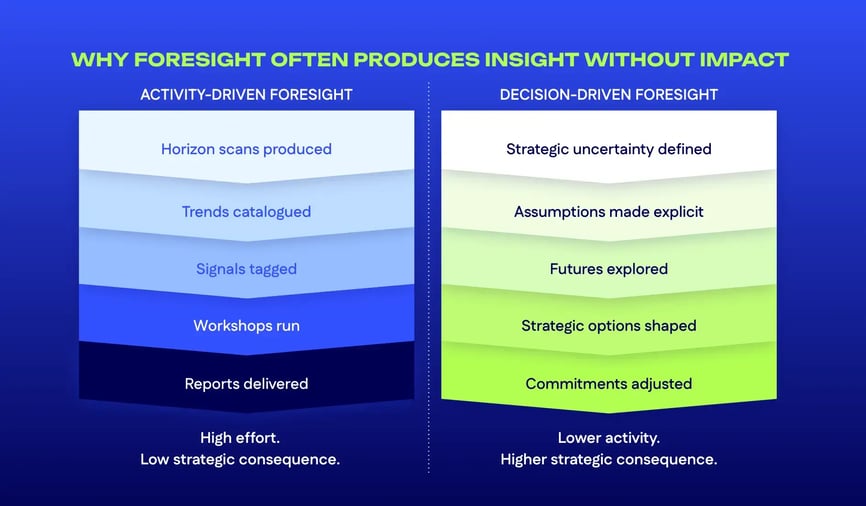
Strategic foresight methods fail when they are treated as a toolbox rather than as a decision system. Many organizations apply multiple foresight techniques, yet leadership behavior remains unchanged.
This typically shows up in familiar ways. Trend decks circulate but do not alter priorities. Scenario workshops spark discussion but not commitment. Weak signals are collected, tagged, and archived, but never escalated.
At Bluemorrow, we see that foresight rarely fails on analytical quality. It fails on decision logic.
When foresight is treated as research, success is measured by coverage and sophistication. When foresight is treated as a leadership capability, success is measured by whether it changes choices.
A useful diagnostic question for senior leaders is simple:
Which decisions would be different today if foresight did not exist?
If the answer is “none,” the issue is structural, not methodological.
Common causes include:
- Methods chosen because they are fashionable, not because they fit a strategic question
- Foresight teams optimizing for insight production instead of executive relevance
- No explicit handover from foresight outputs to decision forums
- Organizational antibodies that quietly resist uncomfortable futures
Foresight becomes valuable only when leadership makes it explicit what it is there to influence and what it is not.
The foresight method stack: sensing, interpreting, deciding
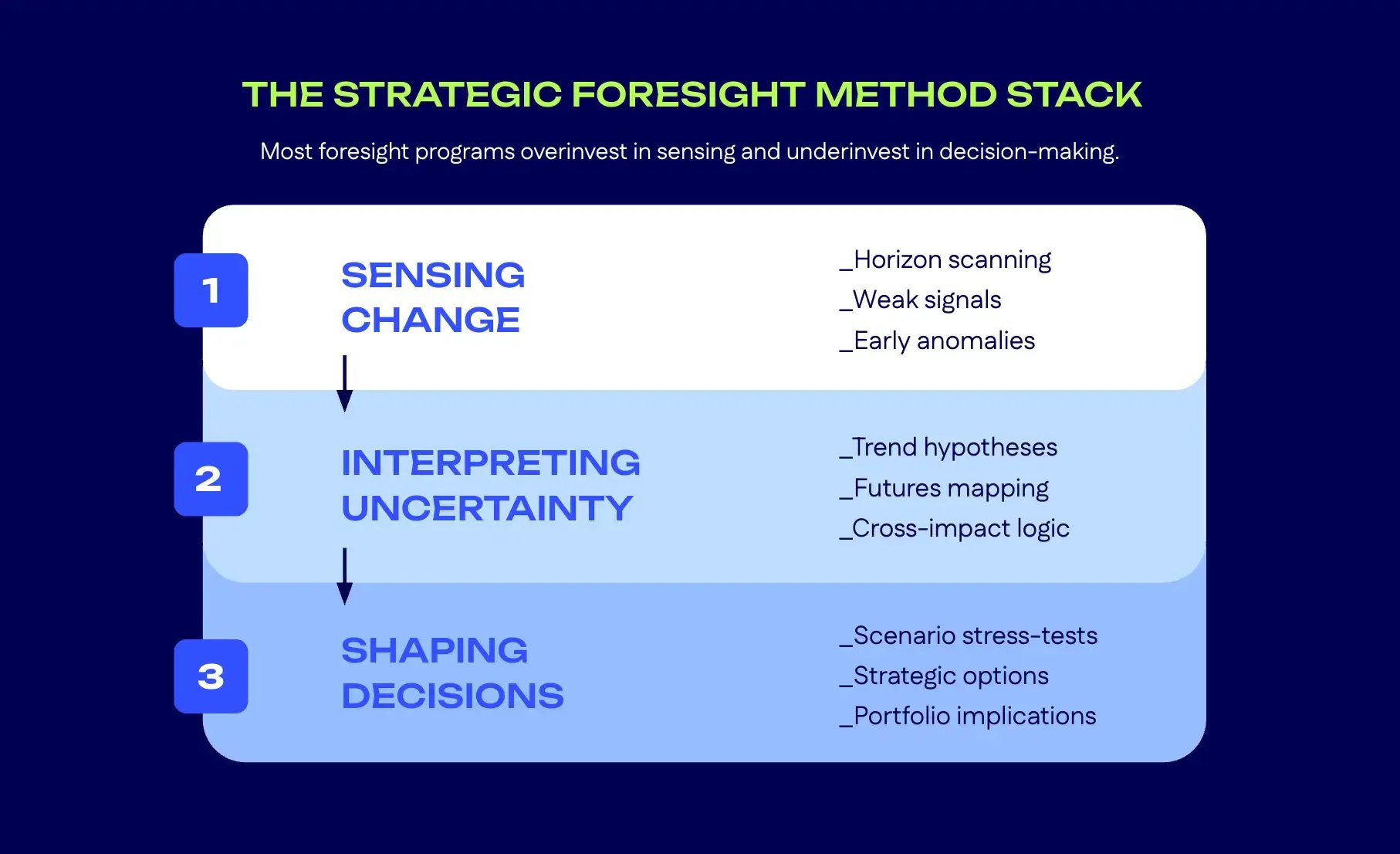
Strategic foresight methods work when they are organized into a clear stack that mirrors how leaders make decisions under uncertainty. This stack has three layers: sensing change, interpreting uncertainty, and shaping decisions.
Each layer has a distinct role. Confusing them or overinvesting in one at the expense of the others is one of the most common failure patterns.
Strategic foresight methods form a system that moves from early detection to strategic choice.
Sensing tools: detecting early change
Sensing tools exist to extend the organization’s peripheral vision. Horizon scanning and weak signal detection surface early indications that existing assumptions may no longer hold.
Their purpose is not accuracy. It is early attention.
Effective sensing follows three rules:
- It is guided by strategic intent, not general curiosity
- It privileges novelty over confirmation
- It is continuous, not episodic
A common leadership mistake is to ask foresight teams to “scan broadly” without clarifying what would actually matter if it changed. Without focus, sensing produces volume, not relevance.
Equally important is knowing when to stop. If sensing does not trigger new questions or challenge existing beliefs, more scanning will not help.
See how we helped Siemens Professional Education build a continuous sensing system to detect emerging trends and translate them into learning initiatives.
Sensemaking tools: turning signals into meaning
Sensemaking tools translate raw signals into structured insight. Key driver analysis, futures mapping, and systems thinking help leaders understand how disparate developments may connect, reinforce, or undermine one another.
This layer is where ambiguity is reduced, but never eliminated.
The goal is not to label trends, but to explore:
- Directional forces shaping the environment
- Interdependencies across technology, regulation, markets, and society
- Potential inflection points that could alter trajectories
A critical discipline at this stage is resisting premature certainty. Trends in foresight are hypotheses, not forecasts. Treating them as inevitabilities closes down strategic thinking too early.
See how AI is already reshaping this layer in practice, including measurable gains in speed and analytical quality from a real corporate foresight cycle.
Decision tools: testing and shaping strategy
Decision-focused foresight methods, most notably scenarios, stress-testing, and backcasting, exist to force choices. They translate uncertainty into implications for strategy, portfolios, and capabilities.
This is where many foresight programs struggle. Sensing and sensemaking are intellectually comfortable. Decision work is not.
Yet without this layer, foresight remains descriptive. With it, foresight becomes strategic.
A useful leadership rule of thumb is blunt:
If foresight does not make at least one strategic option uncomfortable, it is not doing its job.
Choosing the right foresight methods for the right question
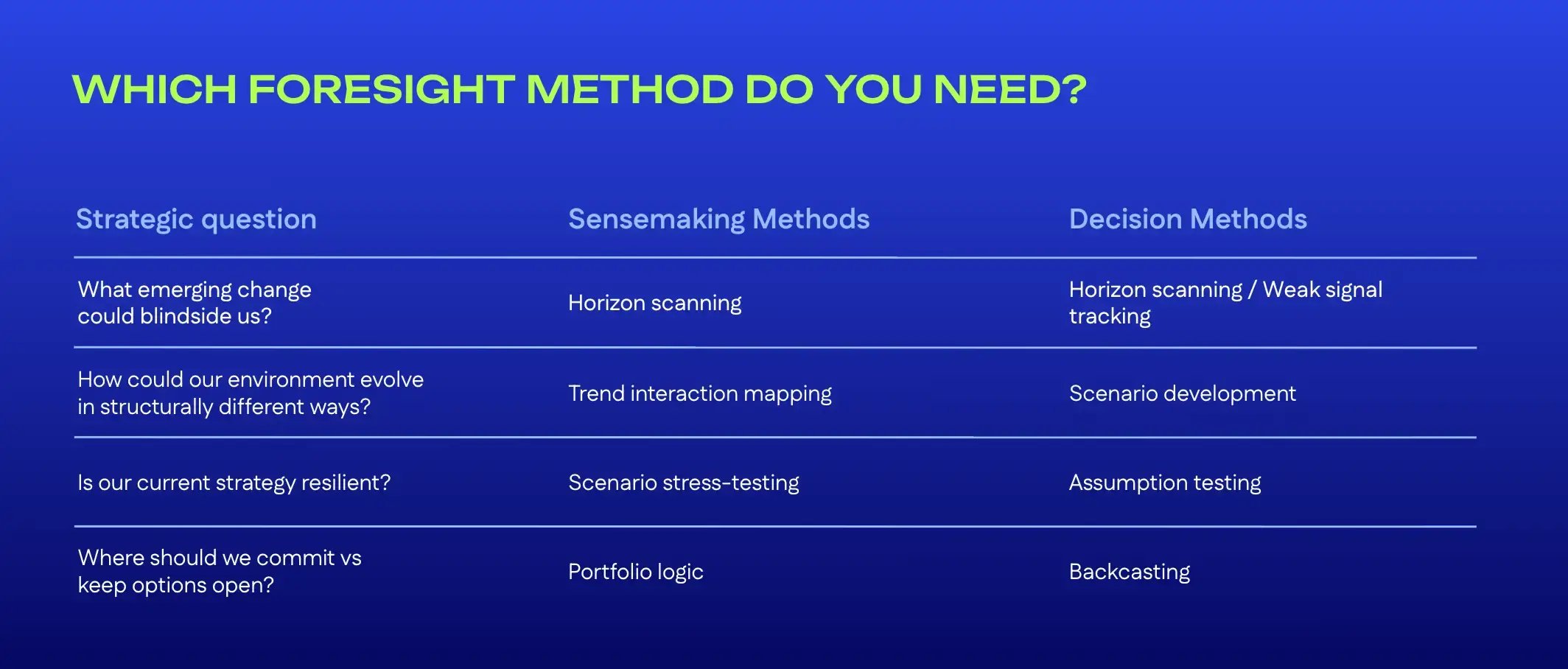
Choosing strategic foresight methods should always start with the decision you are trying to inform. Different questions demand different methods, depths and time investments.
The right foresight method depends on the strategic question, the uncertainty involved and the consequences of getting it wrong.
Senior leaders typically turn to foresight with questions such as:
- Which assumptions underpinning our strategy are most fragile?
- Where should we place long-term bets under deep uncertainty?
- How early do we need to act to retain strategic options?
- What would force us to fundamentally rethink our business model?
Each of these questions implies different method choices.
For example:
- When the question is “What might be emerging that we are missing?”, sensing tools are appropriate.
- When the question is “How could this environment evolve in fundamentally different ways?”, scenario development becomes essential.
- When the question is “What should we commit to now, and what should remain optional?”, stress-testing and backcasting are required.
Leaders often ask how much foresight is enough. The more useful question is: How irreversible is the decision we are about to make? The more irreversible the commitment, the more rigor foresight deserves.
Trade-offs are unavoidable:
- Speed versus confidence
- Precision versus optionality
- Breadth versus depth
There is no perfect method set, only informed choices.
From insights to decisions: where foresight methods create value
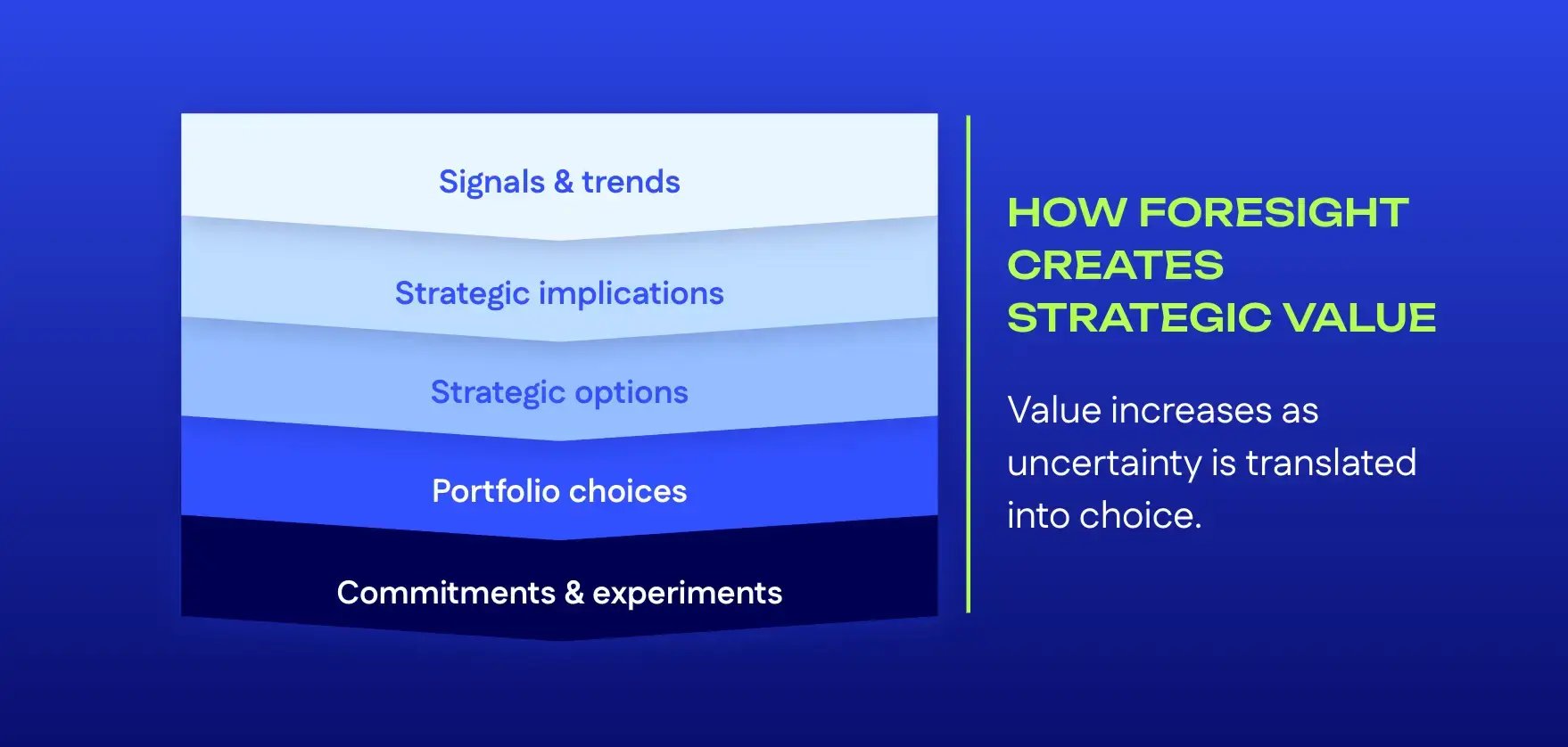
Strategic foresight methods create value only when they are explicitly designed to influence decisions. Insight alone does not justify investment.
Foresight matters when it changes the timing, direction or nature of strategic choices.
In practice, foresight most often supports three decision domains.
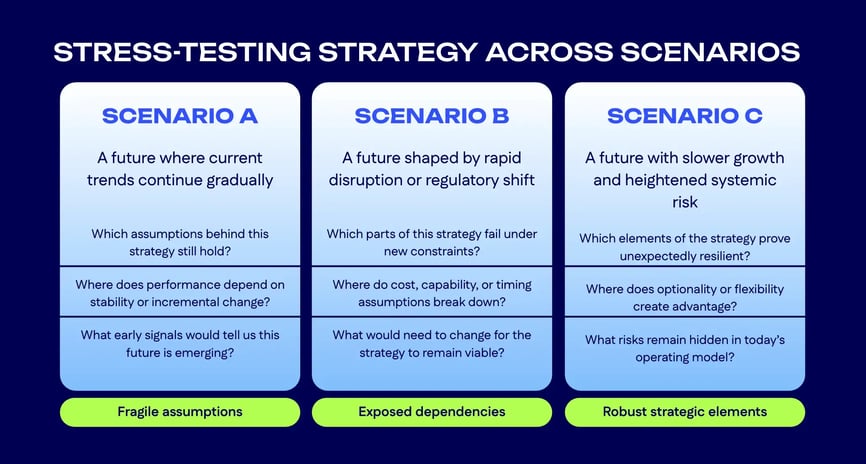
Strategy stress-testing
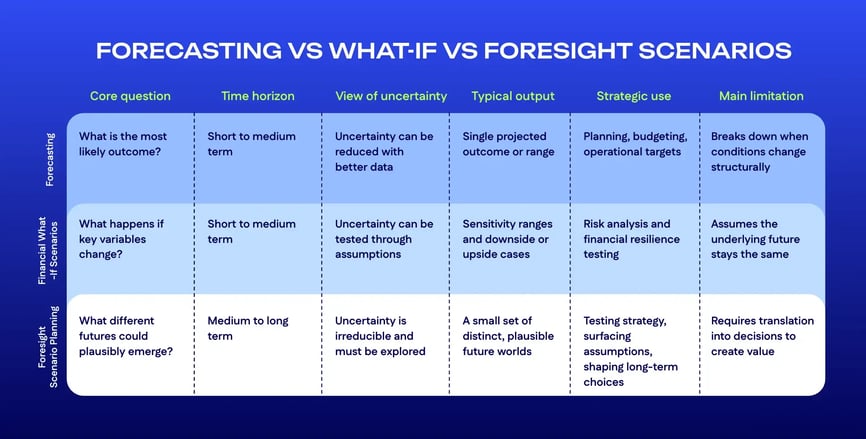
Scenario-based stress-testing challenges whether today’s strategy would remain viable across different future conditions. It surfaces vulnerabilities that remain invisible under a single expected future.
Effective stress-testing answers questions like:
- Which strategic elements are robust across futures?
- Where are we implicitly betting on one outcome?
- What would we need to change if a different future began to materialize?
The outcome is not a “best strategy,” but a clearer view of where resilience or flexibility is required.
Portfolio and investment choices
Foresight methods are particularly powerful when applied to portfolios rather than single bets.
They help leaders balance:
- No-regret moves that pay off across futures
- Strategic options that preserve flexibility
- Larger bets that depend on specific conditions
This portfolio logic shifts the conversation from “Are we right?” to “Are we prepared?”
It also allows organizations to act earlier, when uncertainty is high but options are cheap.
Innovation and transformation roadmaps
Backcasting connects long-term ambition with near-term action. It helps leaders translate future aspirations into concrete capability development, milestones, and learning objectives.
Used well, it prevents two common traps:
overcommitting too early, or waiting until change becomes unavoidable.
To see how this works in practice, see our work with a global FMCG player on applying backcasting to strategy and innovation.
Governing foresight methods at the enterprise level
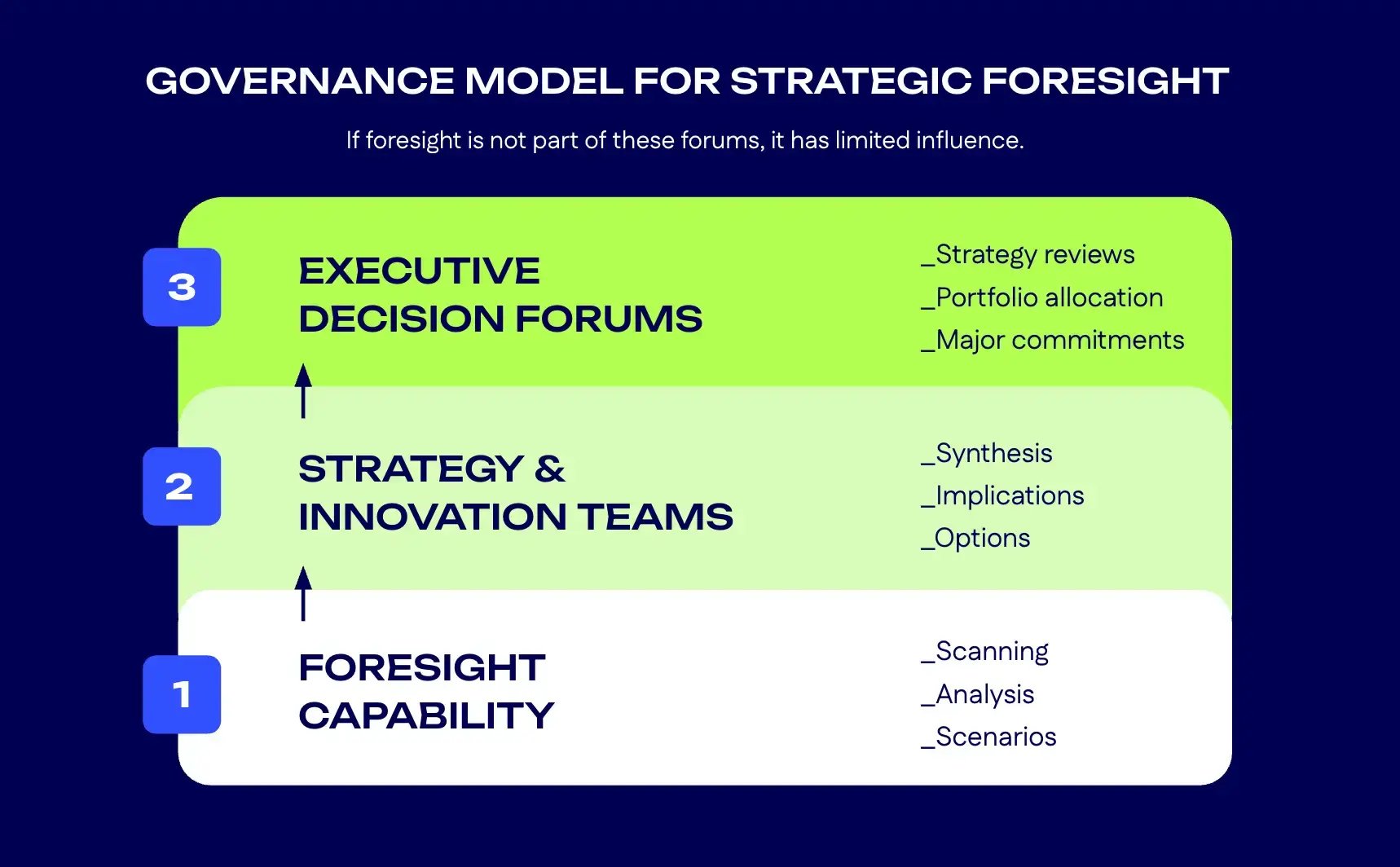
Without governance, even strong foresight methods degrade over time. Ownership, cadence and integration determine whether foresight becomes institutionalized or remains episodic.
Strategic foresight methods require governance to retain credibility and influence.
Three governance questions matter most.
Who owns foresight?
Ownership can sit in strategy, innovation, technology, or a dedicated foresight function. Each model has strengths and risks.
What matters is accountability for:
- Framing the right strategic questions
- Ensuring methodological integrity
- Translating outputs into decision-ready formats
When ownership is unclear, foresight becomes advisory without authority
When is foresight used?
Foresight must align with real decision moments:
- Annual strategy refresh
- Portfolio and investment reviews
- Major transformation or M&A discussions
A simple rule applies:
If foresight has no calendar, it has no power.
How are outputs used?
Executive forums must explicitly request foresight inputs. This includes scenarios, signposts and implications, not just trend summaries.
When leaders consistently ask, “What does foresight tell us about this decision?”, the capability matures quickly.
Common foresight method failure modes (and how to avoid them)
Even well-intentioned foresight efforts can fail. The patterns are predictable and preventable.
Most foresight failures are organizational and political, not analytical.
Typical failure modes include:
- Signal overload: Too much input, no prioritization
- Trend inflation: Labeling everything as a trend to avoid choice
- Scenario theater: Engaging narratives with no strategic consequence
- Ignored weak signals: Early warnings dismissed because they threaten existing power structures
Two forces are often underestimated. The first is cognitive bias, especially confirmation bias in interpretation. The second is politics. Foresight challenges assumptions, and assumptions often protect interests.
Avoidance requires:
- Clear leadership sponsorship
- Explicit decision hooks
- Psychological safety to discuss uncomfortable futures
Building a fit-for-purpose foresight method portfolio
There is no universal best practice for strategic foresight methods. What works depends on context, maturity and ambition.
The right foresight setup evolves over time and prioritizes consequence over sophistication.
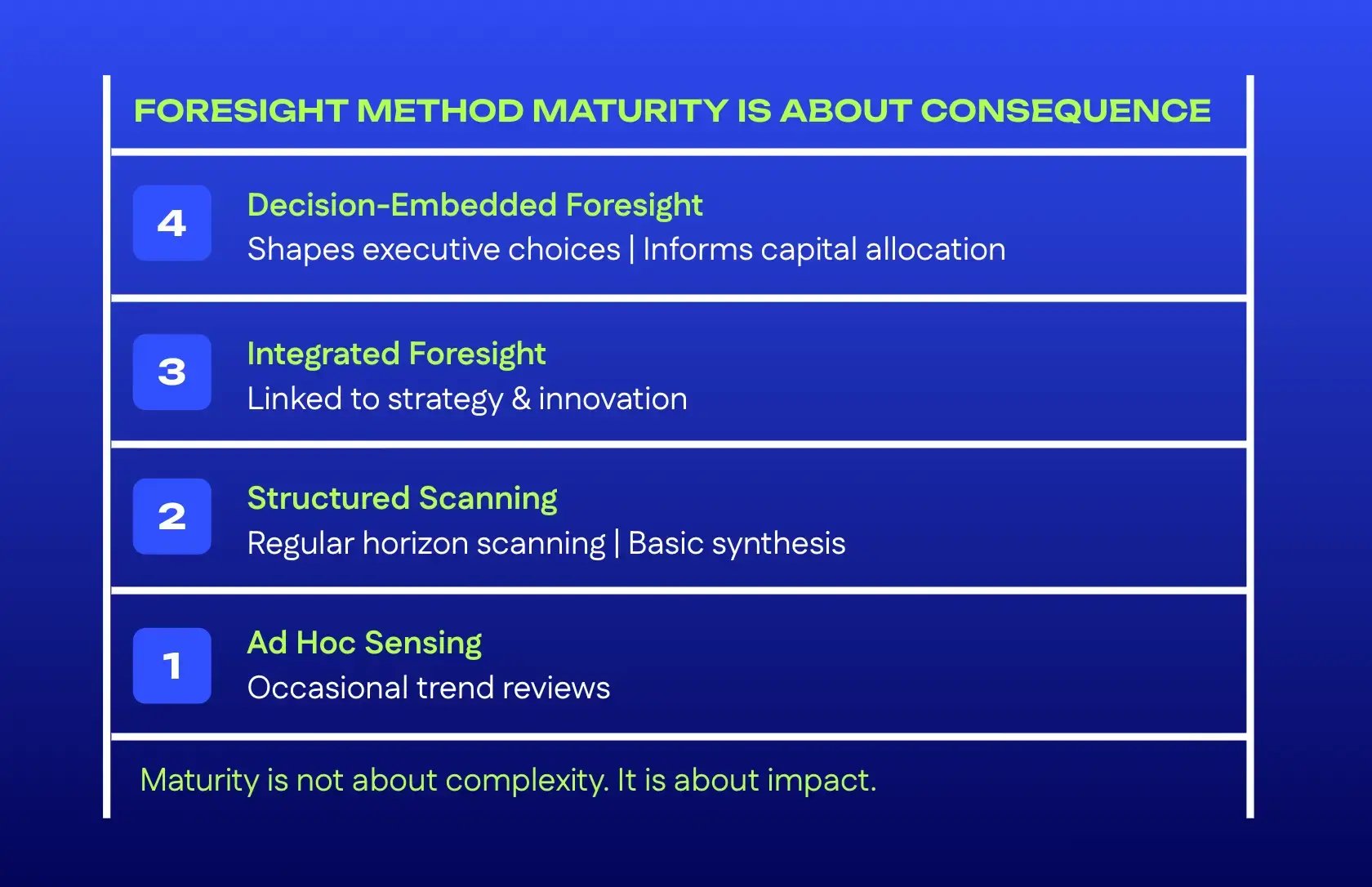
Organizations typically progress through stages:
- Ad hoc sensing
- Structured scanning and synthesis
- Integrated foresight linked to strategy and innovation
- Decision-embedded foresight shaping executive choices
Leaders often ask whether they should aim for the most advanced setup. In our experience, maturity is not about complexity. It is about whether foresight reliably informs decisions that matter.
Sometimes, a lightweight approach, used consistently, is far more effective than an elaborate framework used occasionally.
The decision is the point
Strategic foresight methods are only as valuable as the choices they shape. The organizations that get the most out of foresight are not those with the most sophisticated tools, they are the ones that have made foresight a permanent input to the decisions that matter most.
If your foresight work is not changing priorities, surfacing uncomfortable assumptions or informing where capital goes, the issue is rarely the method. It is how the method connects to power.
Start small if you need to. Pick one strategic decision currently on the table. Apply a single foresight lens to it. Ask what would have to be true for your current assumption to break. That conversation, done well, is worth more than a year of trend reports.
At Bluemorrow, we help leadership teams build foresight as a decision capability, not a research function. Schedule a call with Sebastian and let’s talk about what that looks like for your organization.