
Foresight helps leaders make better decisions under uncertainty – before markets force their hand. In an era of repeated shocks and continuous change, linear plans break quickly. What endures is the need to spot change early, understand its implications, and commit to options with discipline.
Strategic foresight is not about predicting the future. It is about governing uncertainty so you can navigate change with confidence, allocate capital, shape portfolios, and set triggers to change course timely if need be. In this guide, we touch upon how leaders design and integrate foresight into decision-making – covering outcomes, frameworks, governance, workshops, metrics, and responsible use of AI.
What is Strategic Foresight (and what it isn’t)?
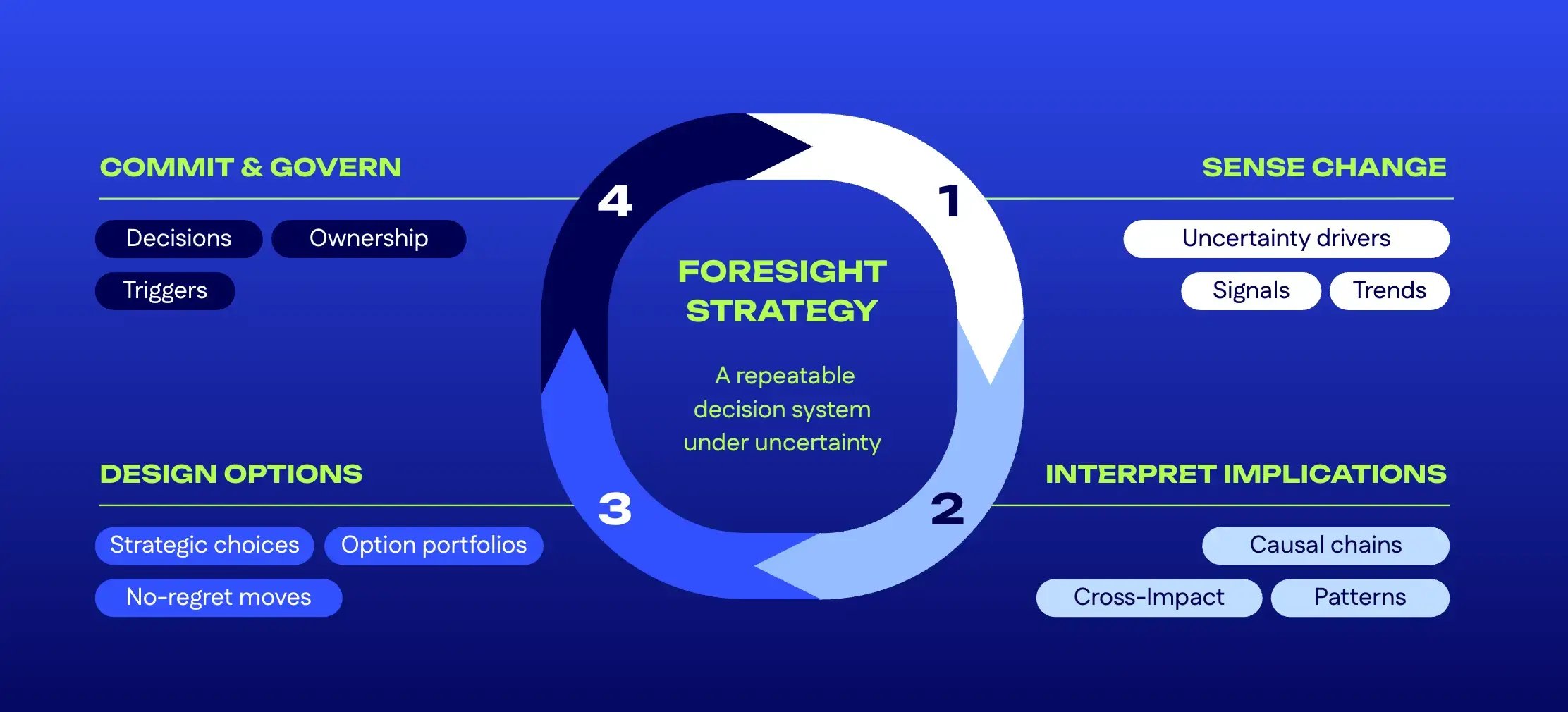
Strategic foresight converts signals of change into a better understanding of the future. Ultimately, it exists to enable leaders to make decisions, what they fund, pause, accelerate, or exit, before uncertainty hardens into risk.
At its core, strategic foresight is about modeling patterns of change that eventually lead to alternative futures. Through foresight approaches, leaders can understand these systematically and prepare the organization to act despite uncertainty. This goes well beyond trend or tech reports and future scenarios. Without ownership, and most importantly integration into decision forums, foresight remains interesting but inert.
Leaders often ask whether foresight is simply a rebranded version of forecasting. The distinction lies in intent and methodology. Forecasting tries to predict the future based on past data. Strategic foresight explores what is plausible in the future, creates optionality and ultimately governs how insights translate into concrete decisions over time.
Strategic foresight basics every leader should understand
Strategic foresight rests on a small number of fundamentals that leaders should be fluent in, even if they never run the analysis themselves.
- Foresight assumes the future is plural, not singular. Alternative futures can emerge depending on how technologies evolve and scale, regulatory decisions are made, consumers act, and systems interact. A good strategy prepares an organization for an uncertain future, not a singular, assumed version of it.
- Foresight focuses on early signals, change drivers and alternative trajectories, not predictions. Early on signals are weak, often ambiguous indicators that underlying systems may be shifting. The value comes from detecting patterns over time, not from any single data point.
Foresight only matters when it is decision linked. Insight without a decision context creates intellectual comfort, not strategic advantage. Effective foresight is always anchored in leadership questions: Where should we place bets? What risks should we take? How can we hedge risk? What options must we therefore keep alive?
Why is strategic foresight relevant for my organization?
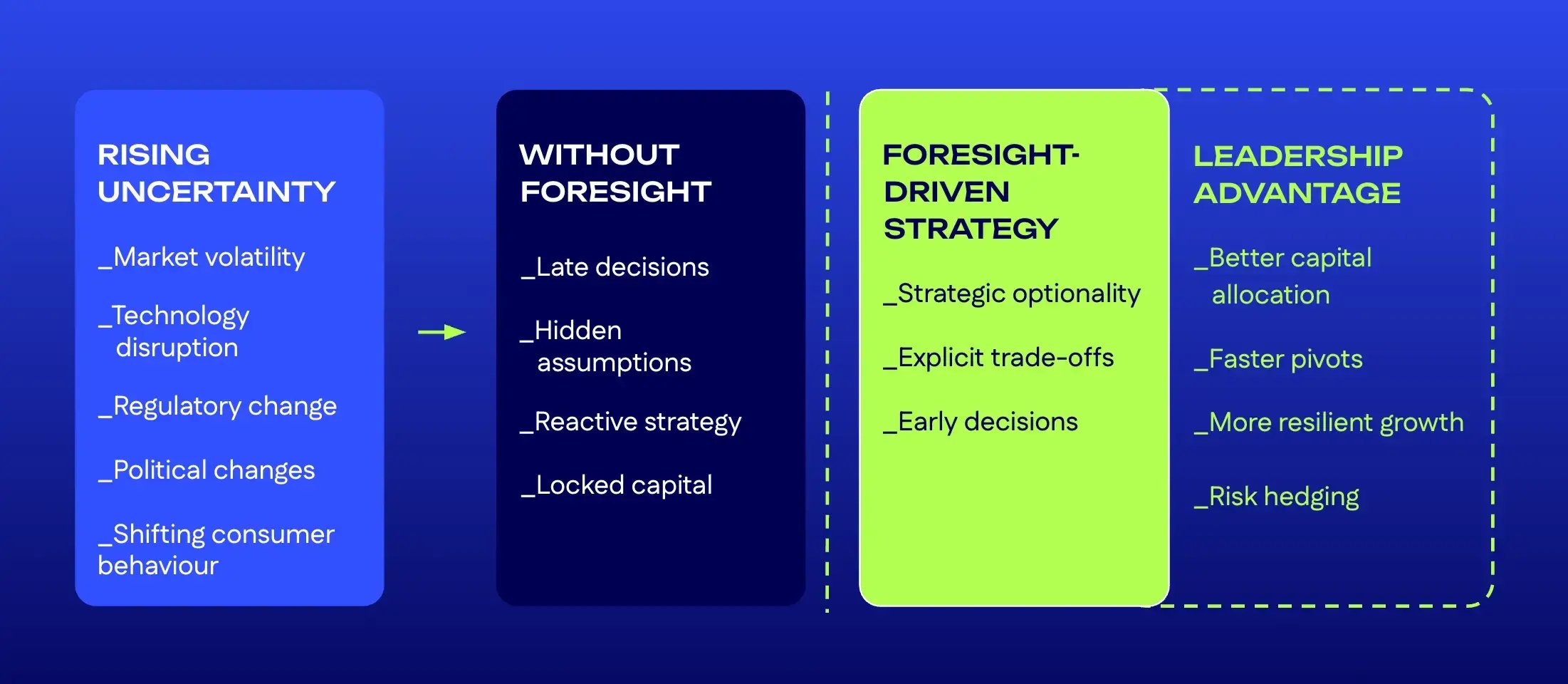
Strategic foresight is relevant because most organizations are no longer failing due to poor execution. They fail because they commit too late, over-commit to the wrong assumptions, or lock capital into paths that become fragile faster than expected.
For leaders, foresight should not be an abstract concept. It is a way to regain control over timing, optionality, and strategic intent in environments where certainty arrives late.
Because strategy is increasingly made under structural uncertainty
Many decisions today have to be made before markets, technologies, or regulations stabilize, speed and being early is a crucial competitive factor. Waiting for clarity often means catching up and paying a premium or missing the window entirely.
Deeply integrated strategic foresight allows organizations to act earlier by:
- identifying where uncertainty matters most,
- distinguishing between reversible and irreversible decisions,
- and preparing options before commitment becomes urgent.
This shifts strategy from reactive adjustment to proactive positioning while hedging risk. It creates the basis for fast course-corrections when the environment changes.
Because traditional planning cycles no longer match the pace of change
Traditional annual planning and resulting multi-year roadmaps assume relatively stable conditions. In practice, assumptions can break within months, depending on the industry even weeks or days, requiring changes to the once-built plans.
Foresight introduces a continuous sensing and review loop that complements planning rather than replacing it. Leaders gain a mechanism to revisit assumptions, adjust portfolios, and reallocate resources without restarting the entire strategy process. With the help of the right tools, strategic monitoring can be largely automated, enabling very fast reactions in case things take a turn against the organization’s intended strategy.
Because capital allocation decisions carry increasing downside risk
As investments become larger, more interconnected, and harder to unwind, the cost of being wrong rises.
Strategic foresight improves capital allocation by:
- making implicit bets explicit,
- clarifying where optionality is worth paying for,
- and defining exit conditions in advance.
This reduces sunk-cost bias and increases strategic discipline
Because resilience and growth now depend on the same capabilities
Historically, resilience was treated as defensive and growth as offensive. Today, the same foresight capabilities underpin both.
Organizations that sense change early and act deliberately are better able to:
- absorb shocks without panic,
- pivot faster than competitors,
- and convert disruption into advantage.
Foresight aligns resilience with opportunity rather than treating them as trade-offs.
Because leadership teams need a shared language about the future
Without foresight, discussions about the future often become opinion-driven, abstract, or politicized. Strategic foresight provides a shared reference frame for discussing uncertainty, trade-offs, and timing.
This improves the quality of leadership conversations by:
- surfacing assumptions and making them explicit,
- grounding debate in structured alternatives,
- and focusing attention on decisions rather than narratives.
When this language is in place, alignment follows naturally.
How Foresight relates to Forecasting and Backcasting
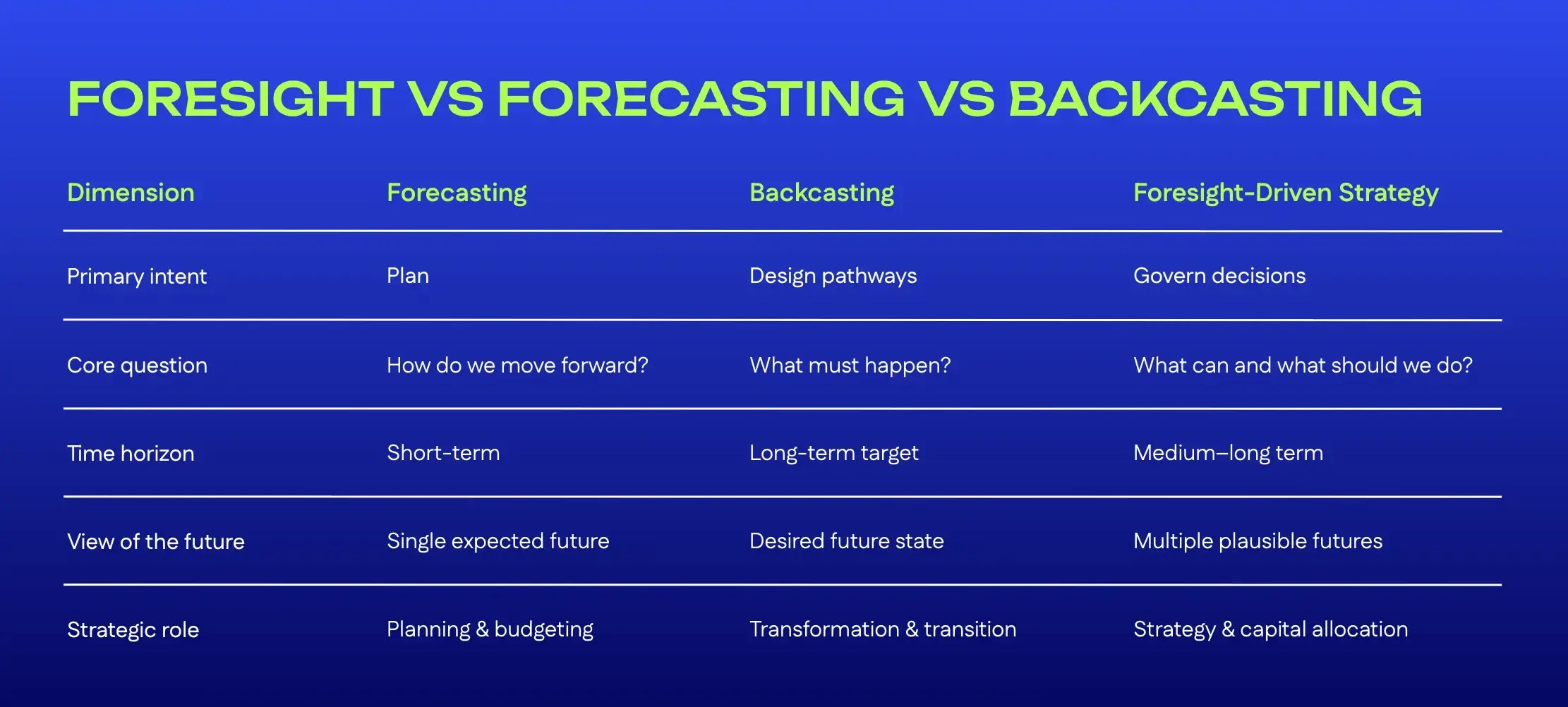
Forecasting and backcasting are often treated as competing planning approaches. In reality, they are methods that serve different purposes inside a broader foresight-driven strategy.
-
Forecasting extrapolates from the past and present into the future. It is effective when conditions are relatively stable and change is incremental. Leaders rely on forecasting to plan execution, allocate resources, and manage short- to near-term performance. Its weakness is not poor technique, but misplaced confidence. Forecasts quietly assume continuity, which makes them unreliable when uncertainty increases, i.e. usually in the longer term.
-
Backcasting starts from a desired future state and works backward to define the steps required to reach it. Its value lies in overcoming incremental, future-forward thinking to future-back thinking. When incremental improvement is insufficient, for example in sustainability transitions, platform shifts, or major business model change, starting from the desired end-state enables overcoming cognitive barriers and path dependencies. Backcasting helps break free from historical constraints, but without grounding in external uncertainty it can drift into aspiration rather than strategy.
Strategic foresight sits above both.
Foresight does not predict outcomes or prescribe end states. It explores multiple plausible futures to help leaders decide when forecasting is still valid, when backcasting is necessary, and when neither is sufficient without revisiting core assumptions.
In a foresight-driven strategy:
- forecasting is used where the future remains stable enough to optimize,
- backcasting is used where a deliberate transformation is required,
- and foresight governs the choice between them as uncertainty evolves.
This hierarchy prevents two common leadership errors: over-reliance on forecasts in volatile environments, and over-commitment to visionary targets that ignore external constraints.
For a deeper explanation of how forecasting and backcasting differ, and how leaders misuse them in practice, see our dedicated article on Forecasting vs. Backcasting.
The outcomes foresight-driven strategy must deliver
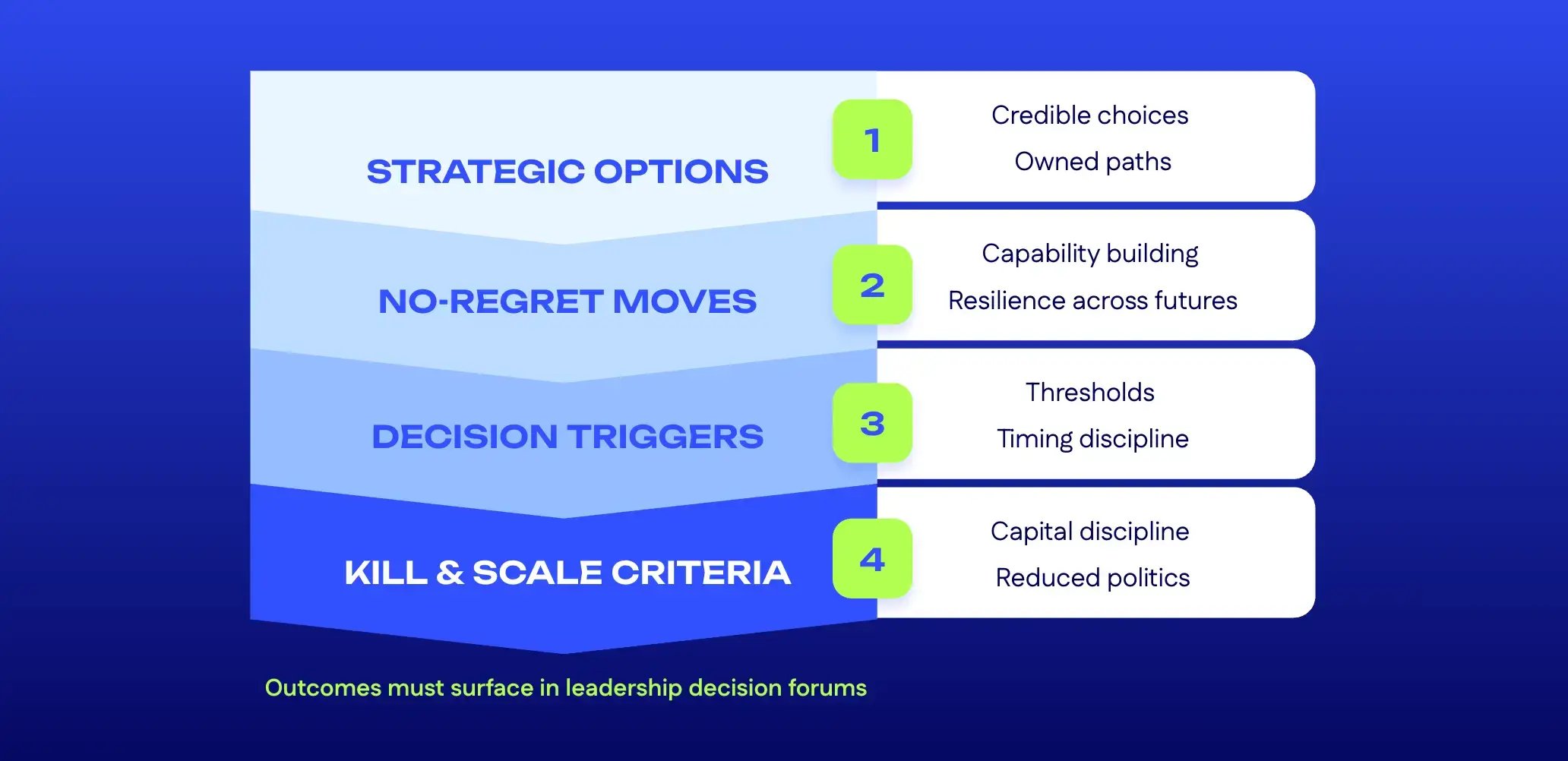
To be effective, strategic foresight must deliver decision-grade outcomes, not generalized insights. For leaders, the value of foresight is measured by how clearly it informs choices about capital, risk, and strategic direction – especially when information is incomplete.
At the executive level, the test is simple: does this insight (originating from a foresight activity) work change a decision now, or define the conditions under which a decision will be made later?
Outcome 1: Clear strategic options, not abstract possibilities
The first outcome leaders should expect is a limited set of strategic options that are credible, comparable, and owned. These options represent different ways the organization could respond if certain futures begin to materialize.
Good options are explicit about:
- the strategic intent they serve,
- the upside they create if the future unfolds as expected,
- the downside if it does not,
- and the resources required to keep the option viable.
This moves foresight away from open-ended exploration and wishful thinking and toward disciplined choice architecture.
Outcome 2: No-regret moves that strengthen the core
Not all foresight outputs require waiting for uncertainty to resolve. A strong foresight-driven strategy activity identifies no-regret moves – actions that make the organization more resilient, adaptive, or competitive across multiple plausible futures.
These moves often involve:
- building foundational capabilities,
- investing in optional infrastructure,
- strengthening data, partnerships, or talent pools.
For leaders, no-regret moves are a way to act decisively without betting on a single future.
Outcome 3: Explicit triggers that connect signals to action
An important outcome of foresight is the definition of decision triggers to monitor. Triggers specify the conditions under which leadership has to revisit a decision, accelerate an option, or exit a path.
Effective triggers are:
- observable and measurable,
- directly linked to signals and indicators that can be monitored,
- agreed in advance by decision-makers.
This removes ambiguity and reduces decision latency when uncertainty starts to resolve.
Outcome 4: Kill and scale criteria that depoliticize decisions
Foresight should make it easier , not harder, to stop initiatives that no longer make sense. Clear kill and scale criteria establish the rules under which options are expanded, paused, or terminated.
For decision-makers this matters because it:
- reduces sunk-cost bias,
- limits internal politics,
- and frees capital for better-aligned opportunities.
When these criteria are explicit and defined in advance, decisions feel fair, disciplined, and strategic rather than reactive.
Where these outcomes should show up to be effective
These outcomes only matter if they appear where power is exercised. In effective organizations, foresight outputs are embedded into:
- strategy and portfolio reviews,
- capital allocation and investment committees,
- innovation funding gates,
- enterprise risk and resilience discussions.
If foresight artifacts live outside these forums, they will inform conversation but not action.
What “good” looks like at the executive level
When foresight-driven strategy is working, leaders observe tangible shifts:
- decisions are made faster under uncertainty,
- fewer surprises escalate into crises,
- capital is allocated with clearer intent across time horizons,
- and strategic pivots occur earlier, not later.
These are the signals that foresight has moved from analysis to leadership advantage.
Steps to build a strategic foresight framework (end-to-end)
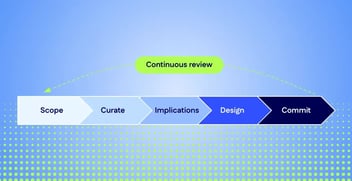
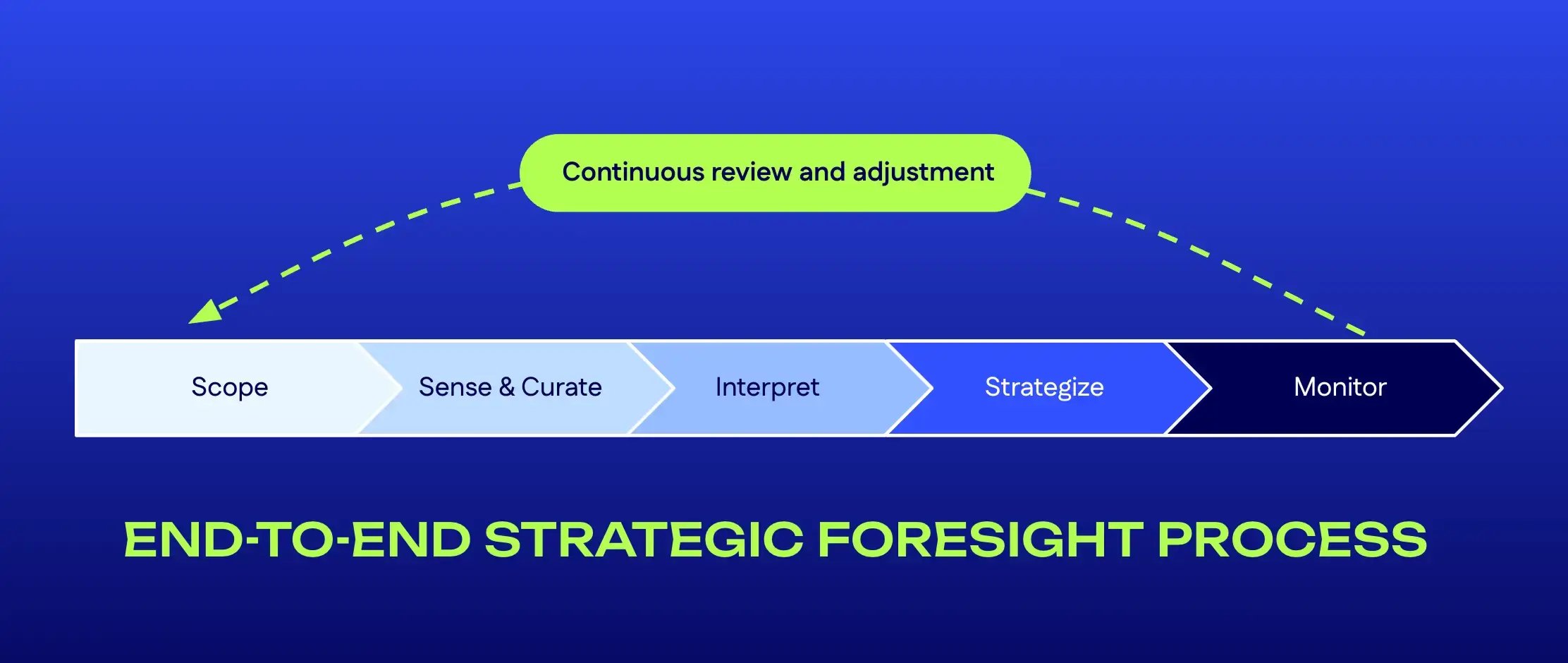
In the best case, a strategic foresight framework forms a closed loop – from defining the scope, sensing change, preparing decisions, to commitment and monitoring. The loop only counts when it changes a decision or installs a trigger that leaders agree to act on.
Step 1: Scope the decision domain
Start by scoping the decision domain. Define:
- The strategic questions that matter
- Time horizons (near, mid, long)
- Risk appetite and constraints
Ask: Which decisions would we regret not preparing for? This anchors foresight in leadership priorities.
Step 2: Sense and curate
Sensing scans for signals across political, economical, societal, technology, ecological and legal areas. Initially, breadth is important to ensure not missing relevant change. Then depth through curation and triangulation matters to ensure high quality and not falling for hypes. Apply quality criteria:
- Relevance to scoped domain
- Credible sources
- Directional impact
Noise kills momentum. Curate aggressively to preserve focus.
Step 3: Interpret implications
Interpretation translates signals into implications for your business. This includes:
- Second- and third-order effects, i.e. causal chains that can unfold
- Cross-impact between change factors that may lead to system shifts
- Assumptions that may break
This is where diverse perspectives, openness and thinking through the unexpected matter.
Step 4: Strategize and commit
A strategy can be prepared by first understanding the space for strategic choices, the Strategy Space. This can be structured by capturing the broader strategic action fields of an organization. These are fields in which leaders of an organization have alternative options and can make a choice.
Options within a strategic action field should be well defined, represent a clear direction within the field, and should be collectively exhaustive, i.e. represent all possible options for the organization. A field becomes strategic when the choices have consequences that cannot easily be undone, e.g. capital allocation, product portfolio, and brand positioning.
The combination of choices across all strategic action fields form distinct strategies. In foresight-driven strategy, alternative strategies should be considered, tested against alternative futures and organizational capabilities before making a choice.
Define and commit to a strategy with asymmetry:
- Clear upside potential
- Limited downside
- Controllable risk
- Clear owners and budgets
Step 5: Monitor
Once commited, define indicators to monitor, set thresholds and triggers that require rethinking the choices made. Monitoring tracks:
- Measurable indicators that represent changes in the environment
- Trigger thresholds that indicate the need to reconsider strategic choices
- Momentum that support choices
Monitoring is crucial to create and ensure agility, and not holding on to choices that are rendered irrelevant or unfavorable by reality.
Scenario planning
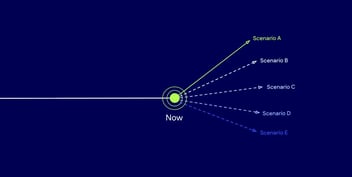
Scenario planning is a core methodology in strategic foresight: it makes uncertainty explicit, challenges hidden assumptions, moves the discussion away from a singular, assumed future, and expands strategic imagination.
Well-designed scenarios describe structurally different futures shaped by critical uncertainties such as shifting consumer behaviour, regulation, technology adoption, or geopolitical shifts. Their value lies not in accuracy, but in contrast.
In foresight-driven strategy, scenarios are used to test current strategy, expose fragility, and identify where optionality is required. They are means to an end to understand straetgic implications of change, options, and triggers. Without that translation, scenarios remain interesting narratives rather than strategic tools.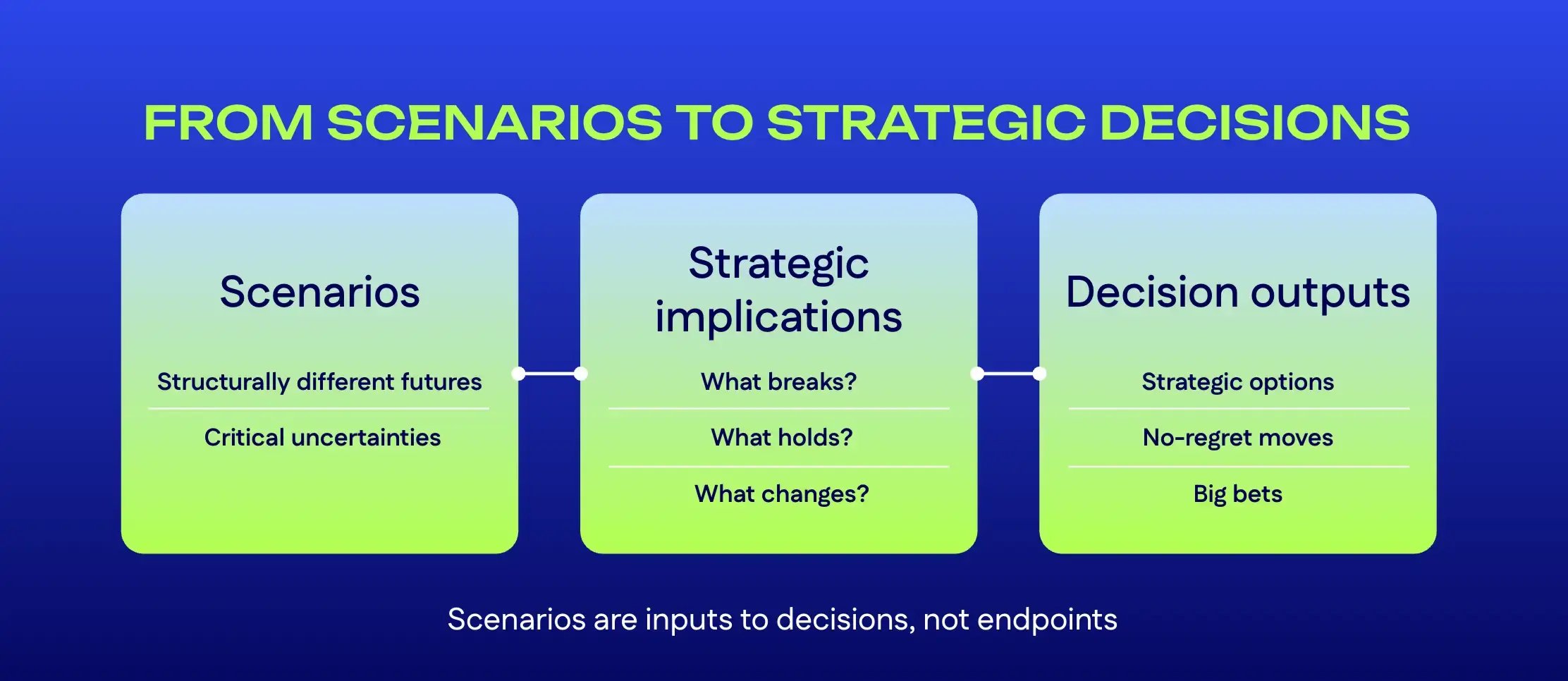
Further tools & methods in strategic foresight
Foresight draws on a much broader toolkit than scenarios. Commonly used methods include environmental or horizon scanning, signal clustering, impact-uncertainty analysis, cross-impact analysis, backcasting, option valuation, real options and more. Increasingly, AI-enabled tools support large-scale scanning and synthesis, accelerating pattern detection.
Tools and methods should always serve decision-making – not the other way around. What matters most is not tool sophistication, but governance. Leaders should insist on transparency of sources, clarity of assumptions, and explicit links between insights and decisions. Tools without discipline undermine trust.
How to implement strategic foresight in organizations
Applying strategic foresight in organizations is primarily an operating-model challenge. Success depends on governance, cadence, and integration into existing leadership processes.
Effective implementations establish clear ownership:
- An executive sponsor accountable for outcomes
- A foresight owner running the system
- Cross-functional teams developing and testing implications
- Domain leaders owning specific options and triggers
Cadence turns foresight into routine. Regular reviews and decision forums, and annual if not continuous strategic refreshes keep foresight alive without overwhelming the organization.
Integration is non-negotiable. Foresight must connect directly to strategy development and execution, portfolio governance, R&D and innovation investment, and enterprise risk management. Non-integrated foresight creates more noise, ambiguity and is usually perceived as ivory tower not adding value beyond insporation to the business.
Foresight workshops for leadership teams
Foresight workshops for leadership teams are most effective when they are explicitly decision-driven. Their purpose is not alignment for its own sake, but commitment under uncertainty. Leaders should enter a workshop knowing which decisions they are preparing for and leave with an understanding on what will change as a result.
Strong workshops follow a clear arc. They begin with decision framing, ensuring that the group is aligned on the strategic question, constraints, and time horizon. They then move into future exploration, using scenarios to surface assumptions and challenge existing beliefs. This exploration is not an end in itself; it creates the conditions for meaningful choice.
The final phase focus on option design and commitment. Leaders identify viable strategic options, define no-regret moves and bets, and agree on triggers that will prompt future action. Ownership is explicit. When workshops are designed this way, they compress learning, surface trade-offs early, and accelerate strategy rather than interrupting it.
KPIs and value: how leaders measure foresight impact
Leaders rightly ask how foresight creates measurable value, particularly in domains where outcomes are uncertain by definition. The answer lies in measuring decision quality and timing, not attempting to predict financial returns directly.
Effective measurement combines leading indicators of system health with lagging indicators of business impact. Leading indicators show whether foresight is influencing how decisions are made, for example, how quickly signals translate into leadership discussions, or how often foresight-driven options are considered in investment forums. These metrics indicate whether foresight is embedded in the organization’s operating rhythm.
Lagging indicators capture longer-term effects, such as avoided losses, seized opportunities, faster pivots in response to change, or improved resilience during shocks. Taken together, these measures provide leaders confidence that foresight is shaping decisions today and improving outcomes over time, without forcing artificial precision where it does not belong.
Using AI in foresight responsibly
AI can dramatically scale sensing and synthesis, but should be governed deliberately. Used well, it extends human capacity to scan large information spaces and detect emerging patterns. Used poorly, it amplifies bias, noise, and false confidence.
AI is currently strongest in tasks such as horizon scanning, signal clustering, and hypothesis generation. It is weakest when asked to replace judgment, resolve ambiguity, or make trade-offs that require contextual understanding. For leaders, the critical distinction is between augmentation and delegation.
Responsible use requires clear guardrails. These include transparency of sources, human review of outputs, explicit assumption audits, and regular “model-off” checks to avoid over-reliance. The leadership question is not whether AI belongs in foresight, but how to integrate it in a way that preserves accountability and trust.
Adapting foresight strategy for startups vs enterprises
Developing a long-term foresight strategy for startups differs significantly from enterprise implementation, but the underlying principles remain constant. What changes is scale, cadence, and governance, not the logic of foresight itself.
Startups benefit from short cycles focused on product-market inflections, customer behavior, and runway-aware options. Foresight in this context helps founders avoid over-committing too early and identify when to pivot or double down. Enterprises, by contrast, require more formal governance, multi-horizon portfolios, and alignment across business units to ensure foresight influences real resource allocation.
In both cases, foresight must remain tightly decision-linked. When it becomes detached from ownership and commitment, it loses relevance regardless of organizational size.
What to do next
The most effective way to begin is to start small and serious. Choose one strategic decision domain where uncertainty is high and the cost of delay is meaningful. Install basic governance, define ownership, and run a focused 90-day foresight cycle that produces options and triggers leaders are prepared to act on.
From there, scale deliberately. Expand foresight to additional decision domains, strengthen cadence, and deepen integration with strategy and investment processes. Foresight strategy earns trust the same way any leadership system does, by changing decisions, repeatedly, and at the right moment.