
Scenario planning is back on leadership agendas and for good reason. As uncertainty accelerates across technology, regulation, geopolitics and markets, traditional planning approaches struggle to keep up. Scenario planning offers a different way forward, not by predicting the future, but by preparing for it.
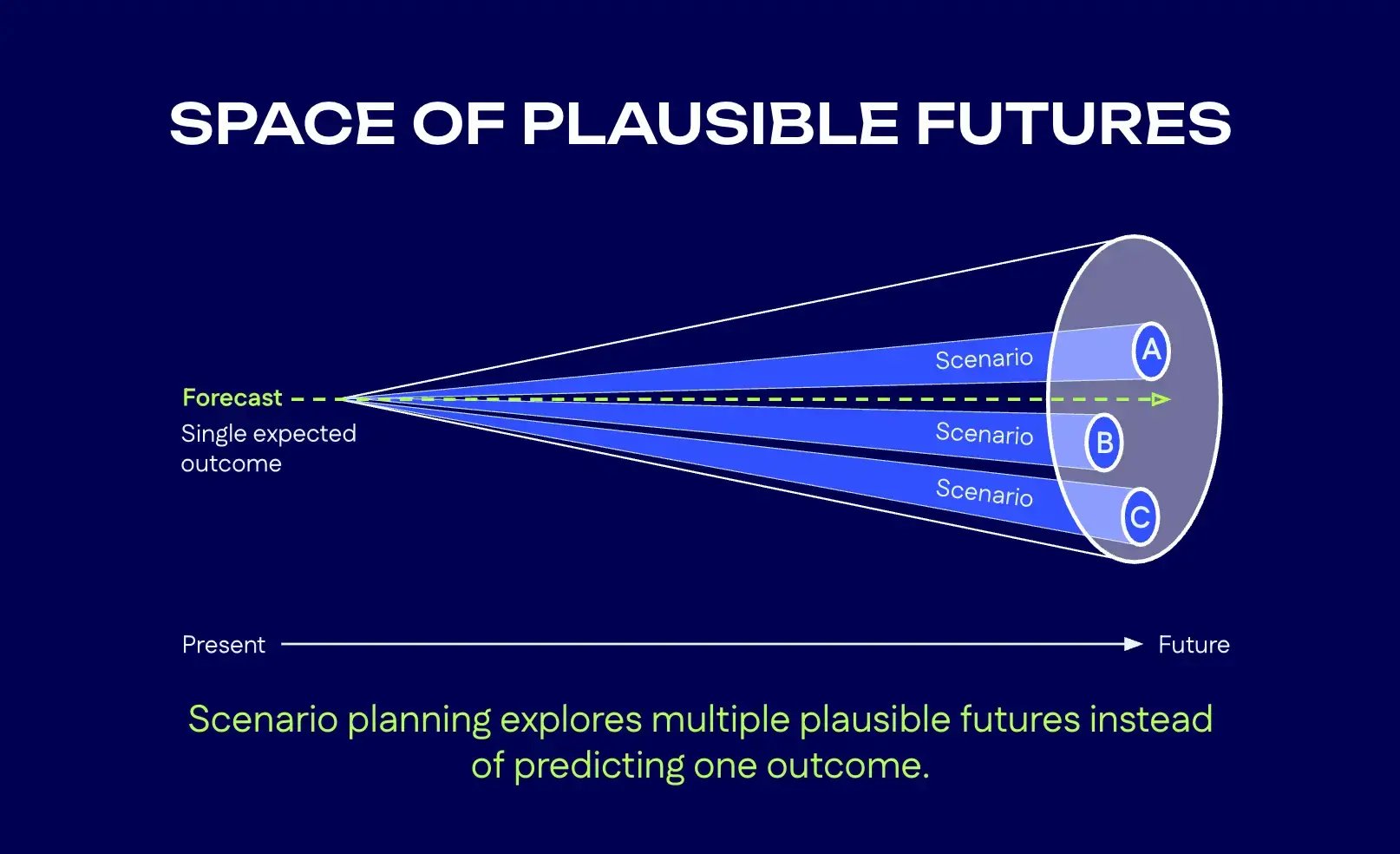
Scenario planning is a core method within foresight strategy that helps leaders make better decisions under uncertainty. Instead of betting on a single forecast, it explores multiple plausible futures and uses them to test strategies, surface risks, and identify robust choices.
In this article, we explain what scenario planning really is, why it exists, and how senior leaders use it to improve strategic decisions, governance, and long-term resilience. This builds on the broader Strategic Foresight perspective and connects directly to how foresight is applied in organizations.
What is scenario planning?
Scenario planning is a structured way to explore multiple plausible futures and use them to inform today’s strategic decisions. It does not aim to predict what will happen. It aims to prepare leaders for what could happen and to reduce surprise when conditions change.
Scenario planning sits at the intersection of strategy and uncertainty. It translates signals about change, technological, societal, economic, and regulatory, into coherent future worlds that challenge assumptions and broaden perspective. Each scenario represents a different way the future might plausibly unfold.
At its best, scenario planning is not an analytical exercise. It is a leadership tool that shapes how strategy is discussed, tested, and governed.
Scenario planning vs prediction
Scenario planning differs from prediction because it accepts uncertainty rather than trying to eliminate it. Predictions assume that the future can be estimated with enough data. Scenario planning assumes that in complex systems, this is often impossible.
Instead of asking “What will happen?”, scenario planning asks:
- What could happen?
- What would that mean for us?
- How would our strategy hold up?
This shift, from accuracy to preparedness, is what makes scenario planning valuable in turbulent environments.
Why scenario planning exists: the limits of forecasting
Scenario planning exists because forecasting breaks down when change becomes non-linear and uncertainty cannot be reduced to probabilities. Forecasts work well in stable environments. They struggle when the future is shaped by discontinuities, feedback loops, and second-order effects.
Senior leaders often ask: “Why can’t we just extend our forecasts?” The answer is simple. Forecasts assume continuity. Scenario planning assumes disruption.
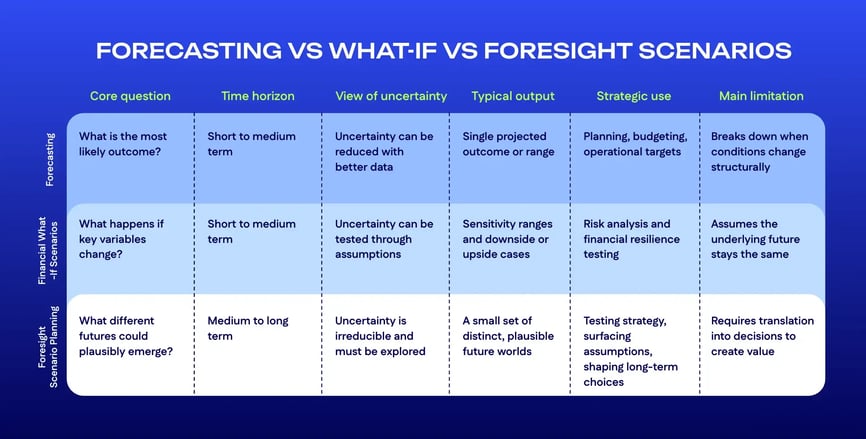
Forecasts, what-if analysis, and scenario planning
Scenario planning is not the same as (often financial) what-if analysis or sensitivity modeling. Confusing these approaches is one of the most common sources of frustration at executive level.
- Forecasting extrapolates trends to estimate a most-likely outcome.
- (Financial) What-if scenarios test how outcomes change when variables shift.
- Scenario planning explores structurally different futures shaped by deep uncertainty.
Scenarios in that sense are qualitative at their core. They are designed to challenge mental models, not fine-tune projections. Financial what if scenarios may follow, but only after strategic implications are clear. This distinction is explored further in our comparison of Foresight vs. Forecasting vs. Backcasting.
How scenario planning actually works (at a high level)
Scenario planning works by moving from uncertainty to insight through a clear underlying logic, not a rigid step-by-step recipe. The goal is not methodological purity, but strategic usefulness.
At a high level, effective scenario planning follows four connected moves.
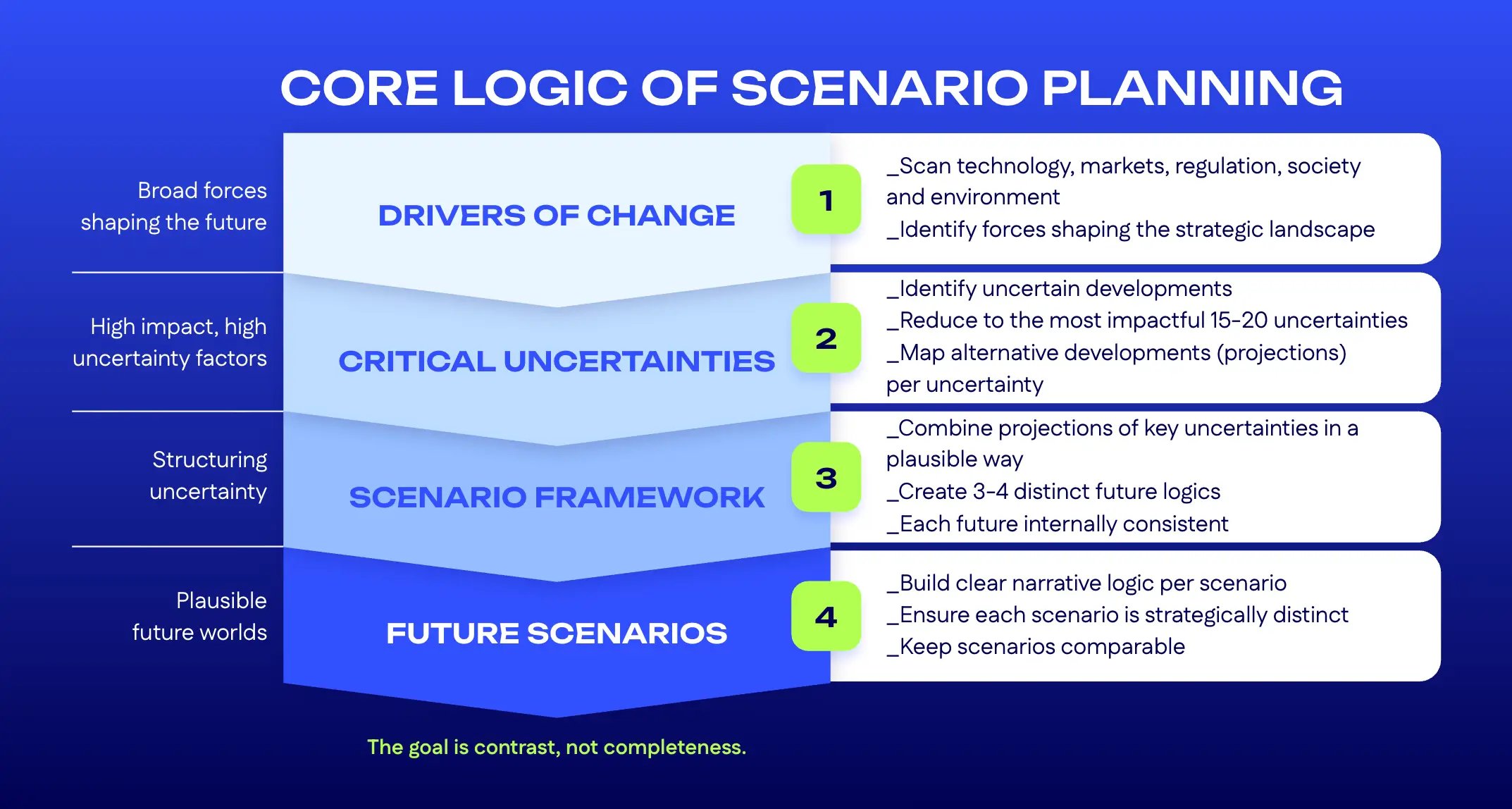
Drivers of change and critical uncertainties
Scenario planning starts by identifying the forces shaping the future and the uncertainties that matter most. These drivers span technology, markets, regulation, society, and the environment. Some trends are relatively certain. Others are deeply uncertain and highly impactful.
Critical uncertainties sit at the intersection of high impact and high uncertainty. They form the backbone of meaningful scenarios and connect closely to horizon scanning and trend analysis.
From uncertainty to future scenarios
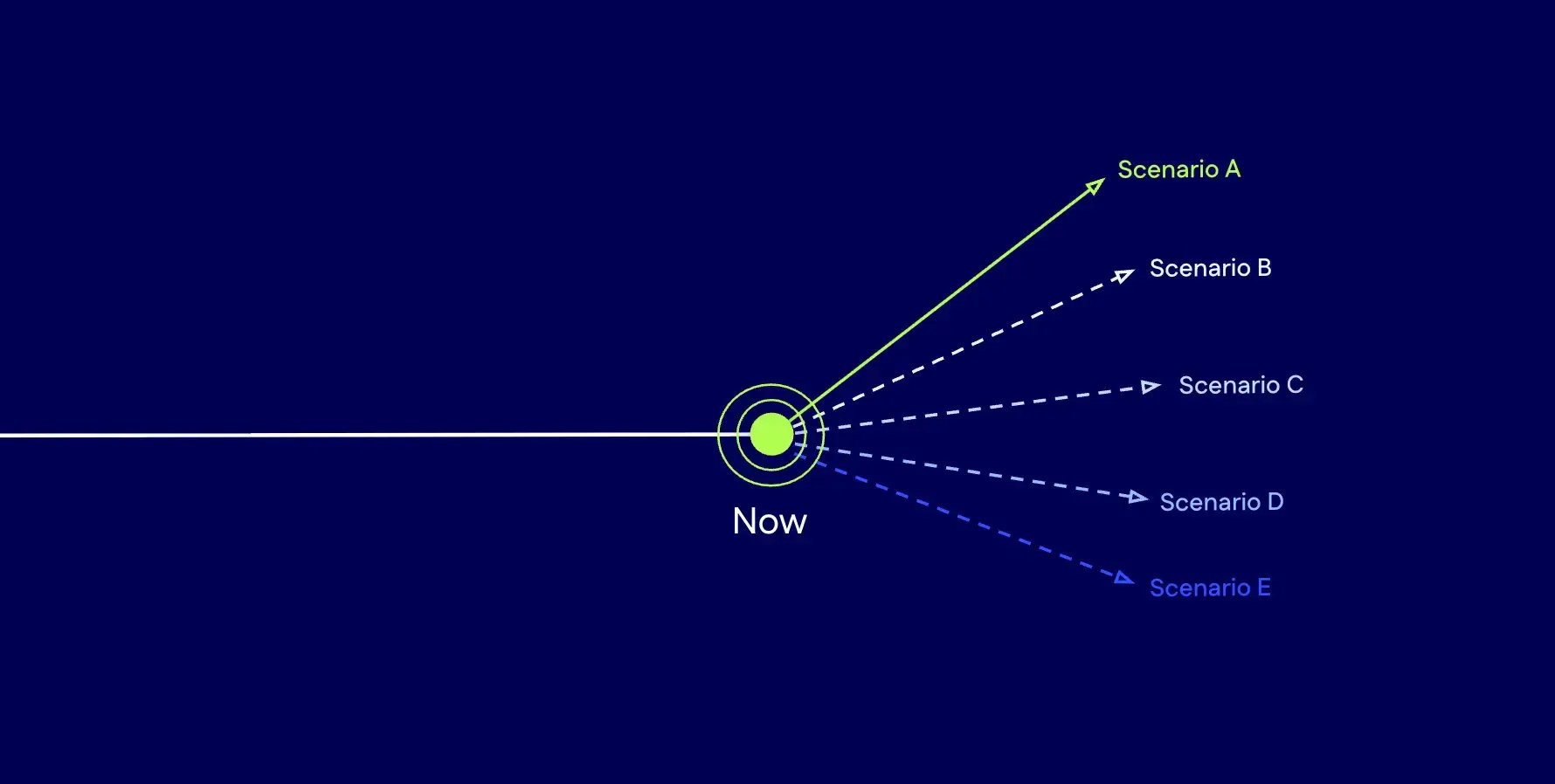
Future scenarios are coherent stories about how the world might plausibly evolve. Each scenario combines drivers and uncertainties into an internally consistent future, not a best-case or worst-case outcome.
Most organizations work with three to four scenarios. Fewer limit perspective. More reduce usability. The point is contrast, not completeness.
Why 3–4 scenarios are usually enough (and when they aren’t)?
Three to four scenarios are usually enough to challenge assumptions without overwhelming decision-makers. However, in highly complex or regulated environments, additional scenario variants may be useful for stress-testing specific decisions.
The rule is simple: scenarios should stretch thinking, not exhaust it.
From future scenarios to strategic decisions
Scenario planning creates value only when scenarios are used to shape real strategic decisions. Producing scenarios without applying them leads to insight without impact.
The critical move is translation, from future scenarios to the choices leaders must make today.
Stress-testing strategy across futures
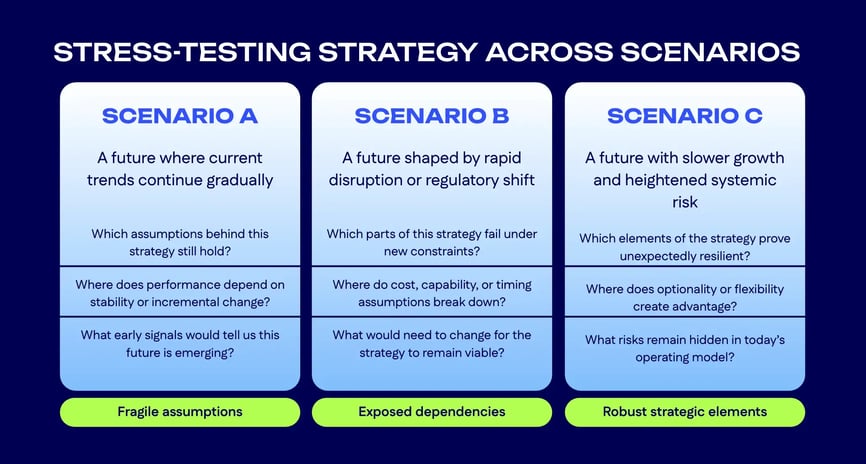
One way to use scenarios is to stress-test existing strategy – a practice sometimes called strategic wind-tunneling – by asking how it performs across different futures. Leaders examine where strategies remain robust, where they break, and where adaptation would be required. See how we applied strategic wind-tunneling with E.ON to surface 20 emerging opportunities and risks.
Questions senior leaders typically ask include:
- Which assumptions fail in which scenarios?
- Where are we exposed?
- Where are we surprisingly resilient?
This process often reveals hidden dependencies and risks long before they materialize.
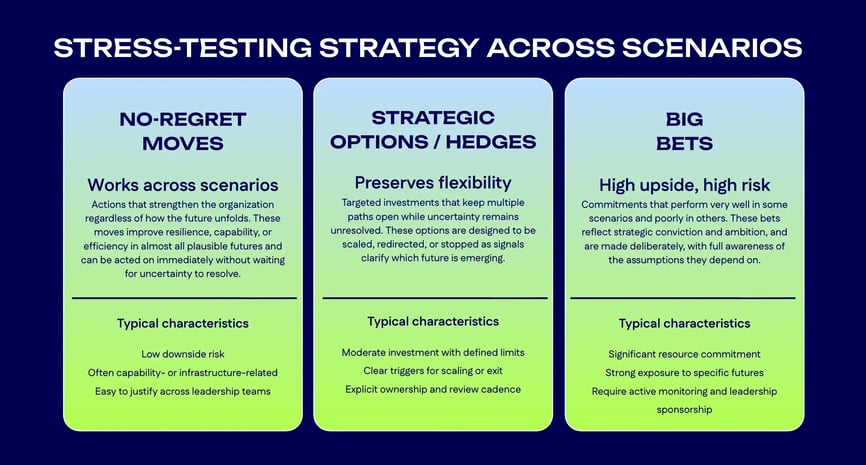
Strategic options: save bets, hedges, big bets (no-regret moves)
Scenario planning translates insight into three types of strategic moves.
- Save bets: Actions that make sense across most scenarios.
- Strategic options or hedges: Investments that preserve flexibility if uncertainty resolves.
- Big bets (No-regret moves): Commitments that pay off in some scenarios and fail in others.
This framing helps leaders balance ambition with resilience and avoid over-commitment to a single future.
Scenario planning as a leadership and governance capability
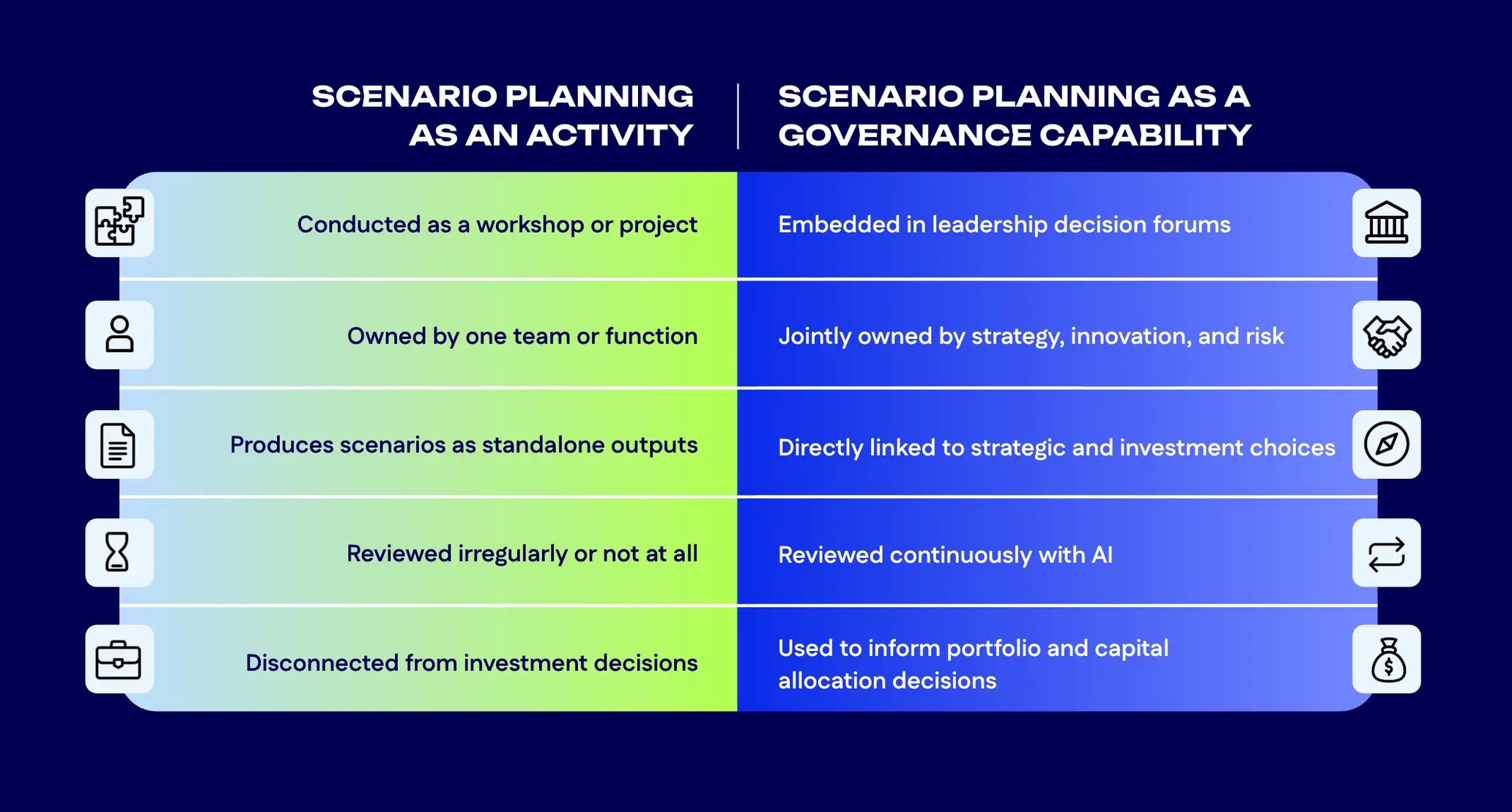
Scenario planning becomes powerful when it is embedded in leadership processes and governance, not treated as a one-off exercise. Without integration, scenarios quickly become shelfware.
Ownership and cadence
Scenario planning needs clear ownership and a defined cadence. In most organizations, it sits at the intersection of strategy, innovation, and risk.
Effective governance typically includes:
- Executive sponsorship
- Integration into the strategy cycle
- Regular review of assumptions and signposts
Scenarios should be revisited when major decisions are made, not only when uncertainty feels abstract. This governance logic connects directly to Applying Strategic Foresight in Organizations.
Why scenario planning often fails
Scenario planning often fails because it is treated as a workshop, not a decision system. Common failure modes include:
- Confusing scenarios with best- and worst-case forecasts
- Over-emphasizing creativity while avoiding hard decisions
- Failing to connect scenarios to investment and portfolio choices
Avoiding these pitfalls requires discipline, leadership attention, and follow-through.
When scenario planning matters most for senior leaders
Scenario planning matters most when decisions are irreversible, long-term, and exposed to high uncertainty. It is not needed for every choice, but it is critical for the ones that shape an organization’s future.
Strategy, innovation, and technology bets
Scenario planning is particularly valuable for strategy, innovation, and technology decisions. Platform shifts, capability investments, and innovation portfolios all benefit from being tested against multiple futures.
Scenarios help leaders avoid locking into strategies that only work under one set of assumptions.
Navigating AI, regulation, and systemic disruption
In domains such as AI, regulation, and geopolitics, scenario planning helps leaders navigate uncertainty without paralysis. These areas evolve too fast and interact too deeply to be forecast reliably.
Scenarios provide a structured way to prepare, adapt, and lead with confidence, complementing other foresight tools and methods.