
What is strategic foresight?
Strategic foresight is a structured approach organizations use to explore multiple plausible futures in order to make better long-term decisions under uncertainty. Rather than predicting a single outcome, it helps leaders anticipate change, identify emerging risks and opportunities, and prepare for disruption before it becomes unavoidable.
Strategic foresight is most useful in environments where change is non-linear, data is incomplete, and past trends are no longer reliable indicators of the future. Instead of asking “What will happen?”, foresight asks, “What could happen – and how should we respond?”
At its core, strategic foresight expands decision-makers’ mental models so strategy is shaped by possibility, not surprise. By deliberately engaging with uncertainty, organizations can move from reactive adaptation to proactive preparation.
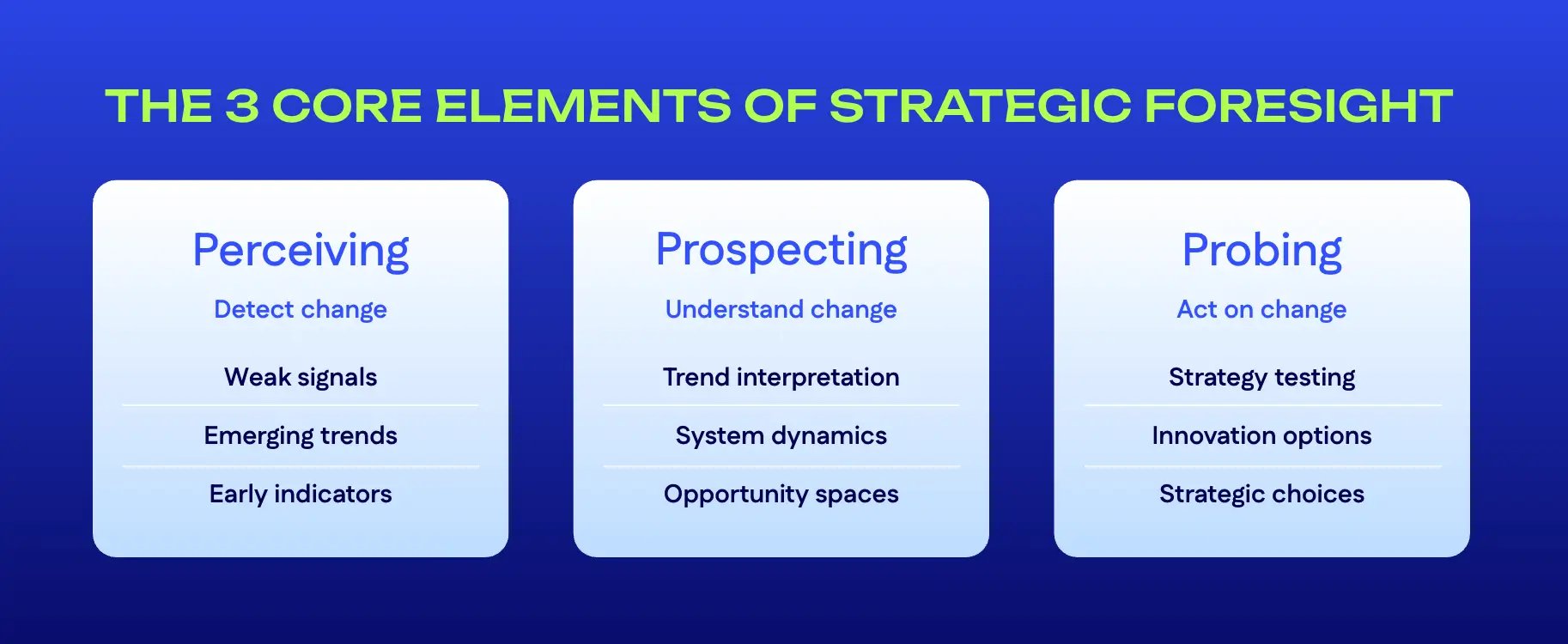
What is the definition of strategic foresight?
The strategic foresight definition refers to a disciplined set of methods used to systematically analyze uncertainty, identify emerging signals of change, and inform long-term strategic choices. It combines qualitative research, systems thinking, and scenario development to support resilient and adaptive strategies.
Unlike ad-hoc future thinking, strategic foresight is:
-
Intentional – guided by a clear strategic question
-
Systematic – based on repeatable methods and frameworks
-
Action-oriented – designed to inform real decisions, not speculation
Most definitions of strategic foresight emphasize three elements:
- Anticipation of change beyond short-term planning cycles
- Exploration of multiple plausible futures rather than one forecast
- Integration of insights into strategy, innovation, and policy
This combination is what differentiates foresight from trend-watching or visionary thinking. Strategic foresight is not about being right about the future, but about being prepared for different ways it might unfold.
Strategic foresight vs forecasting: what’s the difference?
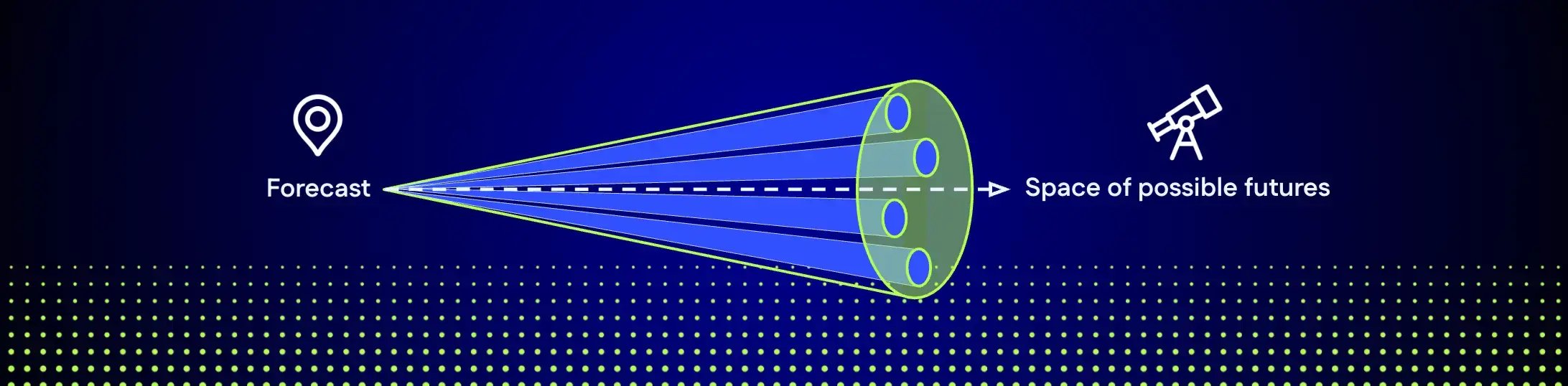
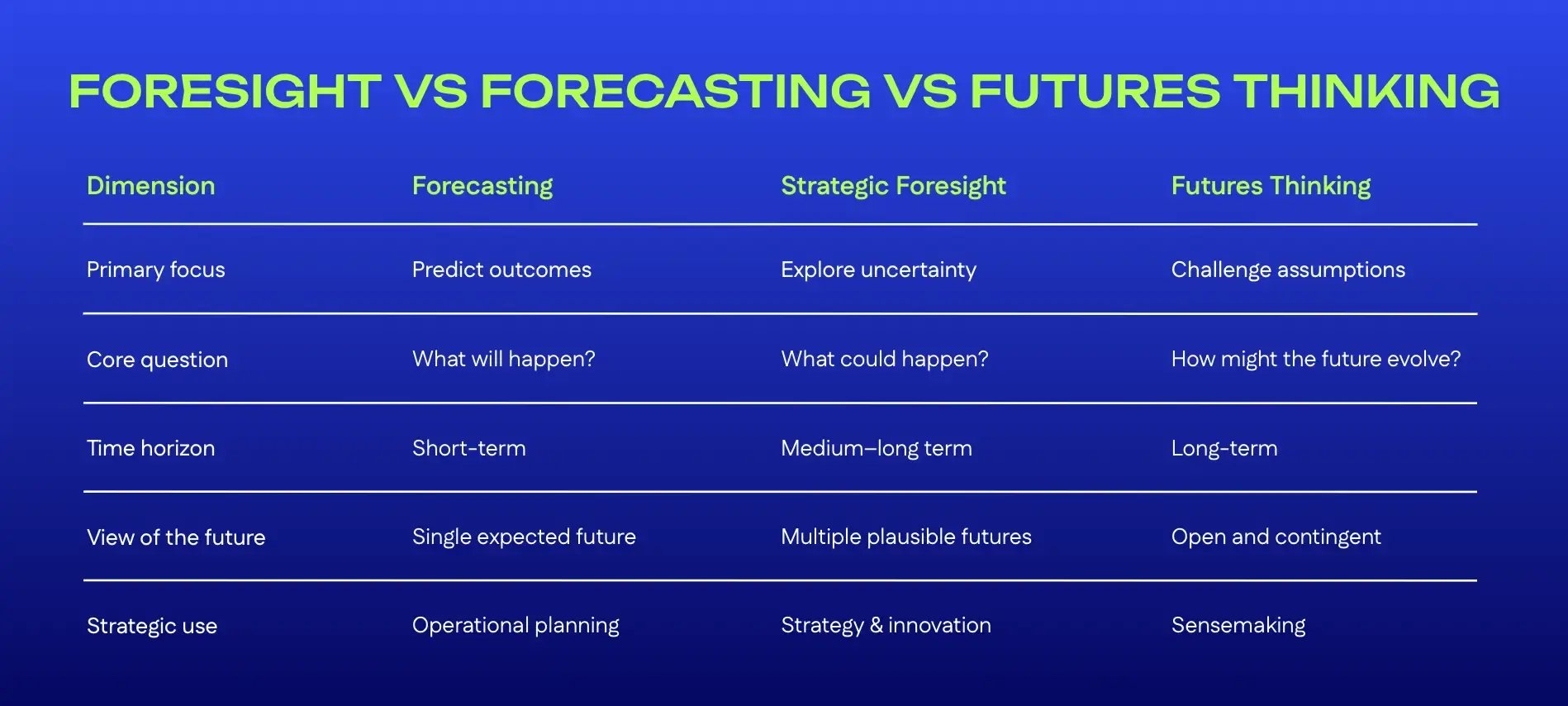
Strategic foresight and forecasting differ in how they treat uncertainty, time horizons, and assumptions about change. Forecasting projects the future from past data, while foresight explores how the future might diverge from historical patterns.
Forecasting
-
Assumes continuity with the past
-
Relies heavily on quantitative data and models
-
Best suited for short-term, stable environments
-
Produces a single most-likely outcome
Forecasting answers questions like:
-
“What will demand look like next quarter?”
-
“How fast will this market grow if current trends continue?”
Strategic foresight
-
Assumes uncertainty and disruption
-
Combines qualitative and quantitative insights
-
Often focuses on medium- to long-term horizons but also short-term when uncertainty is high
-
Explores multiple plausible futures
Strategic foresight answers questions like:
-
“What if this technology reshapes our industry?”
-
“How could regulatory or social shifts change our business model?”
In practice, forecasting is useful for operational planning, while strategic foresight is essential for strategic resilience. Organizations that rely exclusively on forecasting often respond well to incremental change but struggle when faced with structural shifts.
What is futures thinking?
Futures thinking is the mindset and intellectual foundation behind strategic foresight that encourages people to question assumptions about the future. It is less about tools and more about how individuals and organizations relate to uncertainty, complexity, and long-term change.
Futures thinking involves:
- Challenging the idea that the future is predetermined
- Recognizing that today’s decisions actively shape tomorrow’s outcomes
- Accepting that multiple futures are possible at the same time
While futures thinking on its own can be abstract, strategic foresight turns that mindset into practical methods, such as scenario planning, horizon scanning, and backcasting.
In simple terms:
- Futures thinking = how we think about the future
- Strategic foresight = how we act on that thinking
Organizations that cultivate futures thinking tend to be more open to experimentation, innovation, and long-term investment. They are also better equipped to recognize weak signals of change before they become obvious.
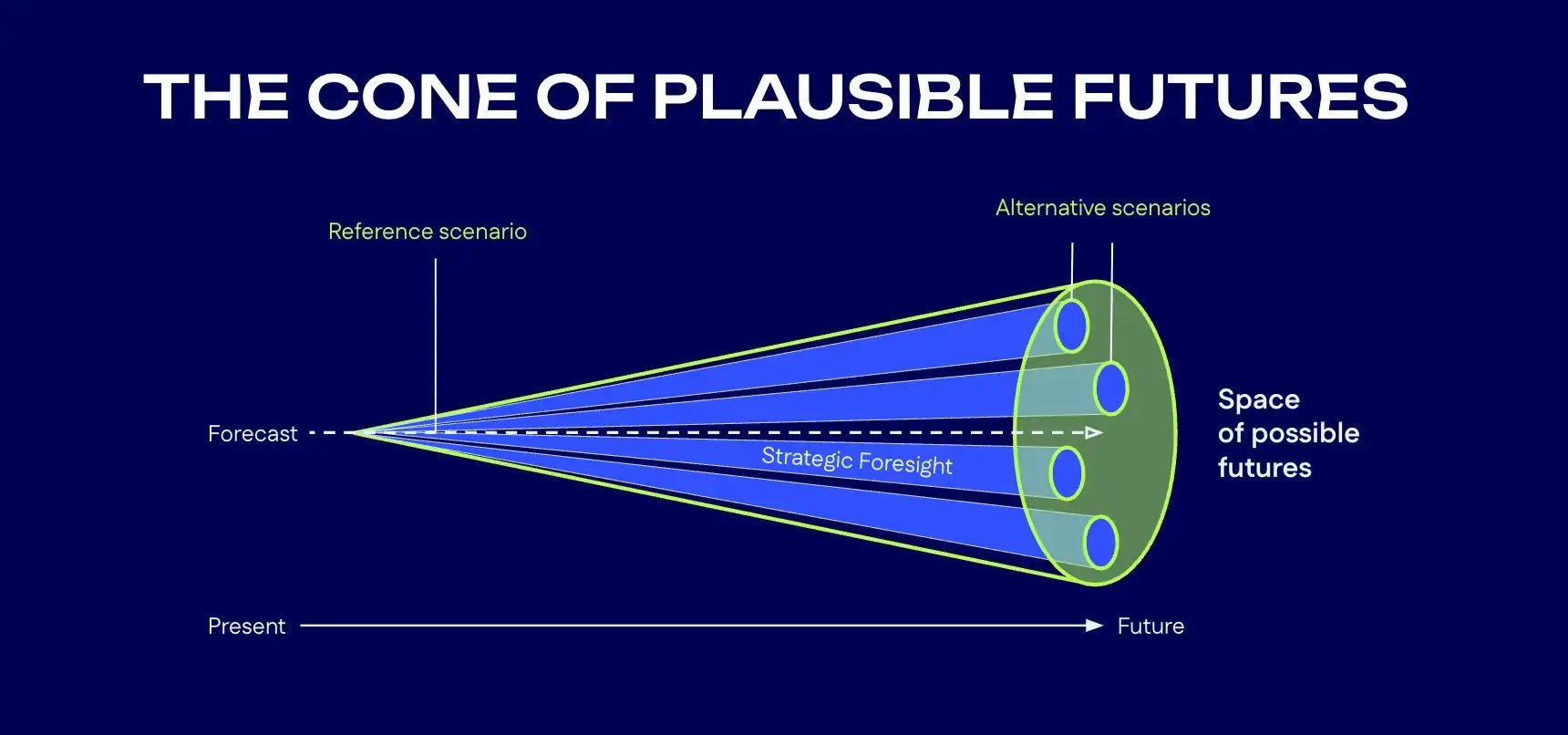
How strategic foresight, forecasting, and futures thinking work together
Strategic foresight, forecasting, and futures thinking are complementary rather than competing approaches. Each plays a distinct role in effective long-term planning.
- Futures thinking expands awareness of uncertainty and possibility
- Strategic foresight structures that awareness into actionable insights
- Forecasting supports near-term decisions within known parameters
High-performing organizations typically:
- Use forecasting for budgets, capacity planning, and operations
- Apply strategic foresight to guide strategy, innovation, and risk management
- Encourage futures thinking to challenge assumptions and avoid complacency
When combined, these approaches help leaders balance short-term efficiency with long-term adaptability, ensuring that today’s performance does not come at the expense of tomorrow’s relevance.
What are the main strategic foresight methods?
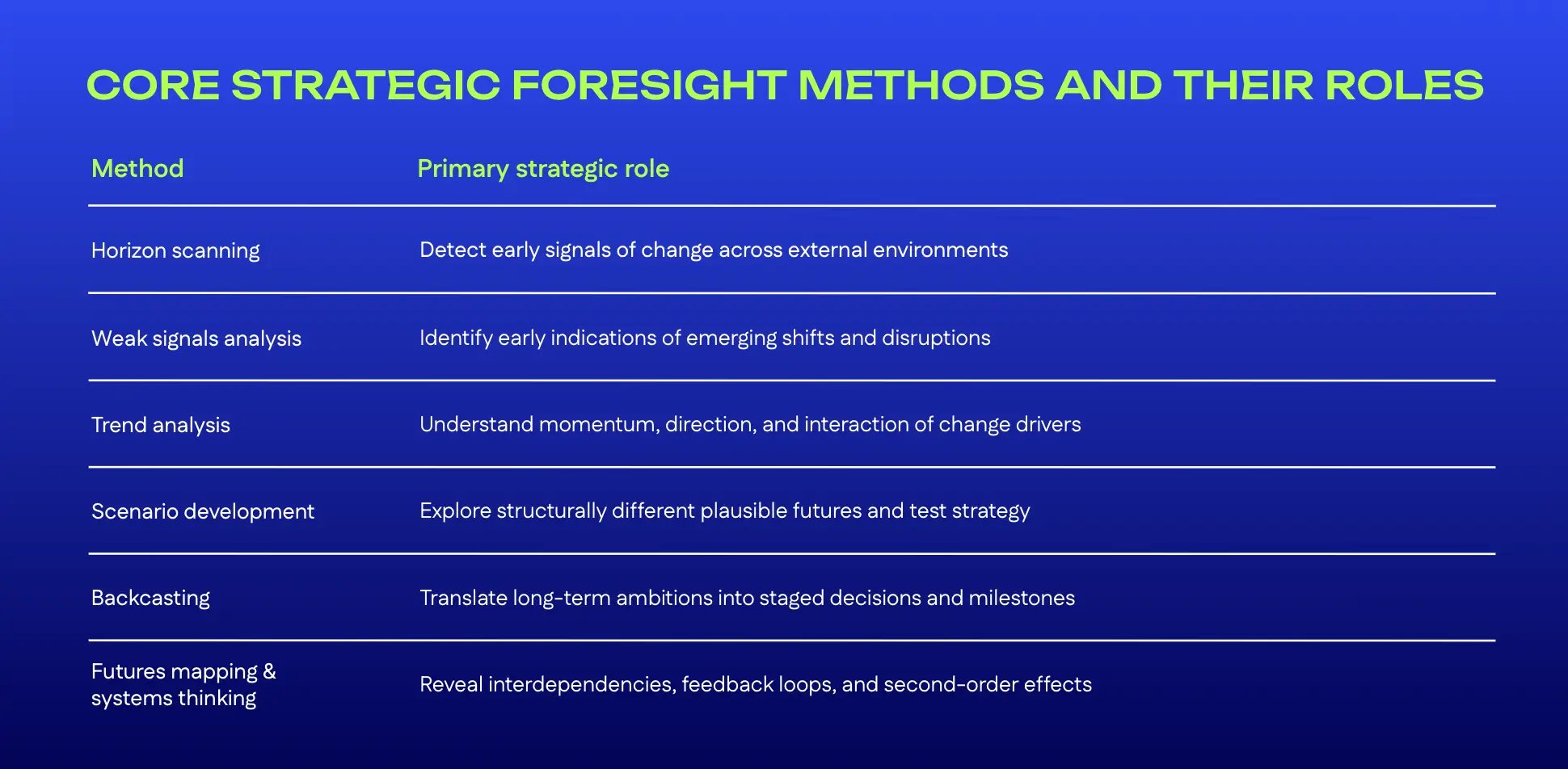
Strategic foresight is built on a small set of core methods that help organizations work with uncertainty in a structured way. These methods are not rigid templates. They are adaptable approaches that can be combined depending on the strategic question, time horizon, and level of uncertainty involved.
What matters most is not methodological purity, but understanding what each method is designed to do and when it is most useful.
Horizon scanning
Horizon scanning is the systematic exploration of emerging developments across technology, markets, society, policy, and the environment. Its purpose is to detect early signals of change that may not yet be visible in mainstream data.
Rather than tracking everything, effective horizon scanning is guided by strategic relevance. Organizations scan with specific questions in mind, filtering signals based on their potential to challenge assumptions or influence future decisions.
Horizon scanning helps leaders extend their peripheral vision and avoid being surprised by changes that were already visible at the edges.
Weak signals analysis
Weak signals are early, ambiguous indicators that existing patterns may be shifting. On their own, they are often unreliable or easy to dismiss. Their value emerges when multiple signals begin to point in a similar direction.
Weak signal analysis focuses on identifying, comparing, and tracking these early signs over time. The goal is not to prove that change will happen, but to recognize when it might—early enough to prepare.
This method is particularly useful in fast-moving or highly uncertain environments, where waiting for clear evidence often means reacting too late.
Trend analysis
Trend analysis examines how clusters of signals develop into broader patterns of change. Unlike forecasting, which assumes continuity, foresight-based trend analysis treats trends as directional forces, not guarantees.
Organizations use trend analysis to understand momentum, interaction effects, and potential inflection points. This helps leaders ask more nuanced questions, such as what would need to change for a trend to accelerate, stall, or reverse.
In foresight, trends are inputs for strategic thinking, not predictions of inevitable outcomes.
Scenario development
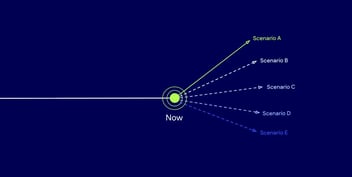
Scenario development is a method for exploring multiple, structurally different futures shaped by key uncertainties. Each scenario represents a coherent and plausible world in which today’s strategy would need to perform.
Scenarios are not forecasts or alternative plans. Their role is to challenge assumptions, stress-test strategies, and reveal vulnerabilities that remain hidden under a single “expected” future.
By comparing how decisions play out across scenarios, organizations gain clarity on where they need flexibility, optionality, or risk mitigation.
Backcasting
Backcasting starts from a defined future state – such as a sustainability goal, regulatory end-state, or strategic ambition – and works backward to identify the decisions and capabilities required to reach it.
This method is particularly valuable when leaders have a clear direction but uncertainty about the path forward. Backcasting helps break long-term ambitions into staged commitments and intermediate milestones.
In strategic foresight, backcasting complements scenario work by connecting future aspirations to present-day action.
Futures mapping and systems thinking
Futures mapping brings together signals, trends, and uncertainties into a systemic view of how forces interact. Rather than treating drivers independently, it visualizes relationships, feedback loops, and second-order effects.
This method helps organizations understand complexity without oversimplifying it. It is especially useful for identifying unintended consequences, leverage points, and areas where small changes could have outsized impact.
Futures mapping supports more informed strategic conversations by making complexity visible and discussable.
How these methods work together
In practice, strategic foresight methods are rarely used in isolation. Horizon scanning and weak signal analysis surface early change. Trend analysis and futures mapping provide structure and context. Scenarios and backcasting translate uncertainty into strategic insight.
Together, these methods help organizations move from awareness of uncertainty to better long-term decisions – which is the core purpose of strategic foresight.
Why strategic foresight matters for organizations
Strategic foresight matters because it reduces the cost of surprise and improves decision-making in uncertain environments. Organizations that rely only on historical data often react too late to disruptive change.
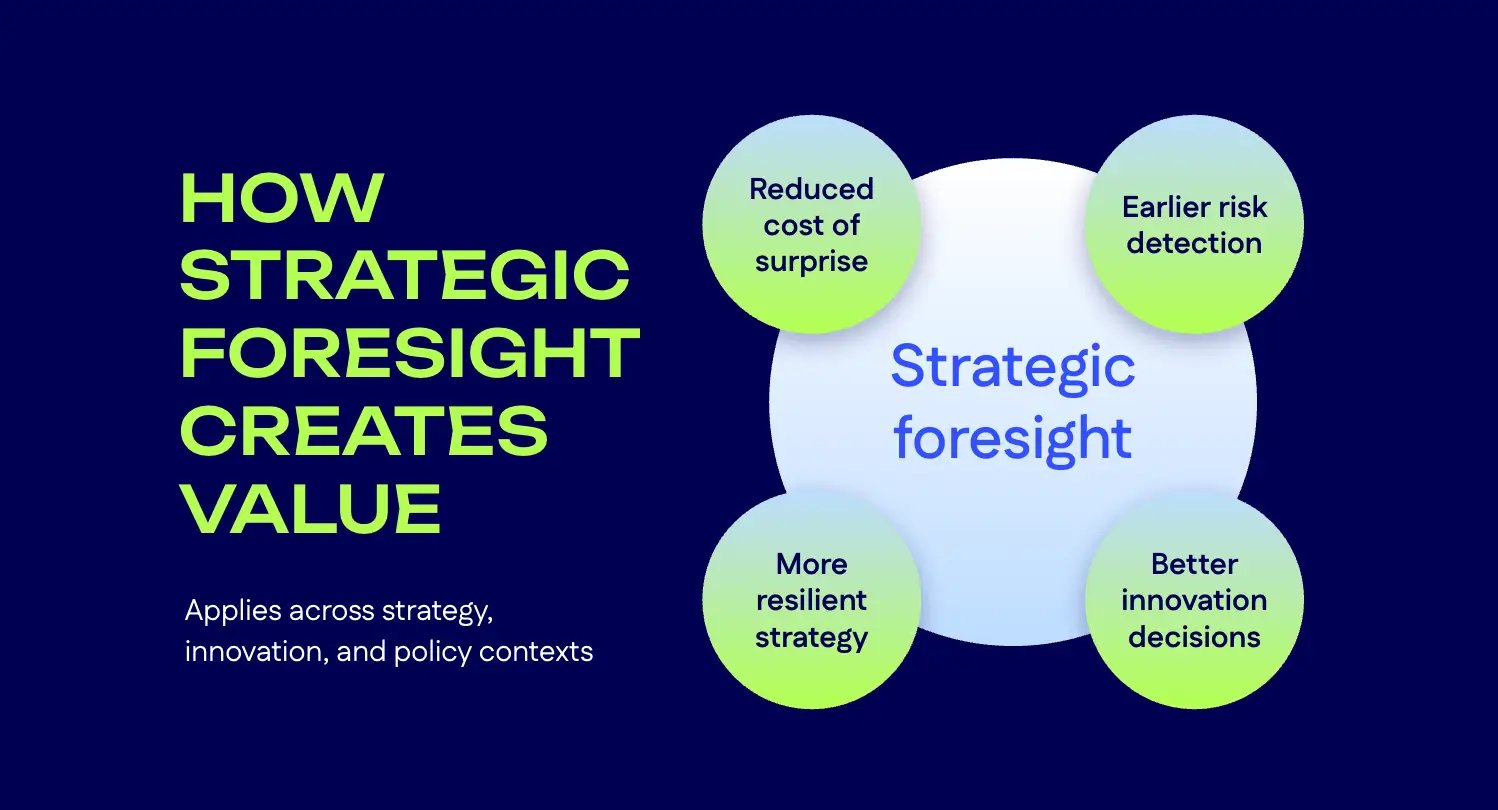
Strategic foresight helps organizations:
- Identify emerging risks before they escalate
- Spot opportunities earlier than competitors
- Test strategic decisions against multiple future scenarios
- Avoid over-committing to a single assumed future
In sectors shaped by technology, regulation, climate, or societal change, foresight is increasingly viewed not as a “nice to have,” but as a core strategic capability. It supports leadership teams in making long-term commitments with greater confidence.
Rather than replacing strategy, strategic foresight strengthens it by ensuring today’s decisions remain viable tomorrow. This is the core of a foresight-driven strategy.