
The world of work is undergoing fundamental change, making it a critical but complex task for every large company to ensure it has a capable, future-proof workforce. A systematic approach to continuously adapting the workforce to new business requirements is becoming essential.
Siemens Professional Education (SPE) is responsible for the evolution of vocational training, dual study programs, and re-/upskilling offerings for over 292,000 employees globally as well as learning programs for the external society. To accomplish this, SPE relies on a rigorous Strategic Foresight (SF) Process which is used to systematically identify new learning needs and skills.
This article shares the key findings from a recent research paper, Artificial Intelligence in Strategic Foresight: The case of Siemens Professional Education, co-authored by our own foresight expert, Julia Schmidt. The study reveals that successful integration of AI is about more than just plugging it into a defined process; it requires re-engineering the process itself to maximize the technology's potential and understanding AI’s advantages and limitations. By identifying the unique strengths and weaknesses of both AI and humans, we can design a smarter task allocation that lets AI handle the scale while human experts focus on validation and the strategic "so what." Ultimately, this paper provides a rare, hands-on blueprint for this evolution, underscoring the indispensable role of expert leadership in guiding a responsible transition.
So what does this look like in a real corporate foresight cycle and where does AI create the biggest lift without compromising quality?
Augmenting the Strategic Foresight process
At Siemens Professional Education (SPE), the core mission is to future-proof a global workforce of over 292,000 employees. To master this complex planning task, the unit spearheads a rigorous Strategic Foresight Process that acts as a dynamic engine to:
-
Anticipate future technology, business, work and education trends.
-
Identify and translate these trends into new innovation fields and actionable learning initiatives.
-
Develop and roll out targeted learning programs for vocational education and training (VET), re/upskilling, and broader capability-building measures
In the paper, Julia together with Stephan Szuppa, Innovation Manager at SPE and René Rohrbeck, Professor of Strategy and director of the chair on Foresight, Innovation and Transformation at the EDHEC Business School, outline how this process is being transformed from a purely human-based approach to one augmented by AI tools, detailing its evolution across three phases:
-
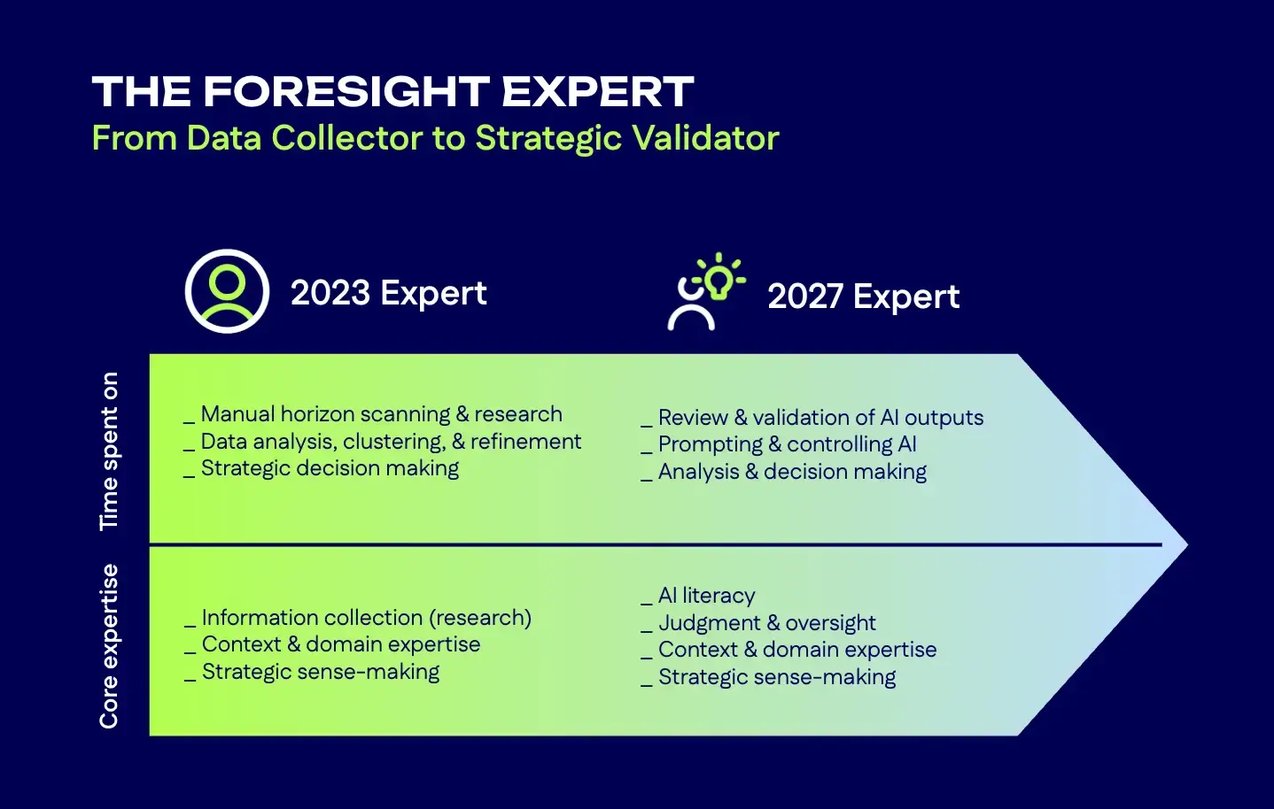
2023: A fully human-based, manual process.
-
2025: The implementation of an AI-Human collaboration model (Status Quo).
-
2027: A projection for deeper, more streamlined AI integration (Outlook).
This transition proves our core philosophy: the future is not about replacing human experts, but complementing and amplifying their capabilities in pursuit of innovation success.
The four big Wins in 2025: Quantifying the value of the AI-Human collaboration model
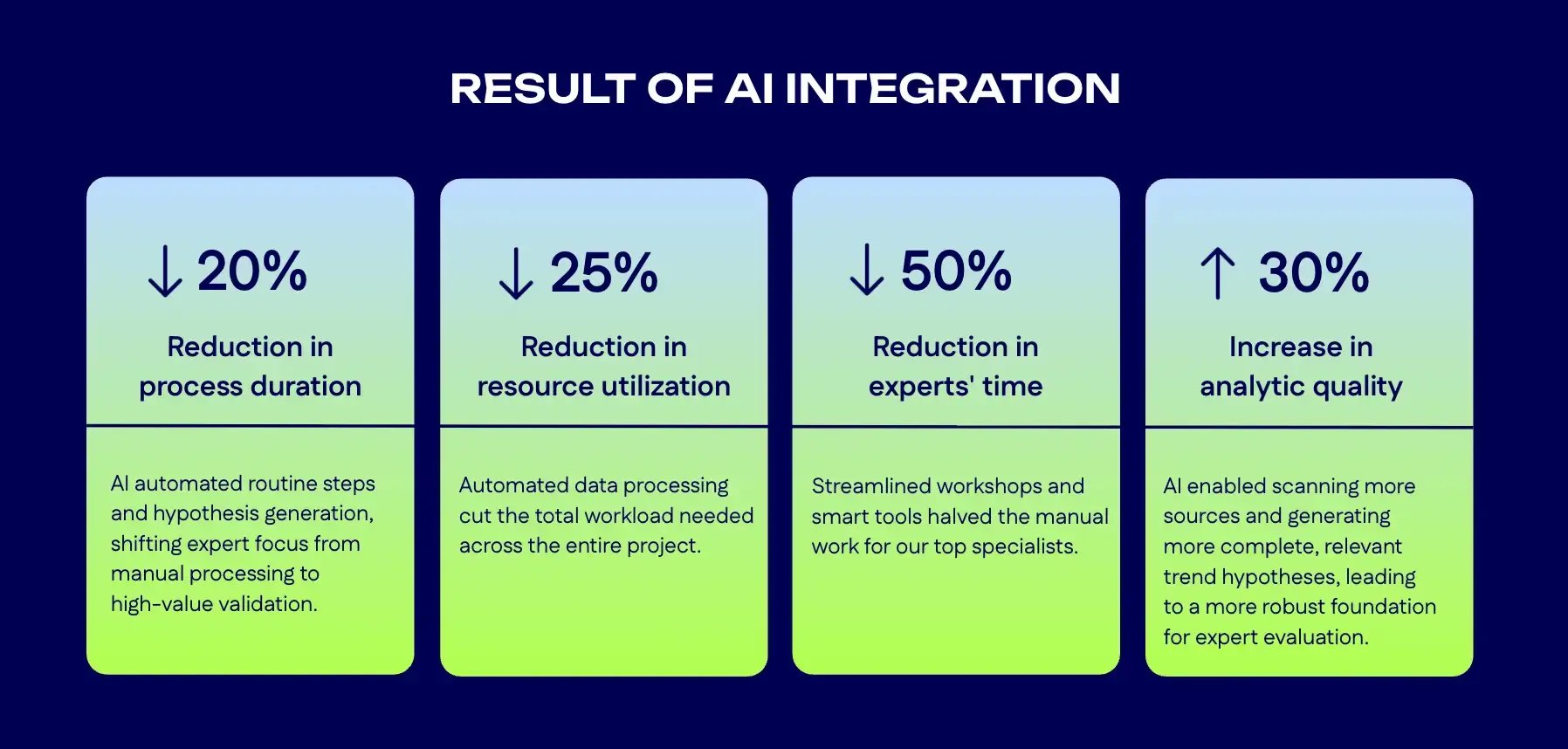
The strategic integration of AI delivered immediate and quantifiable improvements, accelerating the process and reducing resource need while simultaneously increasing the quality of outcomes. These results confirm the positive impact on effectiveness and efficiency seen in earlier research. In the SPE case, AI integration contributed to a ~20% reduction in process duration, ~25% lower resource utilization, ~50% less expert time required and a ~30% increase in analytic quality.
Balancing human and AI strengths
The most crucial insight is defining the effective division of labor, ensuring strategic alignment between AI’s capacity for scale and the need for human judgment. In the SPE model, AI excels at speed and scale, but human judgment is the irreplaceable differentiator.
AI’s role: the efficiency and consistency engine
The integration of AI is valued highly (high to very high value) especially with regards to accelerating the creation of first drafts and automating repetitive tasks. The three core functions AI performs are:
-
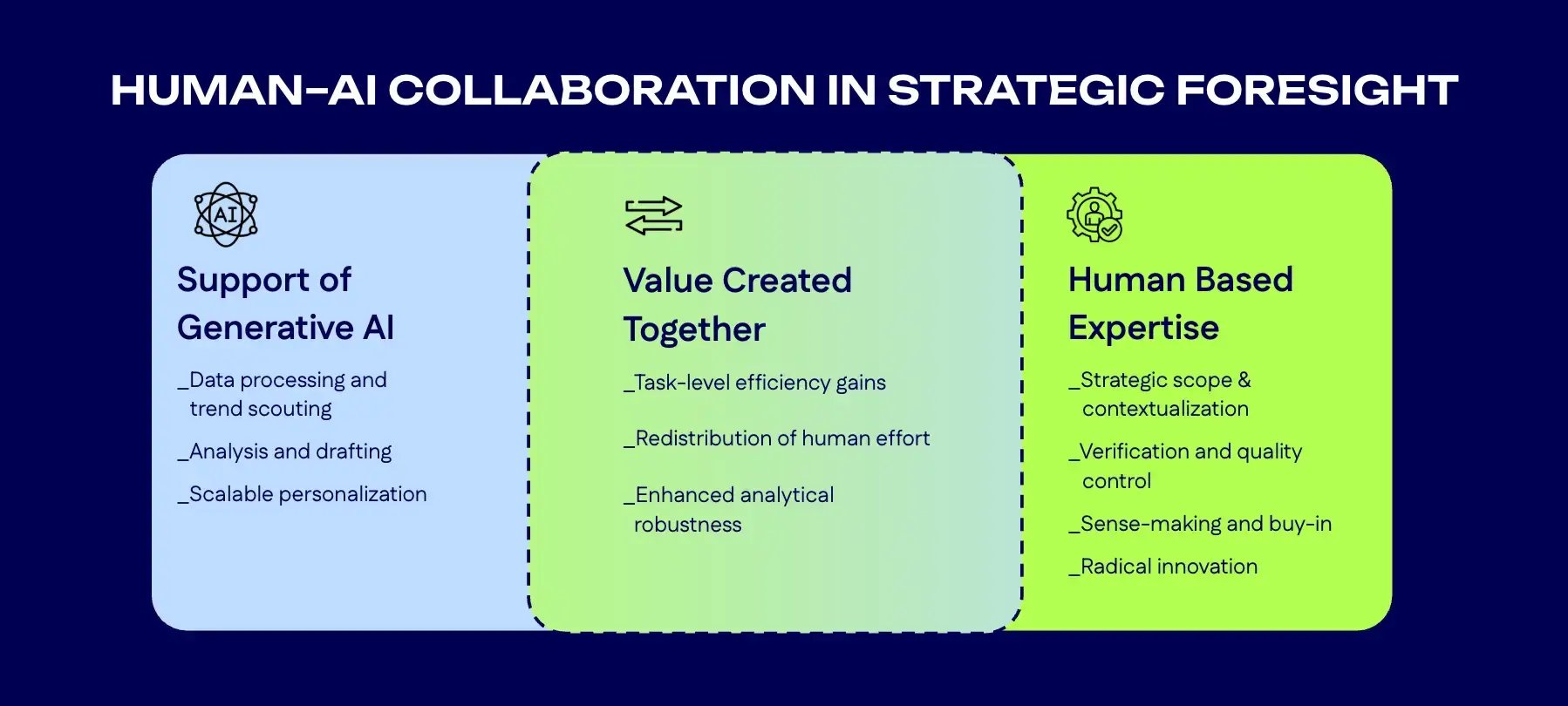
Data Processing and Trend Scouting: AI supports the extraction of trend data from high-quality sources, consolidates trend databases, and clusters similar entries, ensuring a broader and more structured base for analysis.
-
Analysis and Drafting: AI contributes to drafting trend abstracts and profiles, generates hypotheses that inform the definition of learning initiatives, and supports the generation of structured competence overviews, improving both efficiency and consistency.
-
Scalable Personalization: AI contributes to the development of learning formats by drafting general learning paths and supporting the creation of tailored learning personas and learning paths to support scalable personalization.
Human’s role: judgment, strategy, and oversight
The human operator retains control, focusing on four high-value activities.
-
Strategic scope and contextualization: Defining the scope of business activities and strategic development fields, as well as providing organization-specific contextual intelligence and adaption of AI results remains expert-led.
-
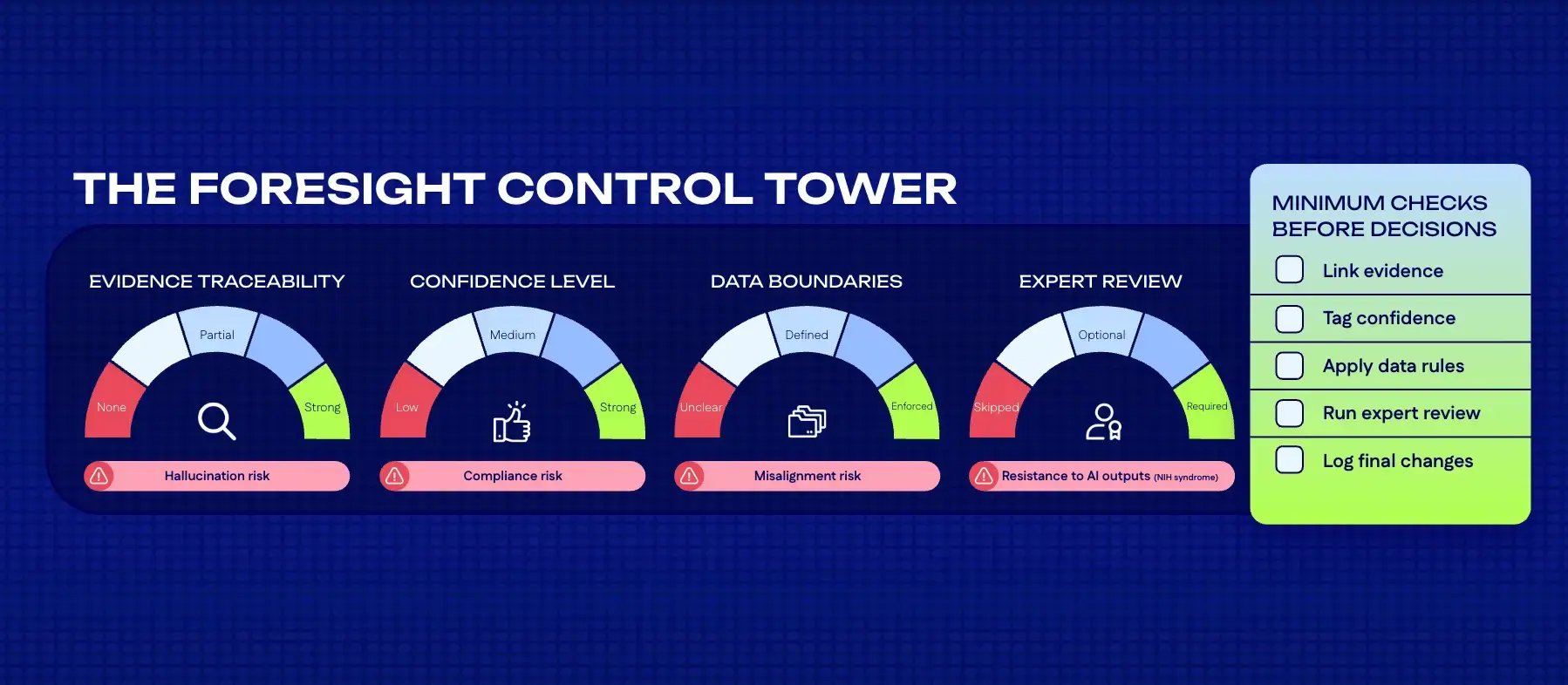
Verification and quality control: AI outputs must be critically reviewed, fact-checked, and validated by human experts to ensure reliability.
-
Radical innovation: Human expert input is needed for radical innovation and to "go beyond the status quo", as the stakeholders are not yet convinced that true innovation can be created by AI alone.
-
Sense-making and buy-in: Expert involvement is essential to secure internal acceptance and build a shared strategic understanding among stakeholders.
The combined impact of human–AI collaboration
AI integration leads to task-level efficiency gains, a redistribution of human effort, and enhanced analytical robustness when the collaboration model is designed deliberately. In practice, value comes from clear handoffs, repeatable standards, and accountable expert oversight across the cycle.
-
Task-level efficiency gains: AI accelerates extraction, clustering, and drafting, reducing time spent on repetitive work and improving consistency of first versions.
-
Redistribution of human effort: Experts shift from manual processing toward validation, prioritization, and strategic interpretation, where judgment and context are decisive.
-
Enhanced analytical robustness: A structured human–AI workflow increases the breadth of inputs while strengthening quality control through evidence, review checkpoints, and stakeholder alignment.
How to replicate the AI-augmented foresight workflow
To replicate the AI-augmented foresight workflow, run it like a repeatable pipeline: clear inputs, clear outputs, and clear ownership at each handoff. AI accelerates extraction, clustering, and drafting; experts validate, prioritize, and translate insights into decisions. The sequence below is the simplest structure teams can adopt and improve over time.
Start with trusted inputs and a shared baseline
Define which external sources count as “trusted,” and maintain a shared trend database so the team works from one reference point.
Use AI to build a first long-list at scale
Let AI extract trend signals, remove duplicates, and cluster entries into a draft long-list that is structured enough to review quickly.
Validate with experts through interviews and workshops
Check relevance, time-to-impact, and blind spots. This step adds context, corrects noise, and strengthens stakeholder alignment.
Draft trend profiles and implications (AI-supported, human-owned)
Use AI to draft trend abstracts/profiles and generate hypotheses, then have experts refine the logic and connect it to strategic priorities.
Translate into learning action and decide “make or buy”
Convert prioritized initiatives into competency maps, learning personas, and draft learning paths, then decide what to build internally vs source externally before rollout.
The 2027 Outlook: scaling the innovation culture
The evolutionary journey of the Strategic Foresight Process will most likely continue to deepen its AI integration, showing how Generative AI will transform Strategic Foresight in the coming years. The future application of AI is expected to deepen in two complementary ways: expanding into new application areas and enhancing the performance of existing AI-supported tasks. What changes most in this next phase is the operating rhythm: AI enables more continuous monitoring, while experts focus more on interpretation, governance, and adoption.
Future capabilities driving value
The future value of AI integration will be driven by its capacity to automate time-intensive, knowledge-heavy tasks, fundamentally shifting how foresight insights are produced and applied. In practice, this shifts foresight teams from periodic “projects” to a more continuous operating rhythm, where insights can be refreshed more frequently as new signals emerge. This evolution begins with:
-
Continuous trend monitoring and profiling, where AI will move toward automatically generating and continuously updating trend profiles, allowing for near real-time maintenance and boosting analytic quality.
To make this usable, teams typically need lightweight standards for each profile (evidence links, confidence level, last-updated date, and an expert owner who signs off on changes). This also makes it easier to compare trends over time and spot when a signal strengthens, weakens, or changes direction.
-
Automated content creation, where the value is immediately felt in content personalization and instructional design. AI is expected to generate most of the content required for basic training modules (such as videos and quizzes), dramatically reducing development time and cost and accelerating the launch of learning paths.
This also raises an important practical question for the organizations: how do you keep quality and consistency high when content creation becomes dramatically easier to scale?
A simple approach is to introduce a “quality loop” with clear review checkpoints: align content to a competency framework, apply a consistent style/assessment rubric, and require expert validation before deployment. Over time, learner feedback and performance data can be used to refine prompts, improve module structure, and standardize what “good” looks like across formats.
Requirements for future growth
Achieving this requires developing the organizational innovation culture and new expert capabilities.
-
AI literacy: Experts must develop sufficient skills in prompting, directing and controlling AI systems. This capability is vital to building AI literacy across a wide range of job roles.
-
Stakeholder involvement, acceptance and buy-in: The extent to which AI can be further integrated into the process depends on the acceptance of stakeholders and their buy-in to AI-generated outputs. Thus, expert involvement remains critical not only for quality assurance and oversight.
-
Governance: An AI and data governance model, further integration into existing processes and company specific policies regarding data privacy, transparency and accountability will be required to ensure strategic alignment and human oversight remain intact.
The journey is a continuous cycle of trial-and-error learning to steadily optimize and advance AI-driven foresight approaches.
Navigating the challenges of AI integration
While the benefits are undeniable, we have to be realistic: the journey ahead isn't without its speed bumps. The study highlighted that to succeed, we must actively manage several persistent risks and necessary precautions associated with relying on AI in a complex corporate context.
-
Risk of inaccuracies and hallucinations: AI-generated content may include plausible-sounding but factually incorrect information, meaning all outputs must be critically reviewed and validated by human experts to ensure reliability.
-
Barriers to radical innovation: Experts remain unconvinced that AI alone can create technological breakthroughs. Human expert input is needed for radical innovation and to drive the organization "beyond the status quo".
-
Dependence on expert prompting: Generative AI requires carefully crafted prompts and multiple iterations to produce relevant, high-quality outputs, demanding a certain level of user expertise (AI Literacy).
-
Ethical and governance challenges: Challenges around data provenance, copyright, and ensuring compliance with ethical standards and organizational values must be actively managed.
Ready to design your AI-augmented foresight process?
The Siemens Professional Education case study provides a working model for how established foresight processes can leverage AI to become faster, cheaper and more rigorous.
Curious how your organization can achieve similar gains in efficiency and analytic quality?
Book a chat with Julia Schmidt to explore how a tailored, AI-augmented Strategic Foresight model can make your organization future-ready.