
Managers rarely fail because they lack intelligence, experience, or data. They fail because their organizations make decisions through systems that were built for a more stable world. Strategic blind spots emerge when change accelerates, uncertainty increases, and decisions are still made as if the future was predictable.
Strategic blind spots are especially dangerous because they do not feel like mistakes while they are forming. They feel like reasonable choices based on available information. In this article, we explain what strategic blind spots really are, why they persist in capable organizations, and how foresight helps to reduce blind-spot risk at the moment decisions are made.
This article builds on the foundations laid out in our article on foresight strategy and complements articles on strategic foresight fundamentals, the foresight process, and scenario planning in foresight strategy.
What are strategic blind spots in decision-making?
Strategic blind spots in decision-making emerge when critical signals or implications are overlooked, misinterpreted, or discounted when strategic choices are made. They do not arise because the organization fails to see information, but because they fail to translate emerging signals into decision-relevant insights.
In practice, organizations are continuously exposed to early warnings. Market shifts, new technologies, regulatory changes, or customer behaviors often appear years in advance. The blind spot forms when these signals do not change priorities, investment logic, or strategic commitments. In hindsight, leaders may ask, “Why didn’t we act earlier?”. The answer is rarely “We didn’t know”. It is usually “We didn’t believe it mattered yet”.
Seeing vs understanding vs acting
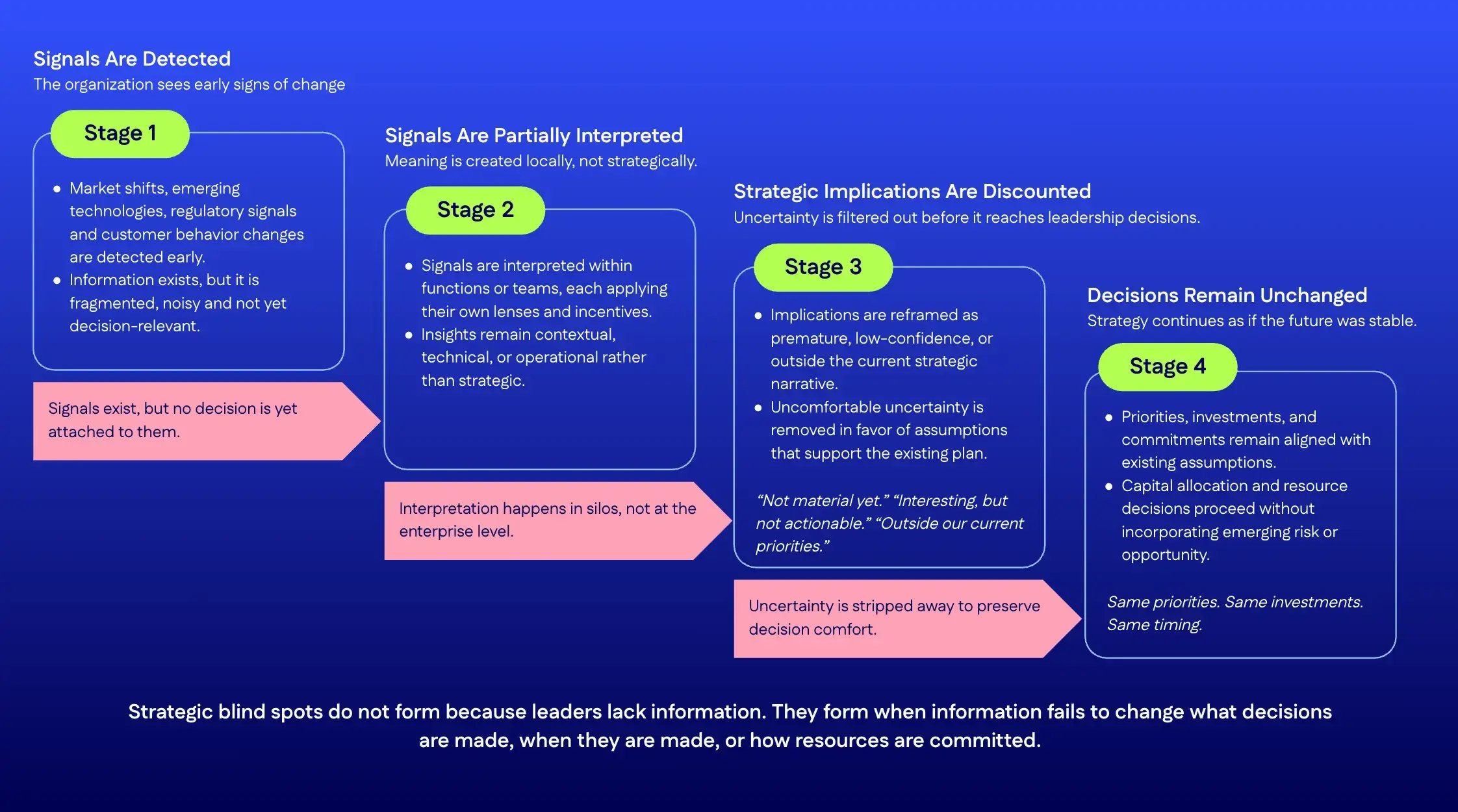
Seeing is not the same as understanding, and understanding is not the same as acting. Strategic blind spots form in the gaps between these three stages. Many organizations detect weak signals, but fail to interpret their strategic implications. Others interpret them correctly, but do not act because existing strategies, incentives, or identities dominate decision-making.
This is why blind spots often persist even after they are named internally. Awareness alone does not change decisions. Decision systems do.
Why successful organizations still develop blind spots
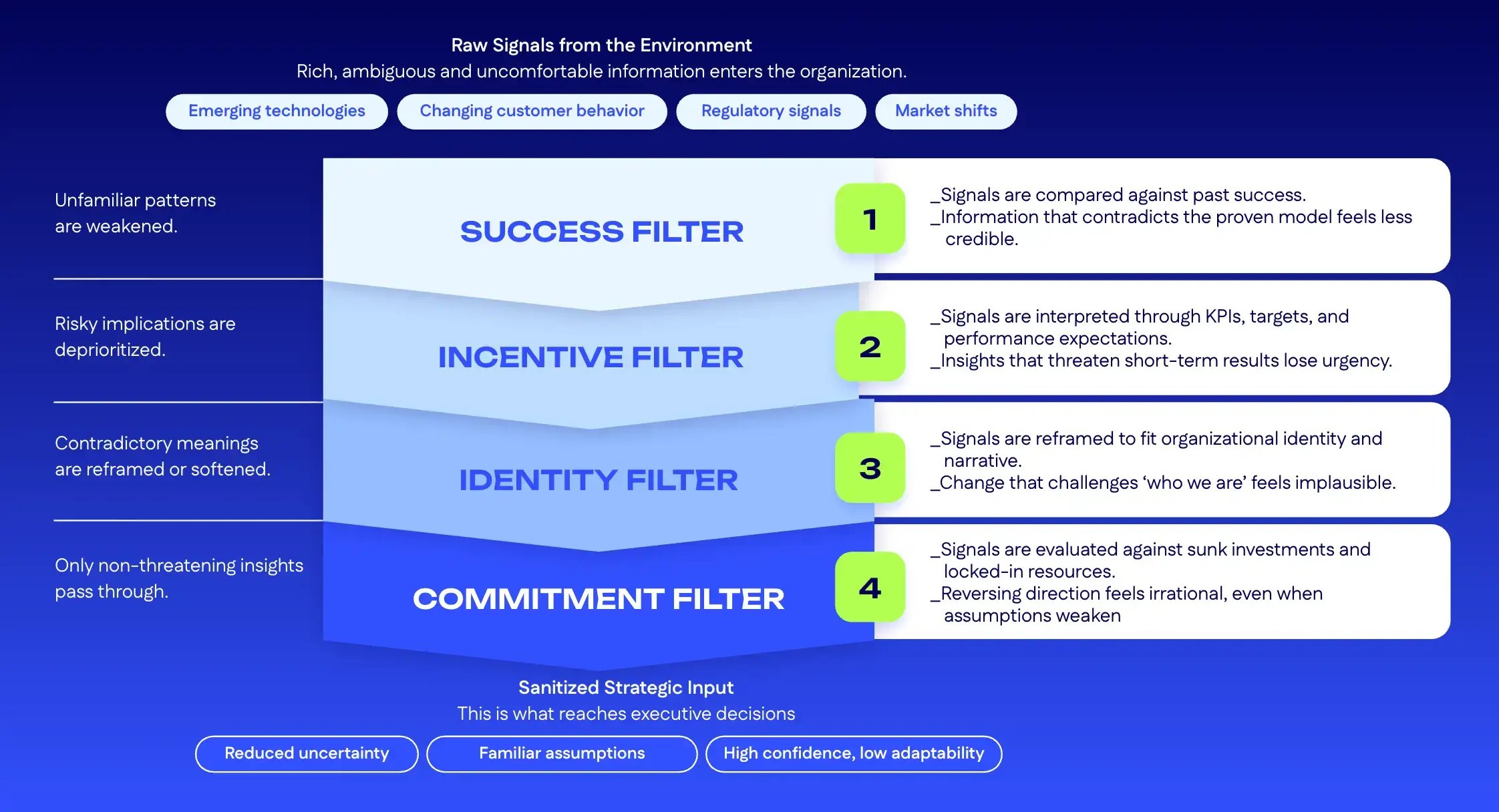
Successful organizations still develop strategic blind spots because success reinforces assumptions, incentives reward continuity, and strategy systems filter out uncertainty. The problem is structural, not personal. And experienced leaders are often vulnerable because past success shapes what feels reasonable.
Organizations optimize around what has worked. Over time, this creates powerful filters that define what is considered relevant, credible, or urgent. Signals that challenge the dominant model are delayed, reframed, or deprioritized. Decision-makers may intellectually accept uncertainty, but their systems reward predictability.
Success bias and commitment lock-in
Success bias and commitment lock-in cause decision-makers to defend existing strategies even as conditions change. Capital investments, talent choices, and performance metrics all reinforce current direction. Walking away from them feels irrational, even when evidence mounts that assumptions are weakening.
This dynamic explains why disruption often appears sudden. The signals were there, but they conflicted with deeply embedded commitments.
Linear planning in non-linear environments
Linear planning persists because it creates a false feeling of stability in complex environments. Forecasts, targets, and single-point projections provide clarity, but they mislead when change is non-linear. When decision-makers rely on linear tools in volatile and ambiguous contexts, blind spots grow at the edges of what the plan assumes.
Incentives, identity and organizational inertia
Incentives and identity often matter more than insight. Decision-makers may recognize emerging threats but delay action because it conflicts with short-term targets, organizational identity, or political realities. Over time, this inertia becomes invisible. Decisions appear rational inside the system, even when they are strategically risky.
Where blind spots occur
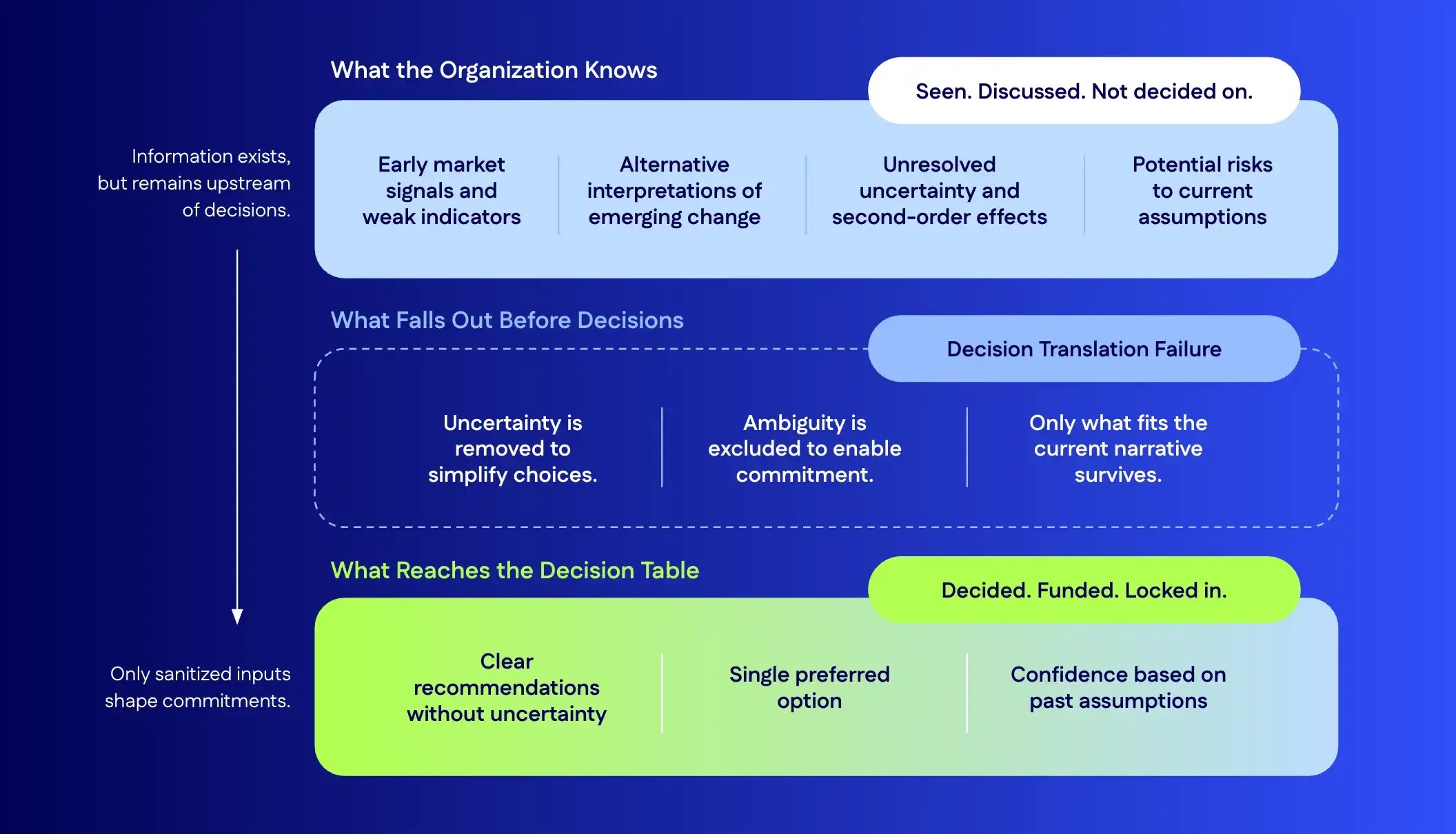
Strategic blind spots enter the decision process between sensing change and committing resources. They rarely originate at the scanning stage. They form when insights fail to influence priorities, trade-offs, and investment decisions.
Most organizations have some form of market intelligence, trend analysis, or risk monitoring. The breakdown occurs when this information remains separate from core strategy discussions. Leaders may review signals, but decisions are still driven by legacy assumptions.
The sensing–sensemaking–decision gap
The sensing–sensemaking–decision gap is where blind spots take hold. Signals are collected, but not translated and interpreted into shared understanding. Interpretation happens in silos. Decision-makers receive conclusions, not the underlying uncertainty.
As a result, strategic choices are made with false confidence. Decision-makers might believe they are informed, while the real uncertainty remains unaddressed.
Why early signals fail to change strategic direction
Early and weak signals fail to change strategic direction because they are ambiguous, often justify action only in combination with other developments, and might imply uncomfortable future paths. They rarely justify immediate action on their own. Without a structured way to explore implications across multiple futures, leaders default to waiting for clearer proof. By the time proof arrives, options have narrowed.
How foresight reduces blind-spot risk
Foresight reduces blind-spot risk by reshaping how organizations interpret uncertainty and make strategic decisions. It does not eliminate uncertainty. It makes it visible, discussable, and actionable.
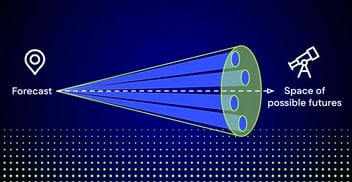
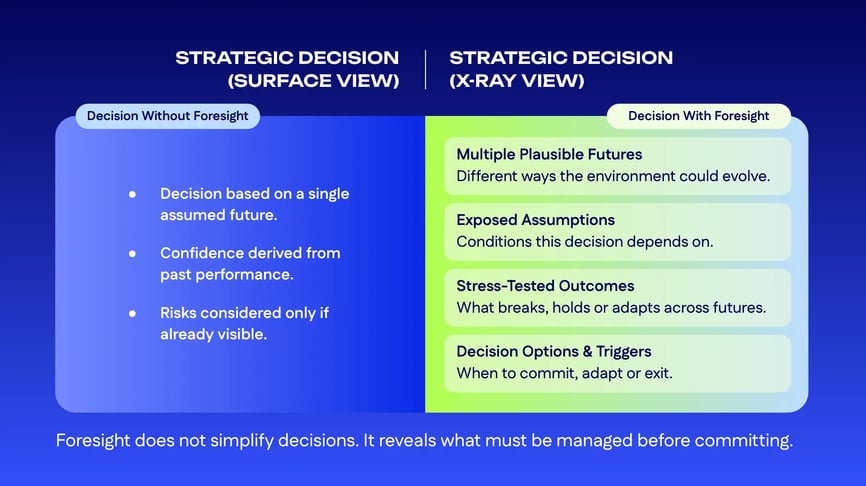
Unlike traditional planning, foresight accepts that the future will not converge into a single outcome. It expands perspective before commitment. For decision-makers, the value of foresight lies in improving decision quality, not predicting events.
This logic is explored further in our article on strategic foresight fundamentals.
From weak signals to strategic meaning
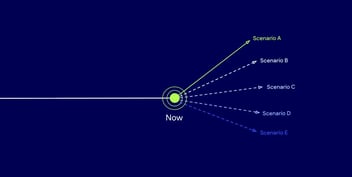
Foresight turns weak signals into strategic meaning by connecting them to plausible futures. Instead of debating whether a signal is “real,” leaders explore what it could imply if it grows, converges and combines with others, or accelerates. This shifts the conversation from probability to preparedness.
Multiple futures vs single-point assumptions
Multiple futures replace fragile assumptions with tested options. When decisions are examined across several plausible scenarios, hidden dependencies surface. Strategies that only work in one future reveal their risk. More robust choices become visible.
Using scenarios to challenge assumptions before they break
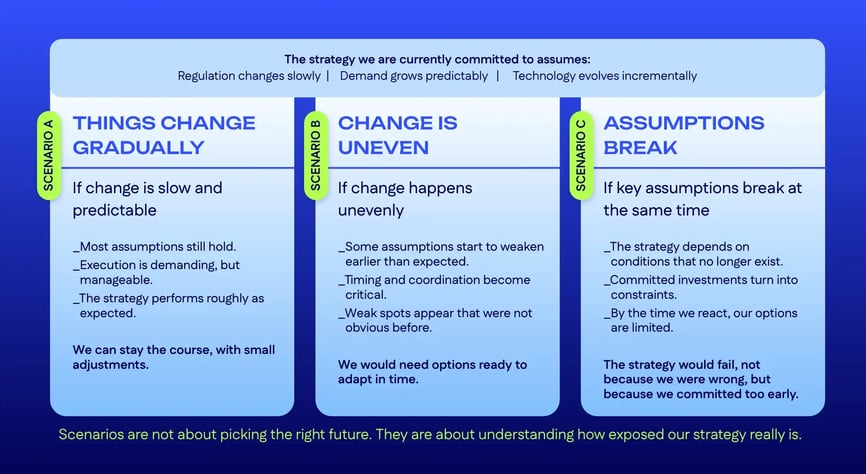
Scenarios help leaders avoid strategic blind spots by stress-testing assumptions. They are not forecasts. They are structured thought experiments that reveal possible future paths and expose where strategies are brittle.
The key question is “Would our strategy still work if a scenario becomes reality?”.
This builds directly on the principles outlined in our article on scenario planning in foresight strategy.
Stress-testing strategy, not predicting outcomes
Scenario planning stress-tests strategy. By examining how a strategy performs across different futures, leaders can identify where future performance is fragile, where options exist, and where no-regret moves make sense.
This approach shifts decision-making from betting on being “right” to preparing to adapt if need be.
Identifying fragile vs robust strategic choices
Scenarios help to distinguish fragile choices from robust ones. Fragile choices depend on specific conditions. Robust choices perform reasonably well across multiple futures. This distinction is critical when decisions involve long-term investments, platforms, or capabilities.
Leadership and governance moves that prevent blind spots
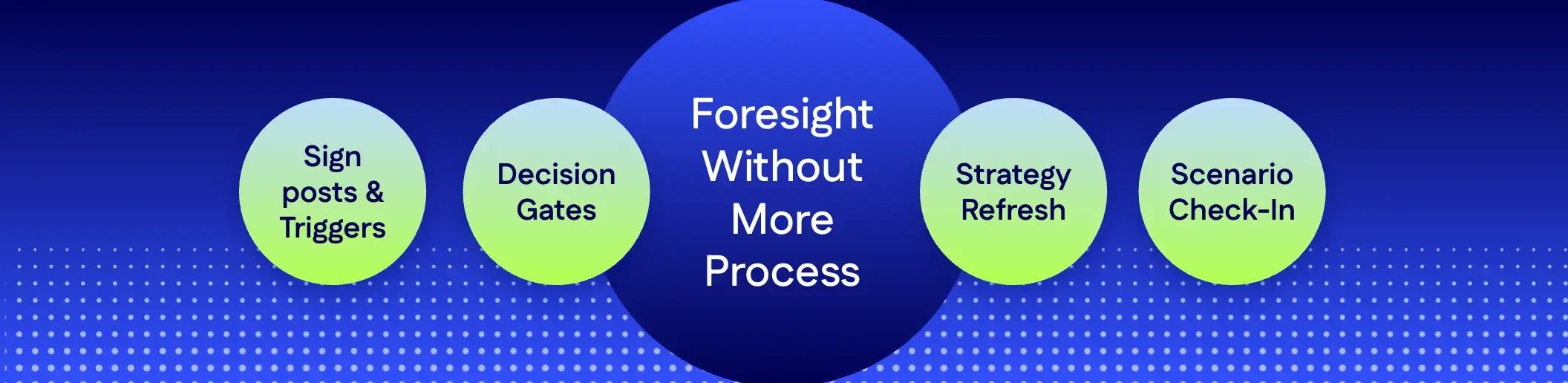
Preventing strategic blind spots requires changes in leadership behavior and governance, not necessarily more analysis. Foresight only works when it is embedded into how decisions are prepared, reviewed, challenged, and updated.
Without the right governance, foresight remains an intellectual exercise. Deeply embedded, it becomes a strategic capability, as described in our article on the strategic foresight process and steps.
Signposts, triggers and decision timing
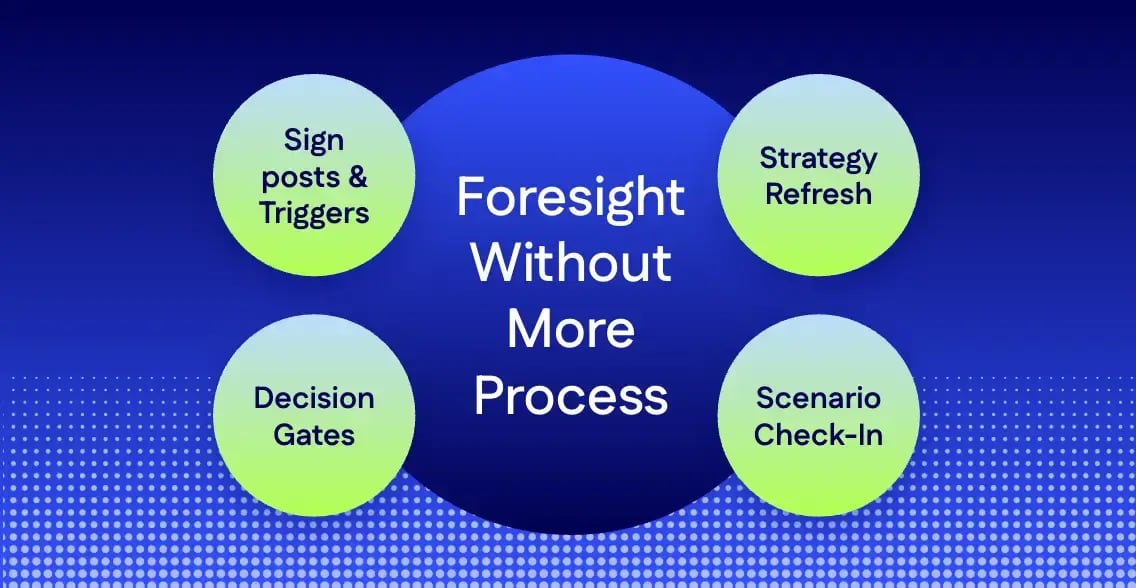
The right signposts and triggers help to act before blind spots become failures. Signposts track early indicators that suggest which future may be emerging. Triggers define when leadership has to revisit decisions or reallocate resources.
This creates discipline without false certainty.
Embedding foresight into strategy cycles
Embedding foresight into strategy cycles ensures insights influence real decisions. This includes linking foresight routines to budget cycles, investment gates, and portfolio discussions. When foresight informs strategy, the blind-spot risk declines.
When blind spots matter most
Strategic blind spots matter most when decisions are irreversible, long-term and exposed to uncertainty. These are precisely the decisions senior leaders have to make.
Not every decision requires foresight. But the most consequential ones do.
Strategy, innovation and technology bets
Blind spots are most dangerous in strategy, innovation, and technology bets. Platform choices, acquisitions, and capability investments lock organizations into paths that are hard to reverse. Foresight helps leaders test these bets before committing fully.
Regulation, AI and systemic disruption
Emerging regulation, AI adoption and systemic disruptions amplify blind-spot risk. These forces evolve unevenly and interact in unexpected ways. Those who rely on linear assumptions are more likely to be surprised.