
Strategic foresight is not a crystal ball. It is a structural capability that allows organizations to act in the face of uncertainty before clarity arrives. In an era of polycrisis – where geopolitical shifts, technological breakthroughs like AI, regulatory divergence, and climate volatility collide – traditional linear planning is no longer a safety net; it is a liability.
Strategic foresight is the mechanism that enables making confident choices despite more and louder external noise. It helps leadership teams decide when to move, where to place bets, which assumptions are underlying their choices, and under which conditions they do not hold any longer.
At Bluemorrow, we advocate for foresight as a rationale that ultimately needs to be deeply integrated, not singular projects or workshop formats. This article explains how the strategic foresight process works, how executive teams can use it to govern in spite of uncertainty, and how it can be embedded in decision-making, capital allocation and corporate governance.
What does an embedded Strategic Foresight process look like?
Embedded strategic foresight is a repeatable methodology used to identify drivers of change, explore alternative plausible futures, stress-test current strategies and identify emerging opportunities. Unlike market research, which analyzes today’s customers, or forecasting, which extrapolates based on yesterday’s data, the foresight process recognizes the possibility of systemic shifts that could render current assumptions obsolete.
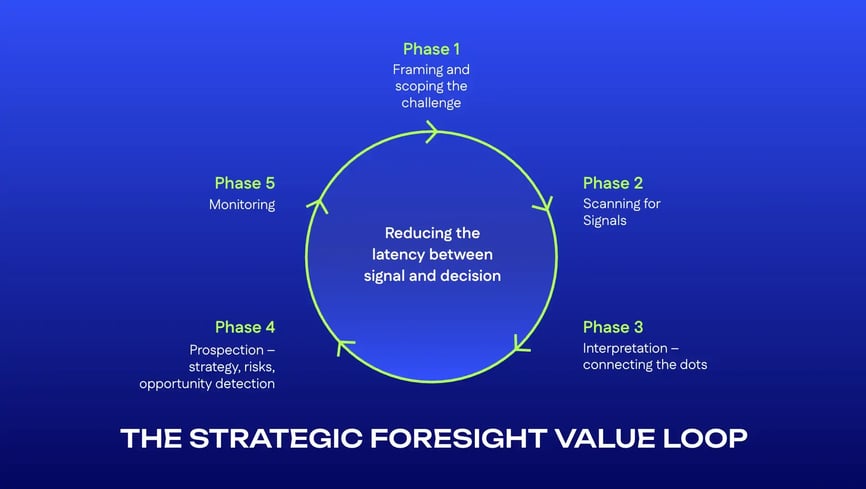
At its core, this process addresses a latency gap between a signal appearing on the horizon and the organization taking corrective action. By formalizing how you scan, interpret, and act, we move from reactive decision-making to proactive positioning and value capturing.
What would we regret not having prepared for? – That question sits at the heart of effective foresight.
How foresight differs from traditional strategic planning
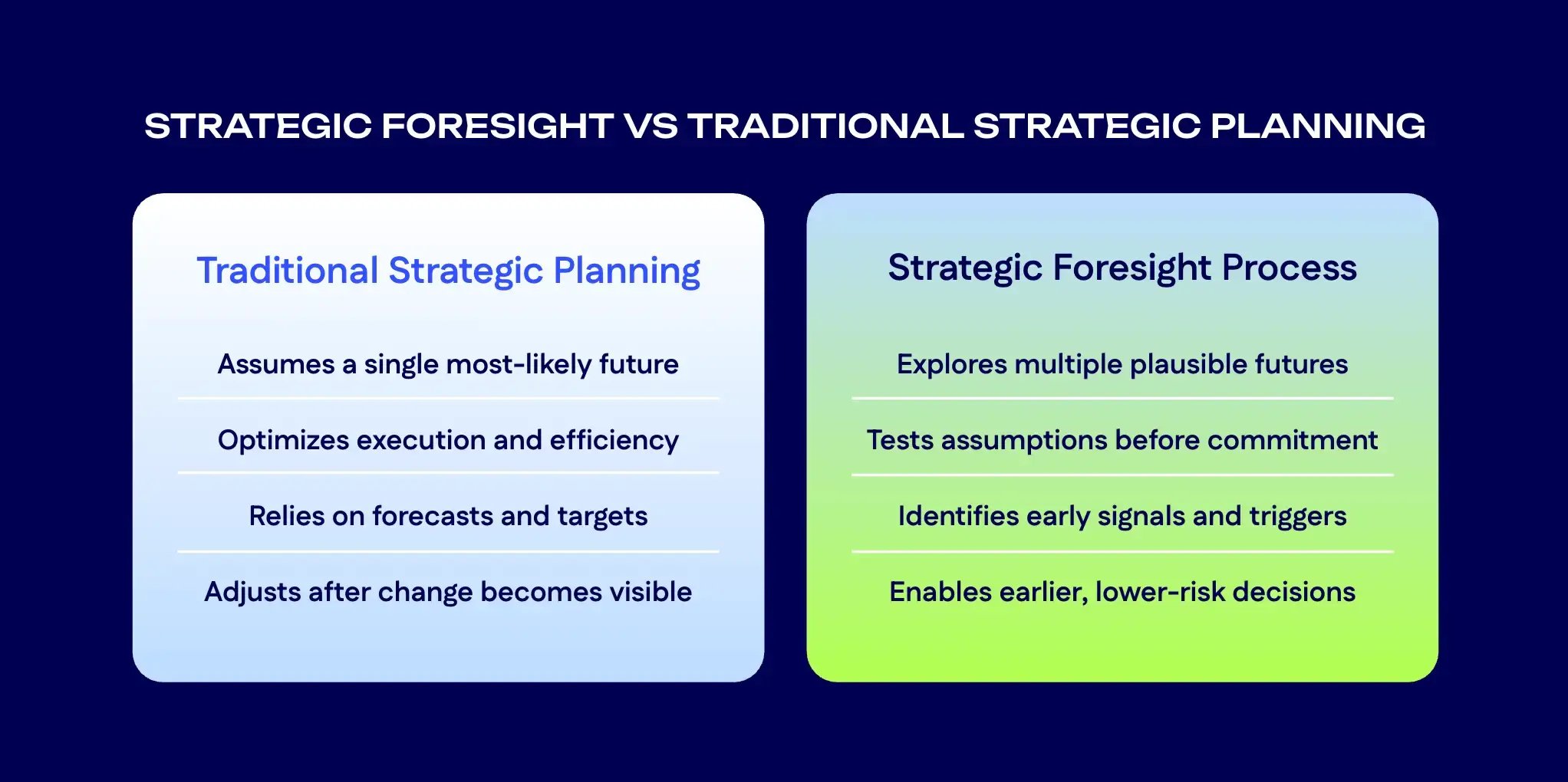
Traditional strategic planning typically assumes a single, most-likely future which is in many cases not made explicit. Budgets, targets and roadmaps are optimized around that assumption, often with a +/- 10% sensitivity analysis to cover for gradual changes in current market conditions. However, when conditions fundamentally shift, organizations scramble to adjust.
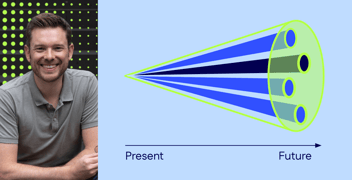
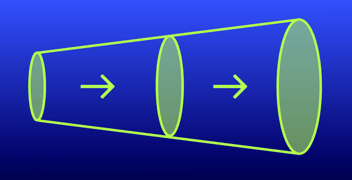
At the core of strategic foresight is a fundamentally different way of thinking: instead of present-forward it is turned into future-back thinking. The process thus starts from a different premise: the future is uncertain, but not random. Instead of committing to one outlook and planning towards it incrementally, we advocate exploring a space of plausible futures shaped by interconnected changes in technology, regulation, markets and society. This allows distinguishing between strategies, opportunities, and risks that are robust and those that are only relevant under narrow conditions.
This does not replace planning. It complements it. Forecasting remains essential for near-term execution. Foresight expands the time horizon and prepares leadership teams for discontinuity before it becomes visible in financials.
The 5-Phase methodology
A professional strategic foresight process is neither academic nor abstract. It is a cycle designed to deliver decision-grade insights.
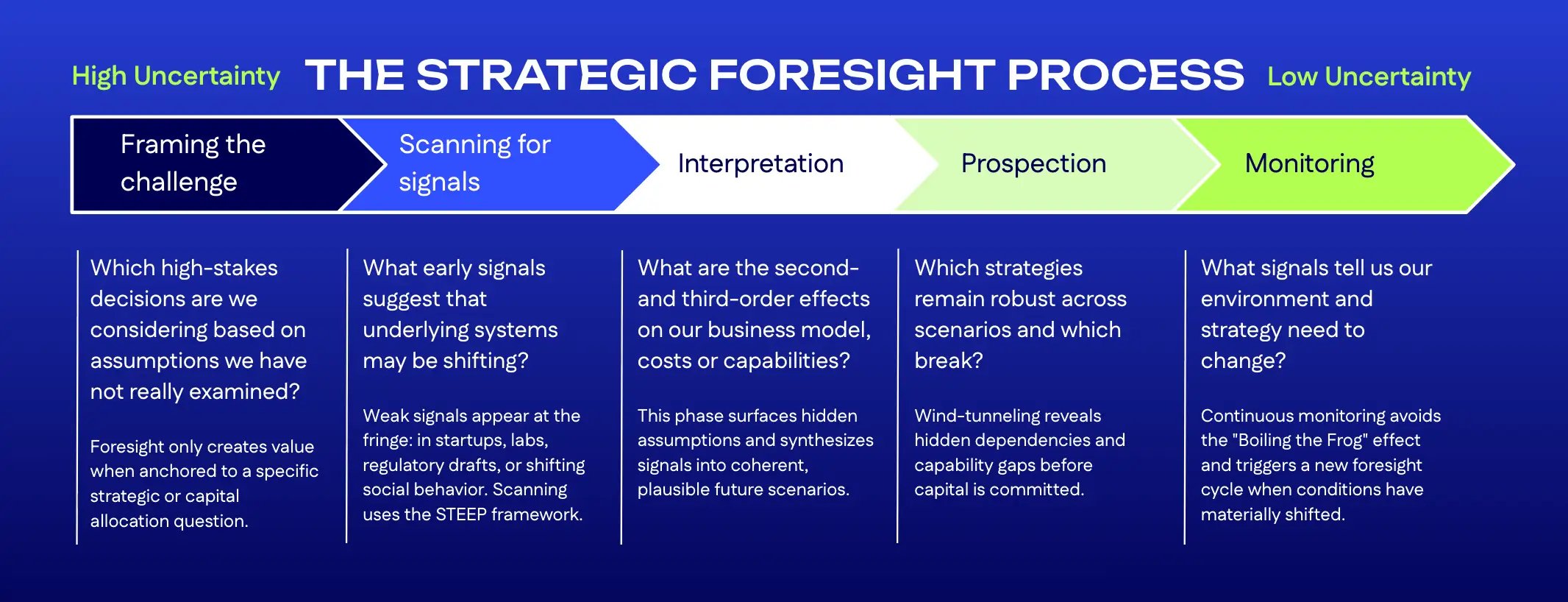
Phase 1: Framing and scoping the challenge
A common reason for foresight failures is poor scoping. When the scope is too broad, the output becomes generic. When the decision context is unclear, insight never turns into action.
The objective of this phase is to define:
-
the strategic domain (corporate strategy, business, portfolio, capability, or market),
-
the time horizon (typically 3–10 years, sometimes more depending on the industry),
-
and the decisions at risk.
Executive teams should ask:Which high-stakes decisions are we currently considering based on assumptions we have not really examined?
Foresight only creates value when it is anchored to a specific strategic or capital allocation question. Thus, the scope should be reevaluated in new iterations of the process. Without that anchor, it remains interesting, but inert.
Phase 2: Scanning for signals (The STEEP Framework)
In the scanning phase, signals are identified - obvious ones and weak signals – early indicators that underlying systems may be shifting. These signals often appear at the fringe: in startups, research labs, regulatory drafts, or changing social behavior.
Most organizations scan too narrowly, focusing on their own industry. A robust strategic foresight process uses structured scanning domains, often summarized through the STEEP framework:
-
Social
-
Technological
-
Economic
-
Environmental
-
Political
The goal is not volume. It is relevance. Increasingly, this phase is augmented by AI tools that scan databases, process large information pools and surface emerging patterns. Used well, AI increases coverage and reduces blind spots. It does not replace judgment.
The key mindset shift is simple: Do not look for what is likely. Look for what is changing.
Phase 3: Interpretation (Connecting the Dots)
Data is not insight. Interpretation is the phase where teams ask “So what?” – repeatedly. Signals are connected, clustered, and translated into implications. Second- and third-order effects are derived, e.g. how a regulatory shift interacts with technology adoption or how a demographic trend reshapes cost structures that again might shift buying behaviour.
At this stage insights might be synthesized into future scenarios. These scenarios are not predictions. They are coherent, plausible future states of the scoped field of interest shaped by different combinations of critical uncertainties.
Good scenarios are:
-
plausible
-
structurally different
-
internally consistent
-
together capture a broad “future space”, i.e. range of possible future developments
Most organizations work with three to five scenarios. Fewer limit perspective. More reduce usability. It is not to capture each and every possible scenario - these are usually millions of different theoretically possible combinations of factors. The objective is contrast, not completeness. A few distinct scenarios allow leadership teams to test how today’s strategy performs if conditions evolve differently than expected. This shifts conversations from “What do we believe?” to “What would break?”
This is also where hidden assumptions surface.
-
What must remain true for our strategy to work?
-
Which dependencies have we never stress-tested?
Interpretation bridges the gap between raw data and decision-relevant insight. Without it, foresight remains descriptive rather than strategic.
Phase 4: Prospection (strategy, risks, opportunity detection)
Prospection is where insights about the future are translated into actionable outcomes. This can be a future-proof corporate strategy, a regional or division strategy, a risk mitigation plan, an innovation strategy or more granular opportunities to pursue.
To make this a foresight-driven phase, the integration of the future-view and the plan is imperative. For example, scenario wind-tunneling or stress-testing examine:
-
which strategies remain robust in all scenarios,
-
when they require adaptation,
-
when outright fail.
During the process, leaders often discover that risk does not sit where they expected it. Hidden dependencies, timing assumptions, and capability gaps surface early – before capital is fully committed.
The output of this phase is usually a portfolio of strategic actions, typically structured into:
-
no-regret moves
-
strategic options or hedges
-
selective big bets
If the foresight process does not give clear direction for priorities, funding, or decision triggers it has failed.
Phase 5: Monitoring
Finally, an integrated foresight process does not stop with a one-time exercise.
In phase 4, a portfolio of actions ready for execution is created. This is done based on the information available and deductible for the future as of the time of their creation. However, this knowledge changes over time, reality changes over time. This can be observed and monitored via measurable indicators.
An environment that changes in unfavorable ways changes the assessment and might change the most suitable actions. If monitored continuously, the organization can react early and avoid the “Boiling the Frog” effect, i.e. inability to react to, or be aware of, sinister threats that arise gradually rather than suddenly.
Ultimately, a substantially changing environment might render a new, deeper foresight analysis necessary. This typically happens after a couple of years when new, previously unknown aspects or knowledge have materialized.
Integrating Foresight into Corporate Governance
To prevent the strategic foresight process from becoming shelf-ware, it must be hard-wired into governance. Foresight cannot be a standalone department; it must be an input to the existing power structures of the firm.
Moving from workshops to cadence
Most organizations run foresight as a one-off project or singular workshops. To gain a competitive edge, however, continuous foresight is required.
- Monitoring and Strategy Reviews: Use continuous monitoring to stay up-to-date about critical uncertainties and regularly if not constantly review underlying assumptions of the strategy or innovation opportunities.
- M&A and R&D Gates: Every major investment case should include a Foresight Stress Test to see how this asset will perform in different scenarios.
- Board Reporting: Complement the standard economic outlook with a signal map that highlights shifts in critical uncertainties.
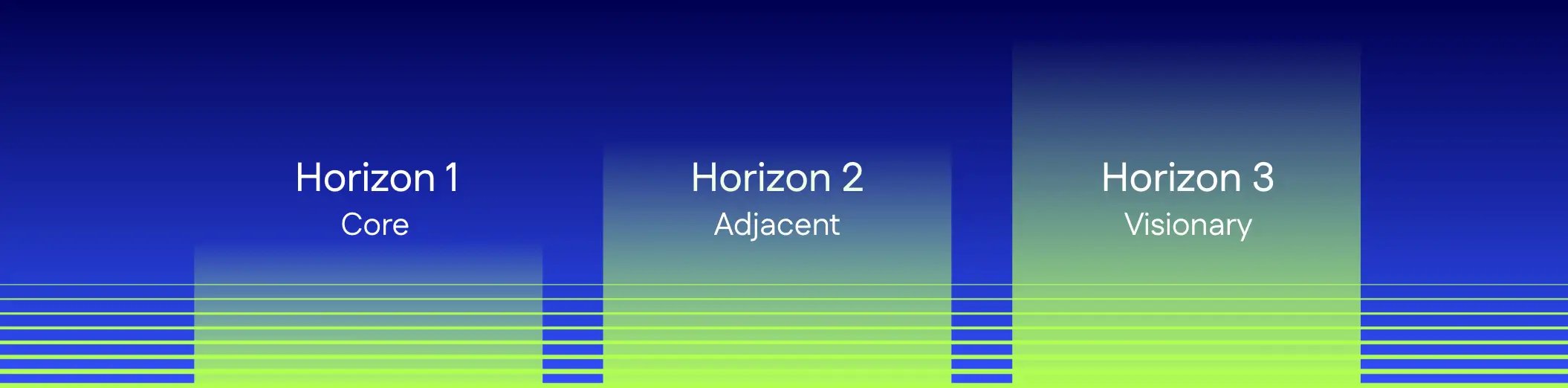
The Three Horizons Framework
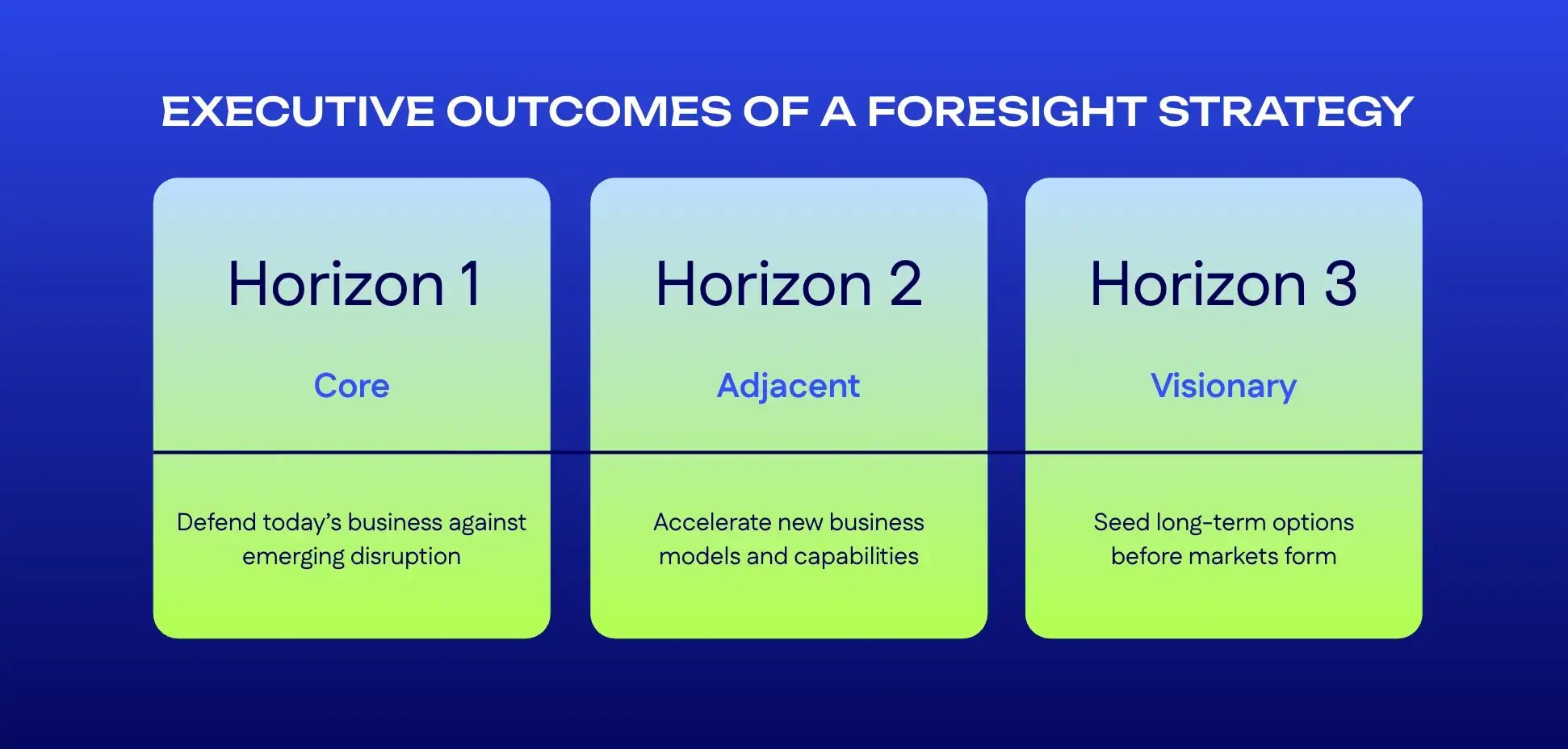
Governance is simplified when using the Three Horizons model.
- Horizon 1 (Core): Use foresight to defend against disruption.
- Horizon 2 (Adjacent): Use foresight to accelerate new business models.
- Horizon 3 (Visionary): Use foresight to seed long-term optionality.
How AI is changing the Strategic Foresight process?
Previously, horizon scanning took months. Today, AI-supported trends and research tools monitor patent databases, news outlets, social media, and scientific databases in real-time. This allows the strategic foresight process to move to a real-time sensing loop.
The Executive Advantage: AI does not replace the leader's judgment; it can remove the blind spots caused by human cognitive bias. It allows spending less time finding data and more time debating the implications of that data.
The distinction is critical: AI augments foresight. It does not delegate it.
Measuring the ROI of Strategic Foresight
Justifying the cost of foresight is a constant struggle because its primary value is the crisis that did not happen or the opportunity captured early.
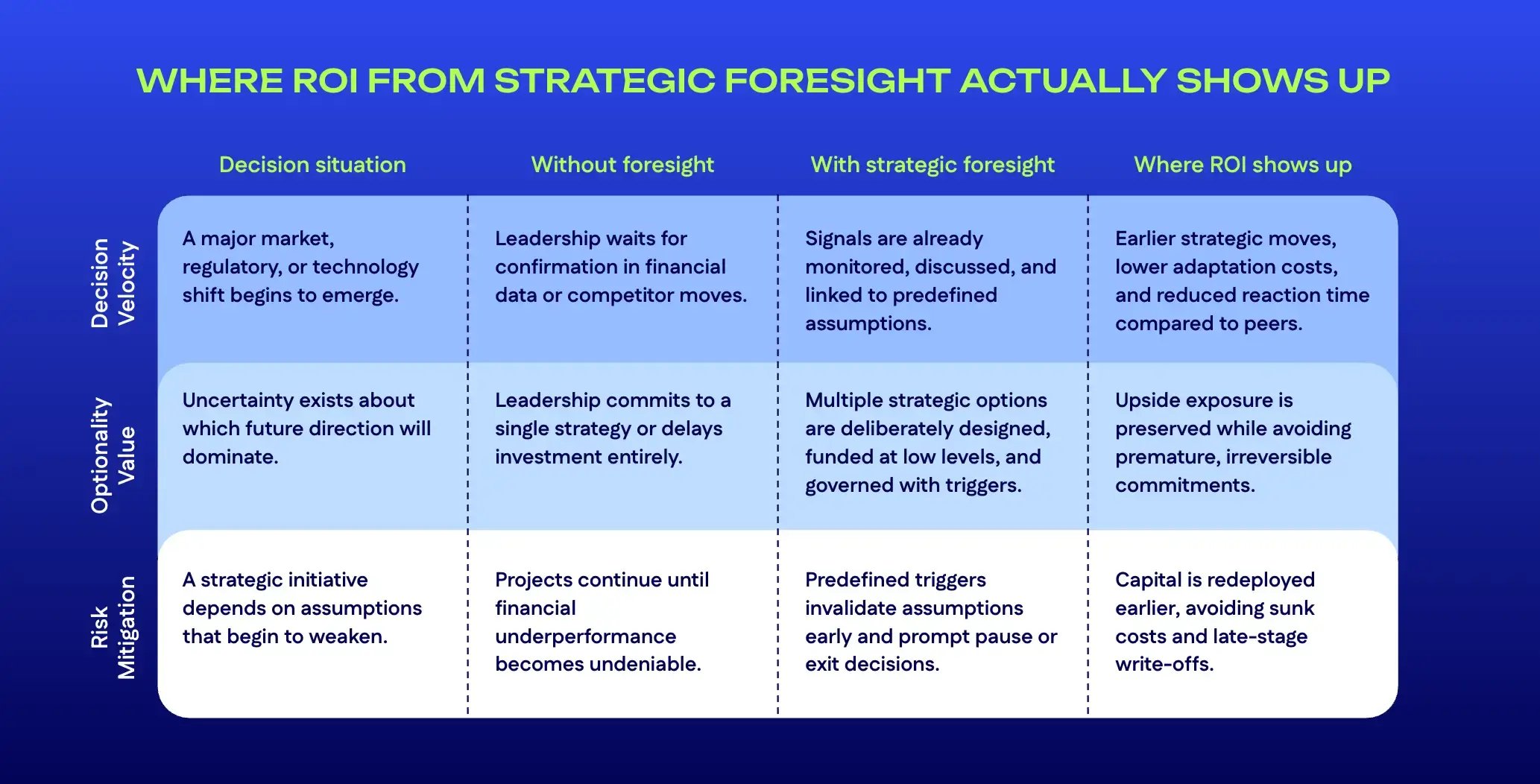
To measure ROI, look at:
-
Decision Velocity: How much faster did we pivot compared to our peer group when a market shift occurred?
-
Optionality Value: What is the potential upside of the Horizon 3 seeds we planted based on early signals?
-
Risk Mitigation: Did we avoid Sunk Cost by killing a project because a foresight trigger was hit?
Don't wait for the disruption to begin
Strategic foresight is not a luxury for large corporations. It is a governance imperative for any organization navigating a world where the next disruption is a matter of when, not if.
The organizations that will lead their industries in the next decade are not necessarily those with the best forecast models. They are the ones that have learned to act confidently under uncertainty to move before clarity arrives, place bets before consensus forms, and recognize threats before they appear in the financials.
That capability does not emerge from a single workshop. It is built through a repeatable process, embedded in governance, and refined over time.
Ready to embed strategic foresight into your organization? Get in touch with Tobias, our Managing Partner & Foresight expert.