
In the high-stakes environment of corporate strategy, the tools you use to view the future dictate the legacy you leave behind. While most executive suites rely on Forecasting to maintain the engine, progressive companies deploy Backcasting to build the vehicle of tomorrow.
At its core, the debate of Forecasting vs. Backcasting is a discussion about two different rationales:
-
Forecasting is a forward projection. It moves from today into tomorrow, asking: Where will our current path take us?
-
Backcasting is reverse-looking based on a desired end state. It moves from tomorrow back to today, asking: What must we do now to reach our desired destination?
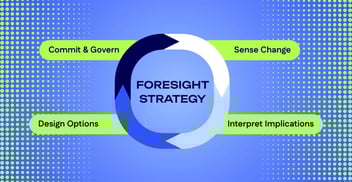
Companies that apply both successfully have deeply-rooted strategic foresight capabilities. This capability enables the organization to navigate uncertainty and change systematically.
Why the distinction matters
The cost of confusing these two lenses is institutional stagnation. Relying solely on forecasting in a volatile market leads to the Incumbent’s Trap, where you optimize a dying business model to extreme efficiency but overlook fundamental changes that render exactly that business obsolete. Conversely, randomly applied backcasting will lead to goals that are disconnected from today’s business, emerging technological, political, regulatory, ecological, or social realities.
At Bluemorrow, we help organizations balance these methodologies. The goal is not to predict the future, but to possess the systemic capacity to make the organization future-fit.
Forecasting: The lens of optimization
Forecasting is the process of using historical data and statistical trends to predict the most likely future outcome.
It operates on the principle of extrapolation. It assumes that the underlying drivers of the past (consumer behavior, market growth, supply chain cycles) will continue to function in a similar way. It is a quantitative discipline rooted in probability and statistical modeling.
The mechanics of prediction
Forecasting generally falls into two categories:
-
Statistical Forecasting: Utilizing time-series analysis and AI-driven models to project sales, inventory, and cash flow based on hard data.
-
Judgmental Forecasting: Applying executive intuition to adjust those models based on known upcoming events, such as a planned product launch or a competitor's market entry.
When to use Forecasting
Forecasting is your tool for efficiency. It is indispensable for:
-
Short-term budgeting: Managing cash flow against specific, hard targets.
-
Supply chain management: Reducing waste in inventory and optimizing logistics based on seasonal patterns.
-
Operational scaling: Planning headcount and resource allocation based on existing growth trajectories.
The strategic limitation: The stationarity trap
Forecasting relies on stationarity, which is the assumption that the rules of the game won't change over time. Relying solely on forecasting makes corporate planning dangerously brittle during Black Swan events or radical shifts like the rise of Generative AI, but can also lead to the boiling frog phenomenon. Essentially, forecasting tells you how to make a better horse carriage; it will never tell you to invent the automobile.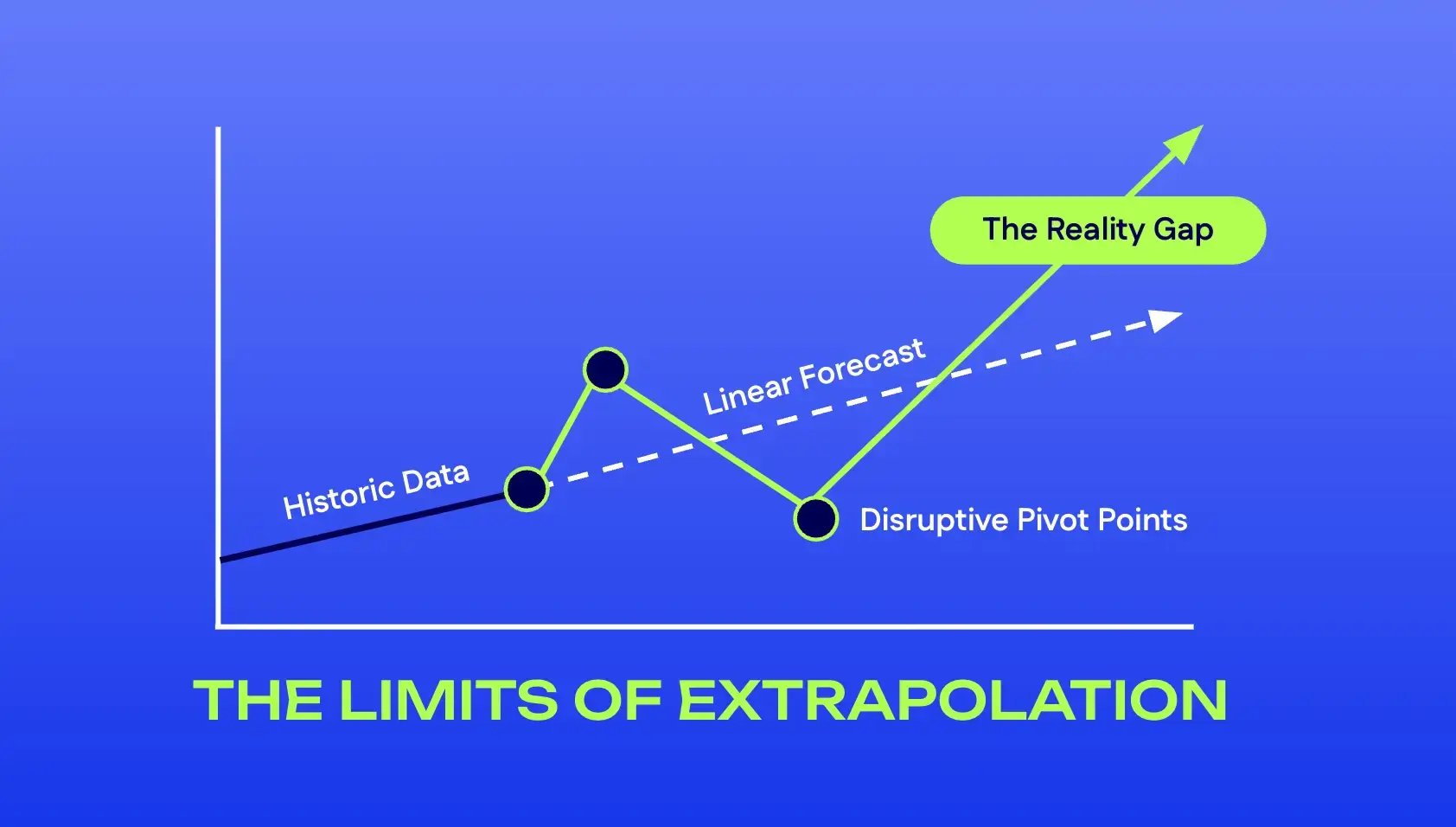
Backcasting: The lens of transformation
Backcasting is a planning method that starts with a specific, successful future outcome and works backward to identify the strategic steps required to reach it today.
Where forecasting asks what is likely, backcasting asks what must happen to achieve a vision. It is a primary tool to systematically work towards disruptive innovation and large transitions.
The mechanics of backcasting
Running a backcasting exercise follows a clear sequence:
- Define the future state. Set a concrete, ambitious endpoint – a market position, a sustainability target, a capability threshold – typically 10 to 20 years out. This is often referred to as the North Star. The specificity of this endpoint matters. Vague destinations produce vague roadmaps. A preceding scenario planning exercise to systematically explore multiple plausible futures helps defining this endpoint. For a fuller picture of what this actually involves, our fundamentals guide covers the core concepts.
- Map the conditions required. Work backward to identify what would have to be true for that future to be reachable. What technologies must exist? What regulations must be in place? What capabilities must the organization have built?
- Identify the milestones. Break the path into staged commitments – what needs to be in place by year 10, year 5, year 2. This converts a long-term vision into near-term decisions and ultimately a roadmap.
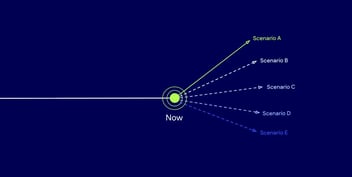
- Stress-test against uncertainty. Run the roadmap through different scenarios to check which milestones hold across futures and which depend on specific conditions materializing. This is where backcasting connects directly to the strategic foresight process.
Breaking path-dependency
Companies are path-dependent – today's decisions are constrained by yesterday's investments and infrastructure. By placing the starting point far in the future, leaders can bypass current internal politics and resource constraints to imagine a fundamentally different organization.
When to use Backcasting
Backcasting is your tool for transformation and large transitions such as
- Sustainability Transitions: Working backward from a 2040 carbon-neutral goal to 2026 procurement and supply chain shifts.
- Market Disruption: Reimagining a legacy hardware company as a leader in software-as-a-service offerings.
- Moonshot Initiatives: Establishing a dominant position in a completely new category such as Space Tech, Hydrogen, or Quantum Computing.
Forecasting vs. Backcasting: A multi-modal view
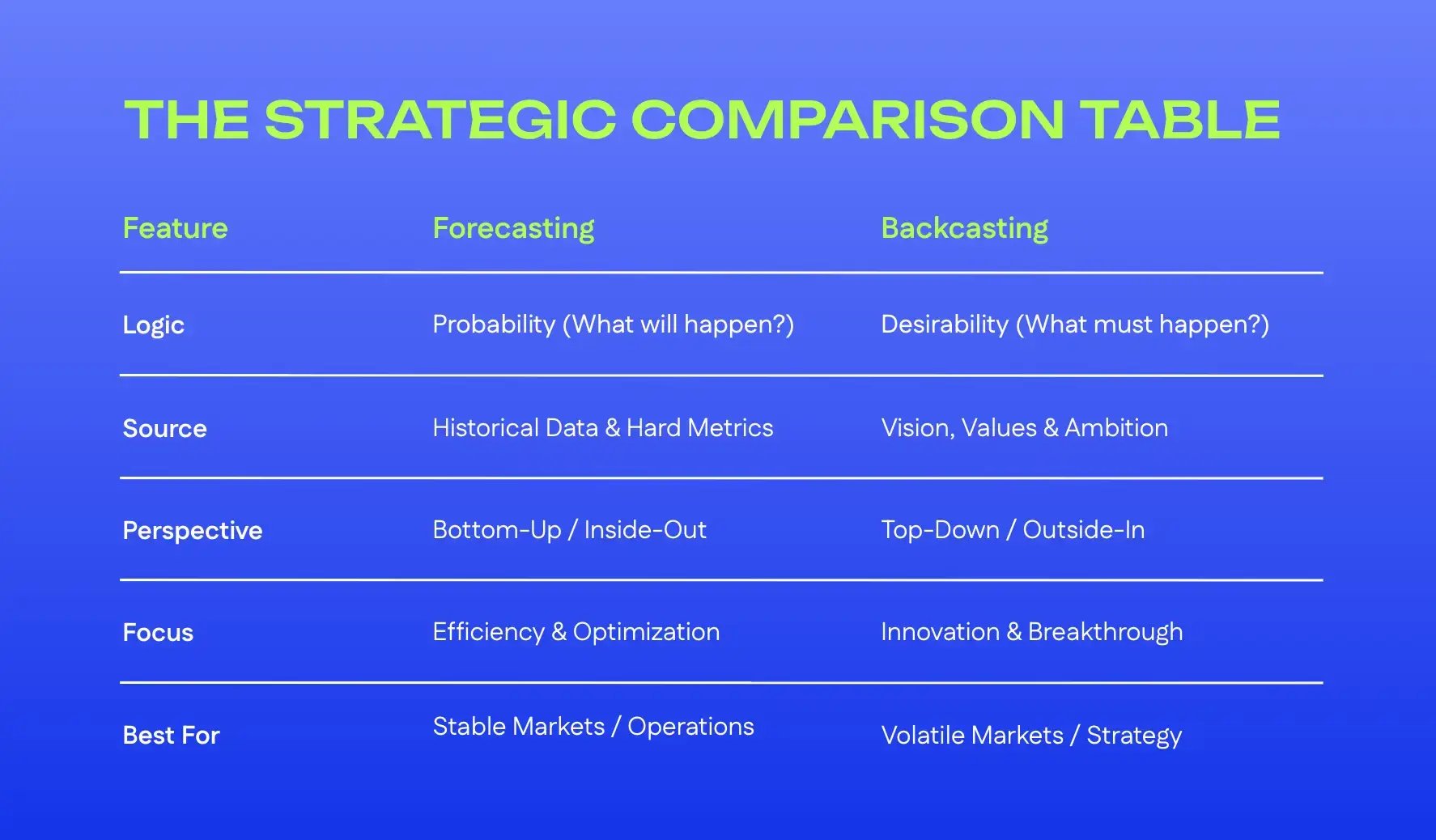
To maximize strategic impact, treat forecasting and backcasting as complementary rather than a binary choice. The table below captures the core differences, but the more important question is knowing when to switch lenses.
Most organizations default to forecasting because it feels safer and fits existing planning approaches, structures, and reporting cycles. The problem arises when forecasting logic is applied to potentially transformative situations where the rules of the game are changing and historical data is a poor guide - such as long-term strategy. Ultimately, this might lead to a hard working organization that nevertheless moves in the wrong direction. Nokia before the rise of the iPhone are a frequently used example for this as is Kodak and digital photography.
The same applies in reverse. Backcasting applied to short-term operational decisions introduces unnecessary complexity and slows execution. A manufacturing team optimizing inventory does not need a 2040 vision, it needs reliable demand data.
In practice, the most resilient organizations run both in parallel: forecasting to manage the core business with precision, backcasting to architect what comes next. Strategic foresight is the underlying capability, ensuring that neither lens operates on assumptions that have quietly stopped being true.
Overcoming the cognitive friction of future-thinking
The greatest barrier to using these lenses is not a lack of data, but the psychological bias of Hyperbolic Discounting. Management is often heavily incentivized to value the immediate, forecasted quarterly result over the long-term vision.
The role of the visionary leader
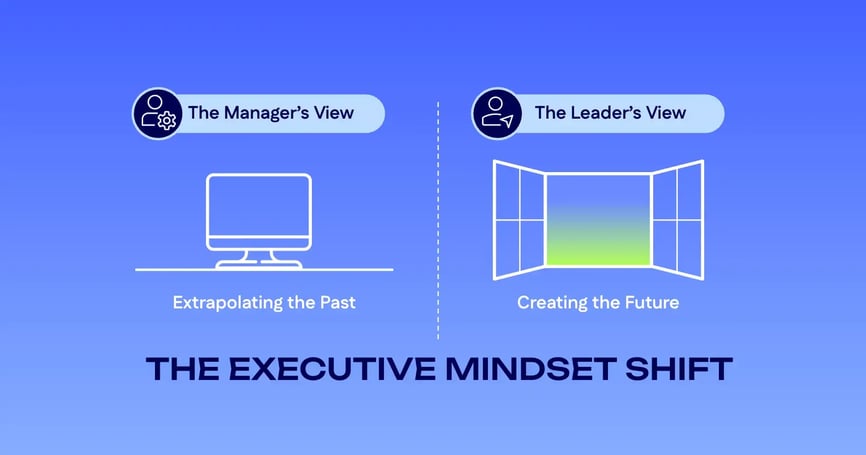
Moving from forecasting to backcasting requires a cognitive reframing. Instead of viewing long-term strategy as a risk, it must be viewed as option value.
- Forecasting minimizes risk by staying near the shore of the known.
-
Backcasting manages the risk of obsolescence by ensuring you are heading in a promising direction in a changing world.
Bluemorrow’s approach integrates these mindsets into the unified strategic engine, allowing to manage the present with precision while preparing for the future with confidence.
The right lens for the right moment
Most organizations are over-indexed on forecasting – not because it is the better tool, but because it is the more comfortable one. It rewards precision, fits quarterly and yearly cycles, and produces numbers that feel certain.
Backcasting floats harder questions: where do you want to go before you know how to get there. That discomfort is not a flaw in the method. That is the point.
Those who will shape their industries over the next decade are already asking different questions – not "where is the market going?" but "where do we want to be, and what has to be true for us to get there?"
Integrating the Strategic Foresight process
At Bluemorrow, we use foresight to systematically derive ambitious goals grounded in a deep understanding of the future and future-proof existing visions. If you envision being a leader in autonomous shipping by 2035, backcasting identifies the geopolitical shifts or technological weak signals that might make that vision impossible or reveal a much faster route.
We work through a 5-phase process:
- Framing: defining the strategic question and the decisions at risk
- Scanning: identifying signals of change across Social, Technological, Economic, Environmental, and Political domains
-
Interpretation: connecting signals into implications and coherent future scenarios
-
Prospection: translating insights into strategic options, no-regret moves, and selective bets
-
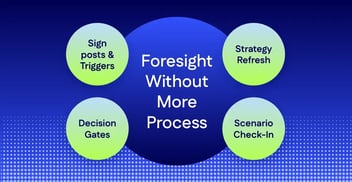
Monitoring: tracking how conditions evolve and triggering action when assumptions shift
We broke down each step of this process in detail here.
At Bluemorrow, we help leadership teams integrate all three lenses into a single decision system. Let's talk about what that looks like for your organization – schedule a call with Tobias