
Corporate innovation tends to follow a familiar pattern.
A new innovation lab is launched. A corporate venture unit is announced. Pilots, partnerships, accelerators, and prototypes multiply. Internal communication is strong and expectations are high. Innovation becomes visible and exciting.
Then, after a few years, momentum slows. Budgets tighten. Leadership attention shifts. Innovation teams are asked harder questions about relevance, impact, and value creation.
Many organizations experience this moment as frustration or fatigue. In reality, it is a predictable phase in how corporate innovation unfolds.
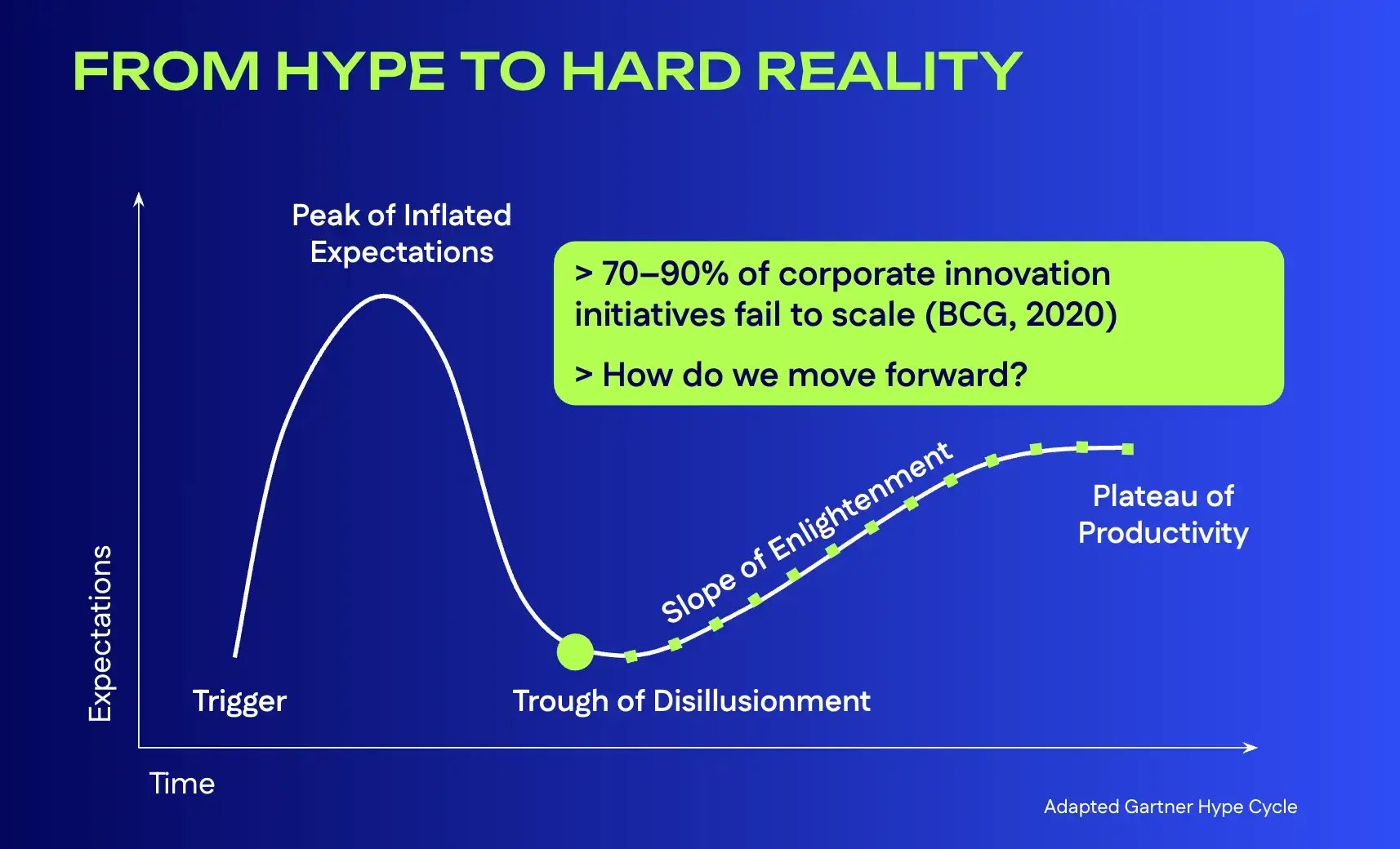
This pattern closely mirrors the Gartner Hype Cycle, a framework developed by the research and advisory firm Gartner to describe how emerging technologies move from inflated expectations into disillusionment before reaching real productivity (Fenn and Raskino, 2008). While the hype cycle was originally designed to explain technology adoption, it has become a powerful metaphor for corporate innovation itself.
The issue is not a lack of ideas, creativity, or ambition. The issue is how corporate innovation is managed.
Corporate innovation and the hype cycle
The hype cycle illustrates a simple dynamic. New ideas generate excitement. Expectations rise faster than capabilities. When results do not materialize quickly enough, disappointment sets in. Only later, if at all, does sustainable value emerge.
Corporate innovation initiatives follow the same trajectory.
Early phases are often characterized by:
- strong executive sponsorship
- visible experimentation
- broad exploration across topics
- limited pressure to show immediate returns
Over time, however, organizations move into what could be described as the trough of disillusionment for innovation. Leaders begin questioning whether innovation efforts are worth the investment. At the same time, the rest of the organization often grows skeptical, questioning the attention, autonomy, and initial slack that innovation units were granted - a dynamic that can create substantial internal friction. Eventually, central innovation units are often scaled down or shut down. Responsibility to innovate is re-distributed back to business units without clear structures or capabilities.
Research confirms that this pattern is widespread and not new. Studies on transformation and innovation repeatedly show that a majority of initiatives fail to reach scale, not because the ideas are weak, but because organizations struggle with execution, integration, and long-term commitment (Sirkin, Keenan and Jackson, 2005; BCG, 2020 “Why Most Digital Transformations Fail”).
Understanding this recurring development cycle of corporate innovation initiatives is therefore not about avoiding experimentation. It is about recognizing that excitement alone does not create value. Sustainable innovation requires ambidexterity – the ability to explore new opportunities while simultaneously strengthening the core business that ultimately scales them.
Why corporate innovation gets stuck
Moving from experimentation to scalable impact is one of the hardest challenges large organizations face.
Multiple studies suggest that roughly 70 percent of transformation and innovation initiatives fail to meet their intended objectives (Sirkin et al., 2005; BCG, 2020, “Why Most Digital Transformations Fail”). In corporate innovation, this failure rarely looks dramatic. Instead, it materializes as gradual loss of relevance. Recent research highlights that innovation failure is often a process rather than a single event, unfolding over time through shifting attention, resource constraints, and organizational dynamics (Freisinger and McCarthy, 2024).
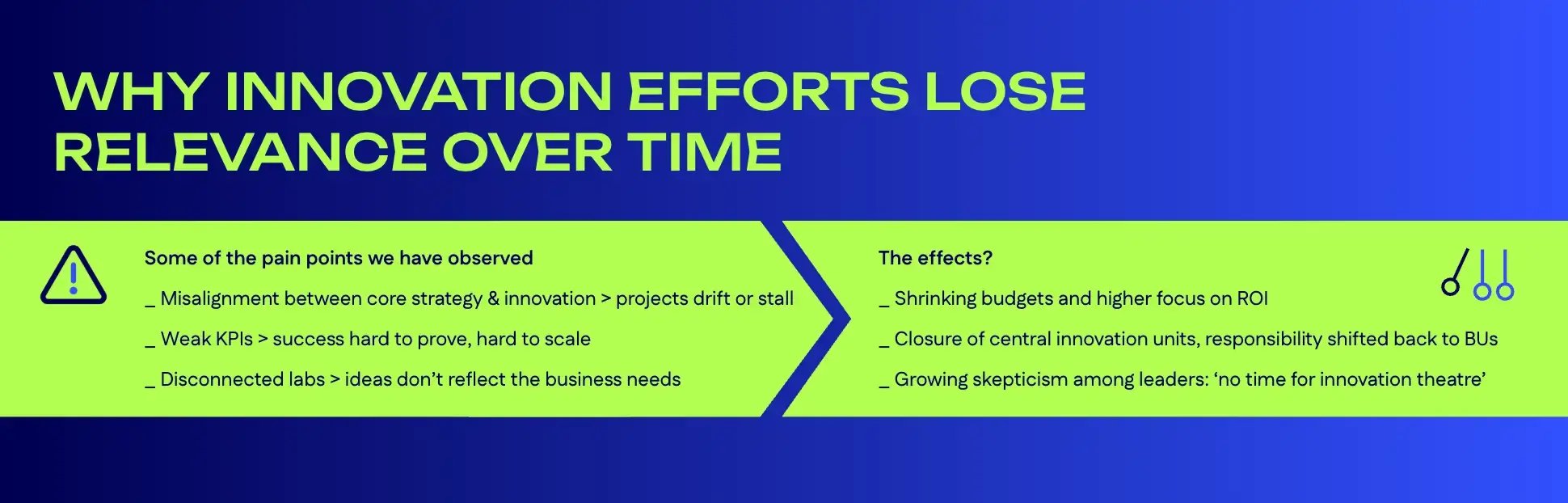
Common symptoms include:
- weak strategic focus with too many parallel initiatives
- innovation portfolios driven by opportunity rather than intent
- success metrics that stop at pilots or proofs of concept
- isolated successes that cannot be integrated into the core business
- lack of a clear path to integration or stand-alone scaling after initial validation
- missing governance, funding models, and decision rights
As a result, organizations generate activity and visibility but struggle to create sustained business impact. Innovation becomes something that happens next to the core business, rather than something that shapes it.
At this point, leaders often respond by changing methods. New processes, new tools, or new innovation models are introduced. Yet the underlying problem persists.
Why measurement drives innovation outcomes more than methods
Much of the debate around corporate innovation focuses on methods. Design thinking, lean startup, agile development, venture building, or stage-gate processes are often presented as solutions in themselves.
In practice, innovation outcomes depend far less on specific methods than on the management logic and measurement systems that guide decision-making.
What organizations choose to measure strongly influences behavior. When innovation is measured by activity, teams optimize for activity. When it is measured by output, teams optimize for output. When it is measured by value, teams are forced to make decisions.
Traditional innovation metrics tend to focus on:
- number of ideas generated
- number of pilots launched
- number of startups engaged
- amount of budget spent
These metrics are easy to track but weak at guiding strategic choices.
Innovation accounting research argues that under uncertainty, progress should be measured by validated learning and decision quality rather than volume of output (Ries, 2011). Leaders need to know:
- what assumptions are being tested
- what has been learned
- what value is emerging
- what should be scaled, adapted, or stopped
This requires a shift from measuring innovation activity to managing innovation decisions.
If innovation performance is shaped by what organizations choose to measure and decide, the question becomes: what management logic consistently increases impact?
The HIT Framework as a management approach to corporate innovation
The HIT Framework provides a simple but powerful way to manage corporate innovation for measurable impact. Its purpose is to increase an organization’s innovation hit rate: the proportion of initiatives that translate into tangible business impact.
Rather than asking how much innovation activity is happening, the HIT Framework focuses on how consistently initiatives convert into real business outcomes. It reframes innovation as a sequence of decisions under uncertainty.
A high innovation hit rate means that an organization:
- focuses on the right opportunities
- validates impact early
- scales what works
- builds the capabilities to repeat success
Achieving this requires clarity across three dimensions: Hypothesis, Impact, and Transformation. Together, these three dimensions create a repeatable management logic for increasing the innovation hit rate over time.
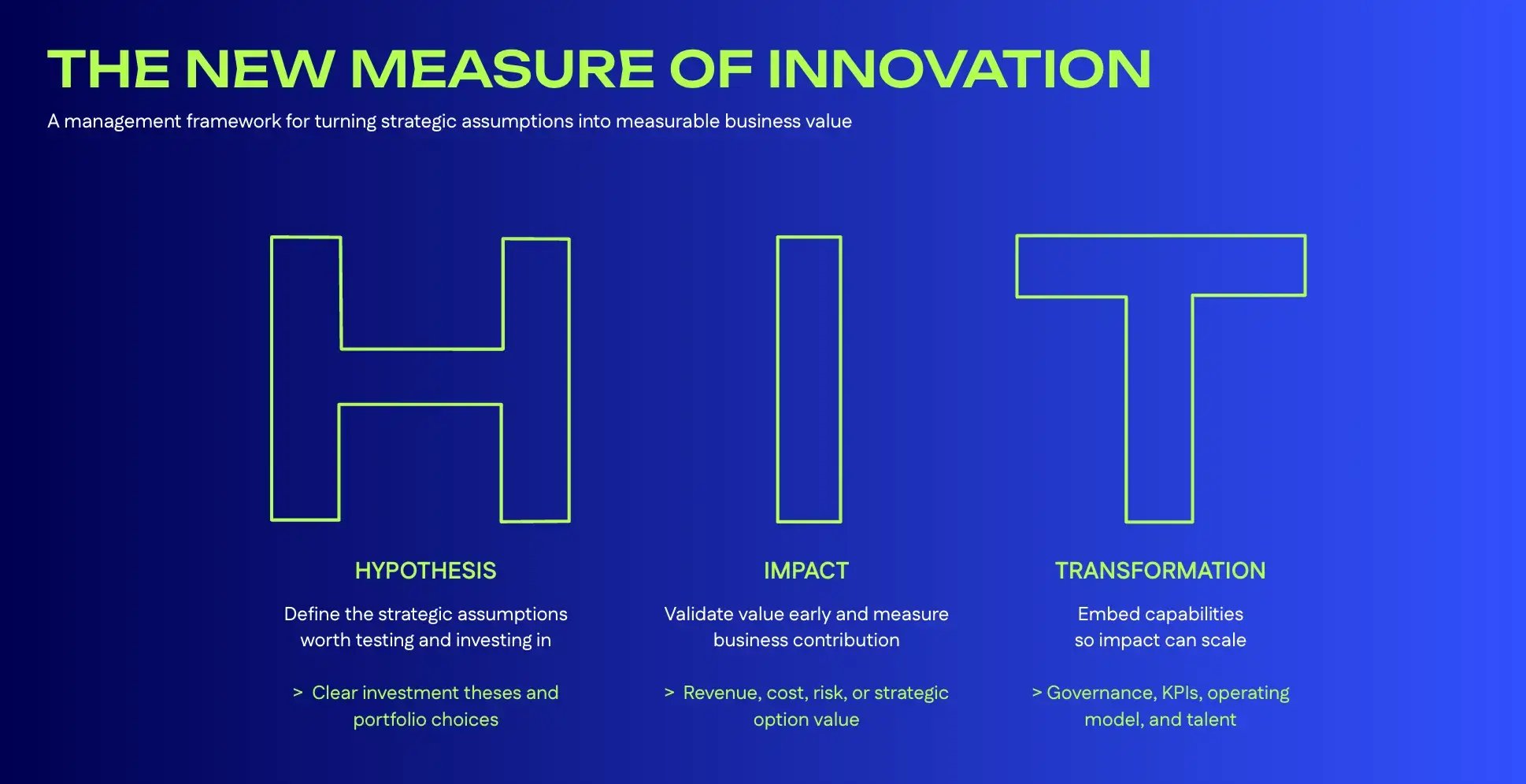
H: Hypothesis
What must be true for an innovation opportunity to justify investment?
Every innovation initiative – whether a new product, business model, or venture concept – is built on assumptions. These assumptions relate to markets, customers, technology, regulation, competitive dynamics, and internal capabilities.
The first management task is to make these assumptions explicit and decide which ones are worth testing.
Strategic foresight plays a critical role at this stage. Foresight is not about predicting the future. It is about exploring plausible futures, identifying uncertainties, and stress-testing strategic choices (e.g. Rohrbeck and Kum, 2018). Research shows that organizations with systematic foresight capabilities are better able to identify emerging opportunities, challenge dominant assumptions, and improve strategic decision-making (Heger and Rohrbeck, 2012; Rohrbeck, Battistella and Huizingh, 2015).
By using scenario analysis, trend intelligence, and weak signal detection (core elements of structured corporate foresight), organizations can:
- articulate clear strategic hypotheses
- define where to play and where not to play
- align innovation investments with long-term intent
Strong hypothesis management leads to explicit investment theses and resilient innovation portfolios. Without it, innovation efforts tend to fragment and drift toward whatever seems interesting or urgent at the moment.
I: Impact
What impact does this create, and how do we know?
Impact in corporate innovation must be understood broadly. While revenue growth is important, early-stage innovation often creates impact in other forms.
Impact can include:
- cost reduction or efficiency gains
- risk mitigation or regulatory readiness
- time-to-market advantages
- strategic option value, which reflects the value of preserving future choices under uncertainty (McGrath, 1997)
This is where a structured New Business process becomes central.
Impact is not created by ideas alone. It is created through disciplined execution that moves opportunities from identification to validation and acceleration.
A robust New Business process typically includes:
- market research and customer discovery
- opportunity identification and selection informed by strategic priorities
- concept and business model validation
- various ways for execution, e.g. venture building, clienting and internal product development
- clear decisions on build, partner, or buy pathways
At each stage, evidence thresholds define whether an initiative should move forward, pivot, or stop. This approach aligns closely with innovation accounting principles, which emphasize learning milestones and decision quality over sunk-cost justification (Ries, 2011).
Managing impact in this way increases transparency and enables better portfolio-level decisions.
T: Transformation
What must change so impact can scale and repeat?
Many innovation initiatives fail not because the solution is weak, but because the organization is not ready to absorb it. Research suggests that innovation failure often unfolds gradually as structural frictions, shifting attention, and resource constraints undermine promising initiatives over time (Freisinger and McCarthy, 2024).
Transformation therefore focuses on the structural conditions required to scale innovation and make success repeatable.
This includes:
- governance models and decision rights
- funding mechanisms aligned with innovation horizons
- KPIs that reflect different stages of maturity
- operating models that support integration or separation
- talent development and capability building
Research consistently shows that structural misalignment is one of the main reasons innovation initiatives stall after the pilot phase (Sirkin et al., 2005; BCG, 2020, “Why Most Digital Transformations Fail”).
Transformation ensures that innovation success is not episodic, but systemic.
Managing corporate innovation beyond the hype
When corporate innovation is managed through the HIT lens, several important shifts occur.
Organizations move from measuring activity to managing decisions. Innovation initiatives are evaluated based on evidence of impact rather than storytelling. Successful initiatives can be scaled because governance, funding, and capabilities are already in place.
The hype cycle does not disappear. What changes is how organizations manage the hype around the next innovation concept by keeping the focus on measurable impact. Instead of reacting to excitement and disappointment, leaders actively manage uncertainty through hypotheses, impact validation, and transformation.
A closing thought
Corporate innovation rarely fails because of weak ideas. It fails because organizations lack the clarity, discipline, and structural alignment to systematically turn ideas into impact.
Organizations that consistently escape the trough of disillusionment are not those that experiment the most, but those that clearly articulate what they believe, how value is created, and what must change to scale it.
That is what a higher HIT rate enables.